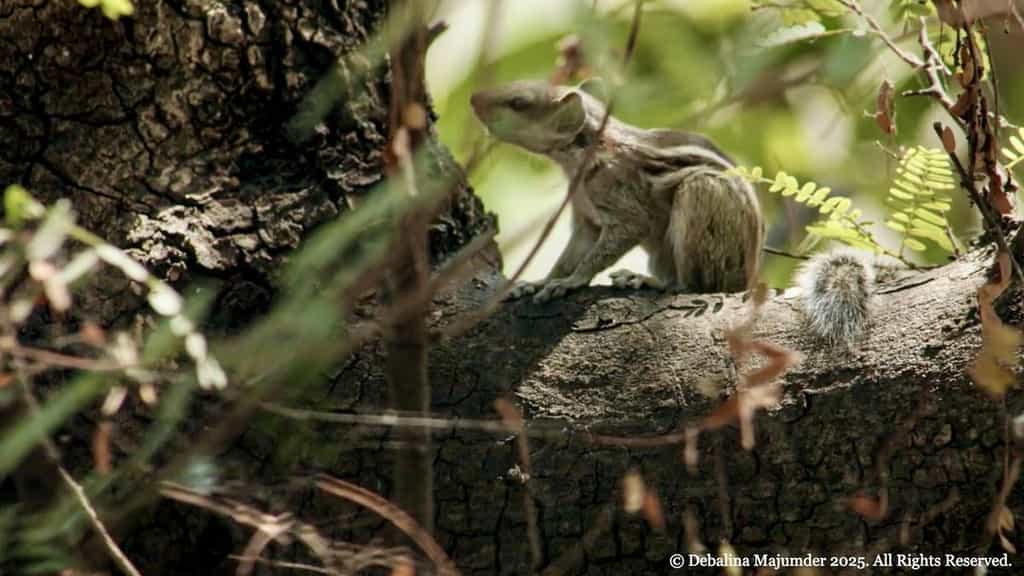
A signature campaign to save a massive tamarind tree with historical value in a Kolkata neighbourhood appears to have paid off with the administration assuring activists that it will not be brought down.
The tree, home to numerous varieties of birds, was planted in her compound by the revolutionary Parul Mukherjee about 70 years ago when she came to settle in a refugee colony (which became Vidyasagar Colony) in south Kolkata. At the age of 20, in 1935, she was convicted in the Titagarh conspiracy case and had spent four years in jail.
A movement to save the tree began in July 2024 soon after builders were handed over the ageing property and it seemed that the tree would be brought down anytime. But with the movement — which included creative activities being organised at the location — gaining public attention, the boundary wall of that house was restructured to bring the tree on Kolkata Municipal Corporation land.
But felling of other trees in the neighbourhood once again raised concerns and the signature campaign was started in December 2025. “I wrote a mail on December 30 to the Chief Conservator of Forests, who sent a ranger to inspect the tree the next day. The ranger called the promoter in front of us and was assured that the historic tree would not be cut and that an altar would be constructed around it.”
“Then, on January 7, [documentary filmmaker] Debalina [Majumder] and I met the Member, Mayor-in-Council of the Kolkata Municipal Corporation with more than 4,000 signatures of concerned citizens. He took us to the Chief Engineer’s office, which assured us that they had not given NOC for the felling of the tree. We are all happy that we succeeded and hope that everybody keeps their promises,” said Barnali Das, a mathematics teacher who was among those leading the movement.
Debalina Majumder, who lives in the neighbourhood and who made a 30-minute documentary on the tamarind tree, Friends of Jilipibala, which featured at the recent Kolkata International Film Festival, said she was amazed by the number of people who came together in the year-and-a-half long fight to save the tree.
“From artists who performed under the tree to friends who collected signatures to our petitions at weddings and memorials, and activists and neighbours who wrote to ministers, the forest department and KMC, the tamarind tree has brought to the fore the resilience of this city and its creative vision,” Ms. Majumder said.
According to Samata Biswas, a professor of English who spearheaded the signature campaign, Ms. Majumder’s documentary had a big role in the saving of the tree. “Friends of Jilipibala included 12 years of footage of the tree and that really helped build awareness about urban biodiversity. We hope to take this film to schools across the State, to tell students that it is possible to protect the environment through collective action,” Prof. Biswas said.
Editorial Context & Insight
Original analysis and synthesis with multi-source verification
Methodology
This article includes original analysis and synthesis from our editorial team, cross-referenced with multiple primary sources to ensure depth, accuracy, and balanced perspective. All claims are fact-checked and verified before publication.
Editorial Team
Senior Editor
Dr. Elena Rodriguez
Specializes in India coverage
Quality Assurance
Associate Editor
Fact-checking and editorial standards compliance