A couple of the more disruptive boys in the class put red laces in their Dr Martens, because someone had told them that was how you showed your support for the National Front. “Jew” was an everyday insult and the N-word was in regular circulation. There were no more than four or five non-white kids in the whole school: I can recall one Asian girl finding her art folder had been covered in racist abuse, and some adolescent desperado singling out a black boy for a spoken version of the same treatment, before insisting that his victim was in on the joke. He wasn’t: he looked at the ground and rushed away, full of the hurt he must have felt every day.
This was what it was like in a Cheshire comprehensive school in the early-to-mid-1980s. Teenage racism was there in plain sight, and there was a scattering of people who seemed to take their prejudices – presumably passed down from parents and elder siblings – very seriously indeed. In what is now known as year 7, for example, each class was given a group of “sixth-form counsellors”, meant to show up once or twice a week and encourage ambition and hard work. One of ours was a tense, soft-spoken young man who liberally used racist epithets, backed the National Front and said he wanted to be a policeman. His view of the world, as far as I could tell, was summed up in a chant that a certain sort of playground thug knew by heart: “There ain’t no black in the union jack/Get back, get back, get back.”
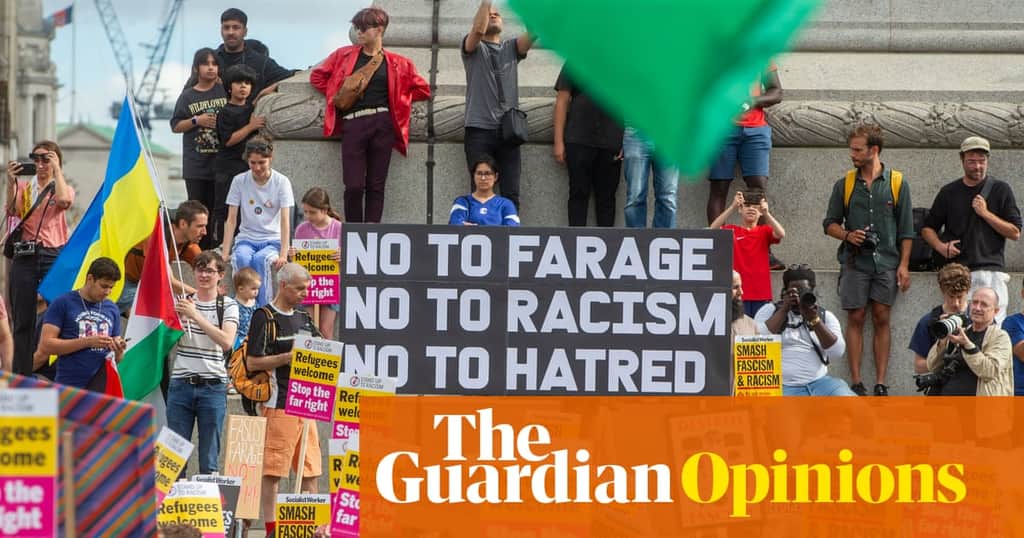
As all those allegations about Nigel Farage’s behaviour at Dulwich college have mounted up, the Reform UK leader has followed his lawyers’ insistence that they are “wholly untrue, defamatory, and malicious” with the claim that he “never directly, really tried to go and hurt anybody”. And amid the resulting noise, thousands – possibly millions – of people must have instantly recalled experiences like these.
They will also have heard echoes of their schooldays in what the accusations have inevitably triggered: yet another argument about the UK’s past, split between some voices who put any alleged racism down to different times and harmless hi-jinks, and others who understand that they came of age amid dire social attitudes that it took years to overturn. That second point of view, moreover, is now combined with a rising sense of alarm, because ideas and beliefs we thought had been defeated are rapidly eating into politics and the public mood.
On 30 December, the Institute For Public Policy Research published a much-publicised report about how what it calls “ethnonationalist narratives” are winning over voters. Some of its findings suggested reasons for hope: a mere 3% of us, for example, think that being a good British citizen involves having white skin. But just over one-third of people now think true Britishness is something people have to be born with, up from about one in five in 2023. This, the authors say, symbolises something that demands urgent action: “No longer consigned to the fringes of British politics, a view of the national community defined in ethnic terms and society as a hierarchy is stirring fear, anxiety and anger in people of all backgrounds.”
Look at how fast all this is suddenly moving. Most provocations about the supposedly ethnic foundations of national identity used to be centred on Englishness; now, what is generating the most noise are claims about what it is to be British. Mainstream media outlets give a platform to people who think that those “without native British ancestry” should be barred from being MPs. The Reform MP Sarah Pochin has complained that: “It drives me mad when I see adverts full of black people, full of Asian people.”
The right’s obsession with immigration is starting to tip into an insistence on “remigration”, the polite term for the old idea of “sending ‘em back”. Beyond the arguments about new arrivals pulling down wages or eating up public services, we now hear claims about “cultural coherence” – yet another example of 21st-century rhetoric updating a familiar insistence: that what the union jack has always supposedly symbolised leaves no room for anything that isn’t stereotypically white.
Which takes us back to the politics of history. Much of the political manoeuvring of the new right boils down to people who grew up in the same horrible cultural atmosphere that I did, basing a huge amount of what they say on the belief that the UK was simply a better place back then. They want, in other words, to live in a much more monocultural country, where Farage wouldn’t feel his infamous unease about the ubiquity in modern London of foreign languages, and white Britons could be more authentically themselves, free of liberal disapproval. Theirs is a retro utopia of camaraderie and freedom: if red bootlaces and everyday racism were once part of the same picture, they were mere trifles.
Farage plays these games comparatively cleverly, mostly via rhetorical nods and winks. A much more clunky practitioner, by contrast, is the free-ranging shadow justice secretary, Robert Jenrick, who followed last October’s reports of his claims that he had not seen “another white face” on a trip to an area of Birmingham with his thoughts on the modern history of English football. His focus was a period when he was just starting primary school, and the game was still indelibly associated not just with racism, but disorder so extreme that English clubs were banned from European competition between 1985 and 1990, while Margaret Thatcher set up a “war cabinet” to somehow deal with the issue. In Jenrickworld, none of this happened. Despite “language, chants, and antics [that] were – at times – less than well-mannered”, he says the culture surrounding football in the 1980s “was largely all good-natured fun … where there was violence, the police put a quick but firm end to it. Such was the rhythm of British life.”
That picture is hilariously wrong, but it stands as another example of a very modern trick: rightwing politicians shutting down their obvious links to the horrors of the UK’s past by denying that there were any such horrors in the first place. And so far, we have not heard nearly enough of the most effective response: that the Britain of yesteryear may have offered some of its people order and “fun”, but it was also a country of deep racism, petty violence, bitter industrial strife, riots, appalling police brutality, corruption in plain sight, awful attitudes to disability and more. You would have to be mad – or downright evil – to want to go back there: in every conceivable respect, modern Britain is better.
Labour, it seems, has resolved to start the new year by launching renewed attacks on Farage and his party, based on Keir Starmer’s insistence that he is involved in “a fight for the soul of the country”. But whether a prime minister so wooden and mistrusted can successfully lead that battle seems doubtful. Besides, the pushback would surely be better helmed by musicians, film-makers, sportspeople, authors, YouTube influencers and whoever else might usefully contribute – the kind of people who could campaign with wit and optimism, reach broad audiences and take things out of the toxic, yah-boo atmosphere of Westminster politics.
What they ought to be focused on is obvious: whether, from the perspective of the 21st century, the hatreds and delusions that once coursed around playgrounds, pubs and football grounds are going to look like pointers to the future or reminders of what we have to once again defeat. At some point over the next 12 months, we may well know the answer – which is why 2026’s stakes are so unbelievably high.
Editorial Context & Insight
Original analysis & verification
Methodology
This article includes original analysis and synthesis from our editorial team, cross-referenced with primary sources to ensure depth and accuracy.
Primary Source
Opinion | The Guardian