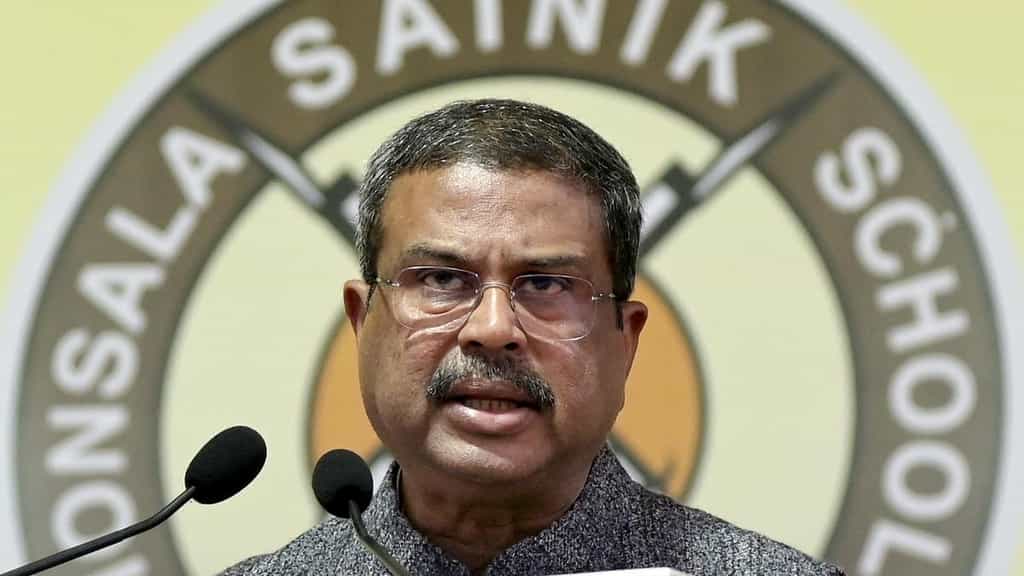
Union Education Minister Dharmendra Pradhan on Friday (January 9, 2026) chaired a consultative meeting with representatives of State governments and experts on the next phase of the Centre’s Samagra Shiksha school education programme, with the Minister noting that it was “essential to once again entrust schools to society” so that the holistic development of students can be promoted and their access to knowledge expanded through “meaningful integration of technology”.
At the meeting held in Delhi, which was co-chaired by Skills Development Minister Jayant Chaudhary, discussions focused on best practices, emerging challenges, and priority interventions needed to strengthen school governance, infrastructure, teacher training, and student entitlements.
Officials told The Hindu that the Union Education Ministry suggested to increase public participation in school management committees, whereas State representatives sought additional support for teacher training and capacity building as they were having difficulties achieving the State objectives of the ongoing second phase of the Samagra Shiksha programme. Mr. Pradhan said that while salaries of teachers and systems should be the responsibility of the government, operation of the schools themselves should be the responsibility of society.
Mr. Pradhan said that Prime Minister Narendra Modi’s vision of a Viksit Bharat by 2047 can be achieved only when every child in India has access to quality education, and the country achieves a 100% school enrolment ratio up to Class XII. “Bridging learning gaps, reducing dropouts, improving nutrition outcomes, strengthening teacher capacity, fostering critical skills, and moving the ‘Amrit Peedhi’ beyond the Macaulay mindset are collective responsibilities for building a strong human capital base,” he said.
School Education Secretary Sanjay Kumar added that there was a need to improve learning outcomes, and stressed the need for curriculum equivalence across State boards. He also touched upon the importance of integrating technology, particularly Artificial Intelligence (AI), into the school curriculum as a “key component of Samgara Shiksha”.
The meeting was attended by top officials of the Union Education Ministry, education secretaries in State and U.T. governments, project directors of Samagra Shiksha from 11 States and Union Territories, representatives of other allied Union ministries, and eminent experts from the education sector.
In a post on social media, Mr. Pradhan said, “This collaborative effort today and the pioneering ideas at this forum will pave the way for charting a clear road map for holistically strengthening our school education ecosystem, aligning them with the goal of Viksit Bharat and re-imagining Samagra Shiksha scheme for building an education ecosystem that is outcome-oriented, globally-competitive, rooted in Bharatiyata and that which caters to the diverse needs of our students.”
After five years of implementing the National Education Policy 2020, India is now “entering a new phase of educational reform with national development goals”, the Education Minister said, urging all stakeholders to come together to prepare a robust and holistic annual plan for the academic year 2026-27 and take it forward as a nationwide movement.
The Minister added that the government’s focus must go “beyond achieving mere quality and equity”. “We must transform Samagra Shiksha from a broad access scheme to an outcome-driven, quality-focused framework aligned with the objectives of NEP 2020,” he said.
Editorial Context & Insight
Original analysis & verification
Methodology
This article includes original analysis and synthesis from our editorial team, cross-referenced with primary sources to ensure depth and accuracy.