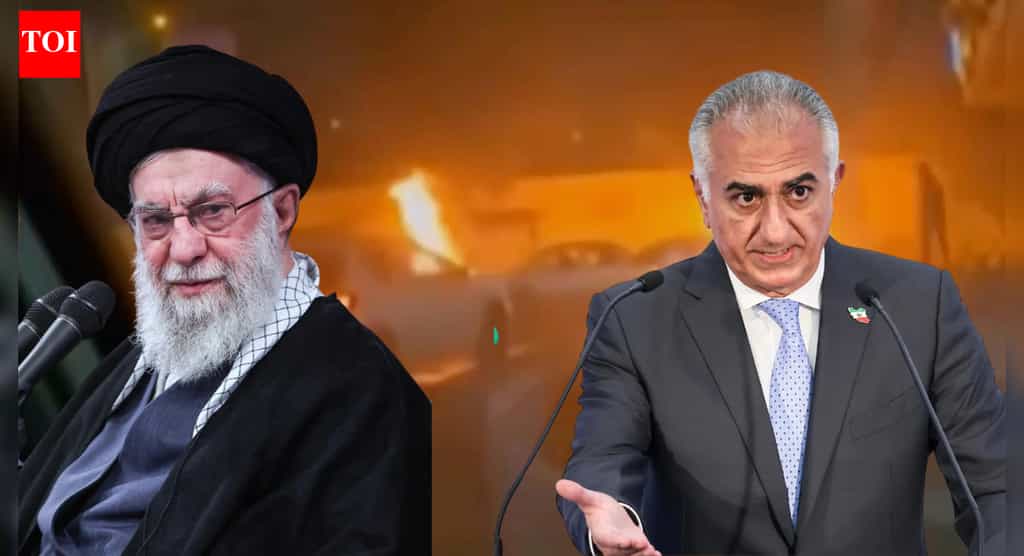
Iran’s most serious wave of unrest in years has reopened an old, unresolved question at the heart of the Islamic Republic: what, if anything, could replace it. As nationwide protests rage over economic collapse, political repression and international isolation, a familiar name has re-emerged at the centre of the debate — Reza Pahlavi, the exiled crown prince and son of Iran’s last shah.From Washington, Pahlavi has urged Iranians to take to the streets, framing the demonstrations as a decisive moment for the country’s future. Videos circulating before a near-total internet blackout showed crowds chanting “death to the dictator” and praising the Pahlavi name — slogans that, only years ago, could have drawn a death sentence. The protests mark the first major test of whether the Iranian public can be mobilised behind the shah’s son more than four decades after the 1979 Islamic Revolution ended his family’s rule.
The unrest, sparked by a collapsing economy and soaring prices, has since morphed into the most direct challenge to Supreme Leader Ayatollah Ali Khamenei in years.
The demonstrations erupted after Iran’s currency plunged to more than 1.4 million rials to the dollar, fuelling inflation and driving up the cost of basic goods. What began as economic protests quickly turned political, with chants calling for the downfall of the Islamic Republic and its leadership.
Despite a sweeping communications blackout, activists reported protests across all 31 provinces, with dozens killed and thousands detained. Iranian state media accused “terrorist agents” linked to the US and Israel of instigating violence, while Khamenei warned that protesters would be “put in their place”.It was into this moment that Reza Pahlavi stepped decisively. In video messages, he said mass turnouts had forced security forces to retreat and called for larger crowds to weaken the regime further.
“Iranians demanded their freedom tonight,” he said after authorities cut internet and phone services. He urged Western leaders to help restore communications so the world could witness the protests.Supporters chanted “This is the last battle! Pahlavi will return!”, signalling not just anger at the present system but a longing — real or symbolic — for life before the revolution.
Reza Pahlavi’s father, Mohammad Reza Shah, fled Iran in January that year as protests spiralled into revolution.
What followed was a rapid collapse of the monarchy, the return of Ayatollah Ruhollah Khomeini from exile, and the birth of a theocratic state.The revolution itself was not initially an Islamist project. It was a broad, chaotic uprising involving secular liberals, leftists, nationalists and religious groups, unified largely by opposition to the shah. Khomeini promised restraint and “Islamic democracy”. Once in power, he moved swiftly to eliminate rivals, crush dissent and consolidate clerical rule.Events such as Black Friday in September 1978, when security forces opened fire on protesters, and the Cinema Rex fire that killed hundreds, hardened public opinion against the monarchy. By the time Iranians grasped the full nature of the Islamic Republic, the new system had already entrenched itself through violence, propaganda and religious symbolism.
Born in 1960 and declared crown prince as a child, Reza Pahlavi left Iran at 17 for US Air Force training just before the revolution.
He has lived in exile ever since, advocating non-violent civil disobedience, a secular state and a referendum on Iran’s future system of government.He has consistently framed himself as a unifying figure rather than a ruler-in-waiting, yet has also embraced royal symbolism and spoken favourably of a constitutional monarchy. Critics argue that he treats opposition leadership as a birthright, contributing to fragmentation among exiled groups.His growing ties with Israel, including meetings with Benjamin Netanyahu — have sharpened controversy, particularly as Israel and the US have clashed directly with Iran. While some see these links as strategic realism, others warn that any leader perceived as installed with Western or Israeli backing would lack legitimacy inside Iran.Washington, for now, appears unconvinced. US President Donald Trump has warned Tehran against killing protesters and hinted at regime vulnerability, but has stopped short of endorsing Pahlavi as an alternative.
The current unrest echoes earlier moments, notably the “Woman, Life, Freedom” uprising sparked by Mahsa Amini’s death in 2022. That movement mobilised millions but ultimately failed to coalesce around a single leadership or political roadmap. Many opposition figures argue that divisions within the diaspora — including tensions around Pahlavi — undermined its momentum.Inside Iran, attitudes appear more fluid. Open praise for the shah signals not necessarily monarchism, but a profound rejection of clerical rule.
For many protesters, Pahlavi represents less a programme than a provocation — a reminder that the Islamic Republic is not eternal.Yet history looms large. The shah’s regime was sustained by repression and a CIA-backed coup in 1953, memories that still shape Iranian political consciousness. Any attempt to revive the Pahlavi legacy must contend with that past as much as with today’s anger.(With inputs from agencies)
Editorial Context & Insight
Original analysis & verification
Methodology
This article includes original analysis and synthesis from our editorial team, cross-referenced with primary sources to ensure depth and accuracy.
Primary Source
Times of India