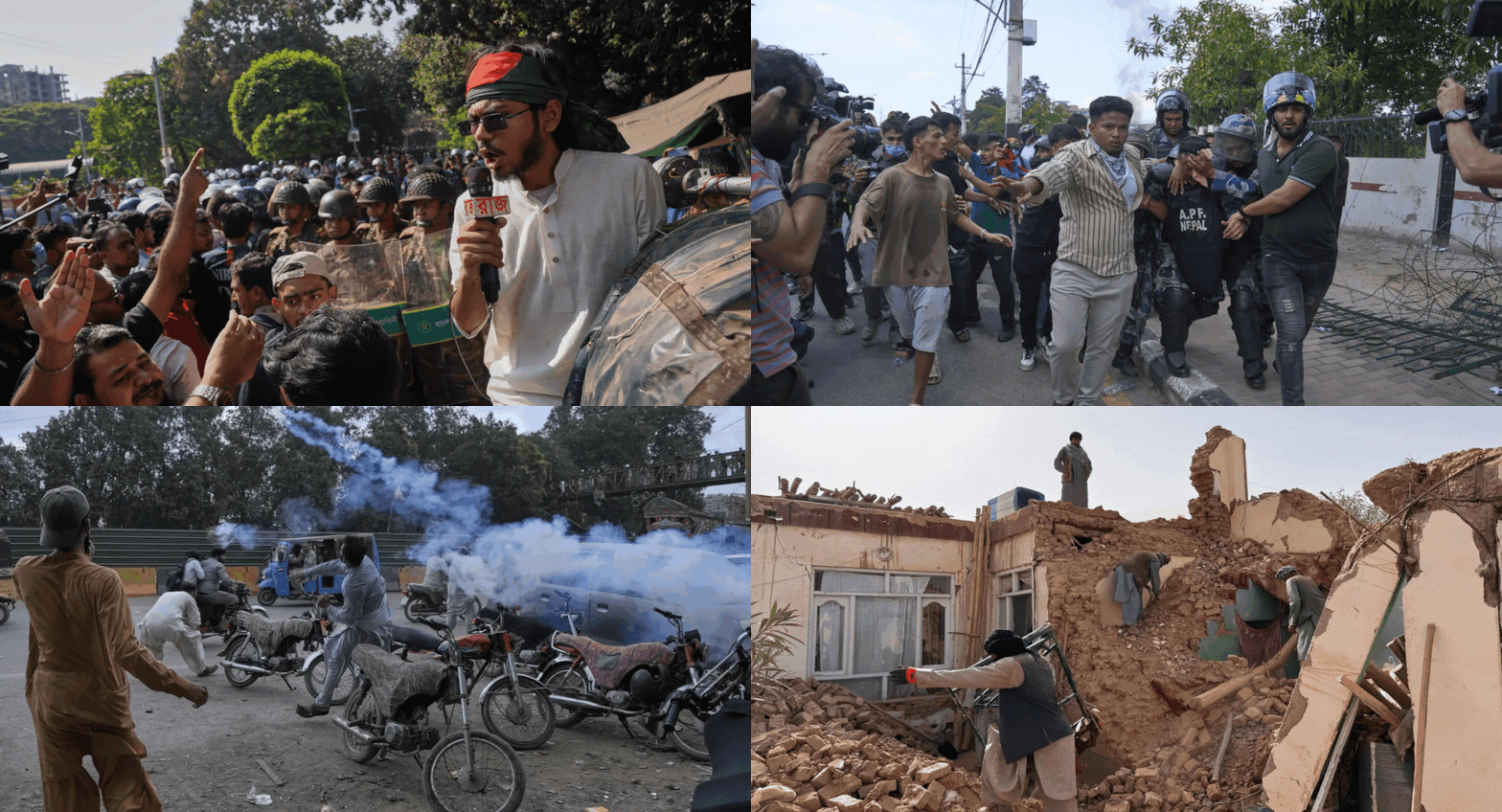
“The greatest threat to stability today is not ideology or invasion, but the collapse of political legitimacy.” - Francis Fukuyama, Political scientist, Stanford UniversityIn 2025, India watched with concern as its neighbourhood navigated troubled waters marked by protests, political instability and humanitarian emergencies.Gen Z–led demonstrations in Nepal shook the political regime, resulting in former PM KP Sharma Oli’s resignation. Bangladesh, already reeling under a political crisis since Sheikh Hasina’s ouster, witnessed mass anti-India protests after the assassination of youth leader Sharif Osman Hadi.
Pakistan’s political system remained caught in judicial complexities, with the sentencing of former PM Imran Khan and his wife Bushra Bibi to 17 years in prison. Tensions have heightened after Khan blamed army chief Asim Munir for the crisis, and urged citizens to rise up.In Afghanistan, a deadly earthquake claimed more than 2000 lives. The Taliban government mobilized defence forces and set up relief camps; however, early relief was slowed by inconsistent policies, including bans on female medical workers, resulting in delays in aid for injured women and girls.What stood out across these crises was that the pressure on states came largely from internal factors rather than external threats, showing that South Asia’s most persistent challenges are homegrown.“When institutions fail to adapt, young people stop waiting and start revolting.” - Fareed Zakaria
Where is Bangladesh heading after two years of political upheaval? Who is next to lead after Sharif Osman Hadi?These questions are running through everyone’s minds as the nation grapples with an unprecedented wave of uncertainty.From targeted assassinations of youth leaders to mass protests and landmark court verdicts shaking long-standing political structures, Bangladesh finds itself at a crossroads.
Following the dramatic ouster of former PM Sheikh Hasina in 2024, Bangladesh entered 2025 under an interim government led by Nobel laureate Muhammad Yunus, bracing for national elections scheduled for February 2026. But the political calm was short-lived.
In November, Hasina was sentenced to death in absentia by the International Crimes Tribunal in Dhaka for alleged “crimes against humanity” linked to the 2024 student-led uprising that ultimately toppled her Awami League government. The tribunal also handed her a separate 21-year sentence for corruption in three separate cases connected to a housing project, with her children Sajib Wajed Joy and Saima Wazed Putul sentenced to five years each. Hasina, who fled to India after her resignation, denounced the verdict as “biased and politically motivated,” insisting she had been denied a fair trial. “The verdicts announced against me have been made by a rigged tribunal established and presided over by an unelected government with no democratic mandate,” she said in a statement.Sharif Osman Hadi, a 32-year-old youth leader and spokesperson for the Inqilab Mancha, was assassinated on December 12 in Dhaka by masked gunmen. He had played a key role in the 2024 uprising that led to the Awami League’s exit.
His death triggered overnight riots across the country, with protesters torching Awami League offices and major media houses, including The Daily Star and Prothom Alo. Thousands flooded the streets of Dhaka and other cities demanding justice. Yunus, addressing Hadi’s funeral at Sangsad Bhaban, paid tribute to the fallen youth leader: “We have come to make a promise to you—that what you told us, we will fulfill. You have given us such a mantra that this nation will never forget. It will echo in our ears forever.” He emphasized that Hadi’s ideals would guide the country’s future governance.The unrest extended to minority communities, as a Hindu youth, Dipu Chandra Das, was brutally lynched and his body set ablaze in Mymensingh district following allegations of blasphemy.
Yunus condemned the attack and vowed that the perpetrators of this heinous crime would not be spared, as authorities arrested seven suspects in connection with the killing.Barely days after Hadi’s death, another youth leader, Muhammad Motaleb Sikdar, Khulna divisional chief of the National Citizen Party (NCP), was shot in the head while preparing for a rally on December 22. Sikdar survived the attack after critical treatment at Khulna Medical College Hospital.
Nepal witnessed one of its most violent youth-led movements in decades as Gen Z–driven protests against a sweeping social media ban and rising corruption turned deadly across the country.The unrest ultimately resulted in the resignation of KP Sharma Oli.What began as peaceful demonstrations in the Himalayan country escalated after police opened fire on protesters, leaving at least 19 people dead and hundreds injured.So what triggered the unrest? The government’s move to block 26 major social media platforms, including Facebook, Instagram, WhatsApp, YouTube and X for failing to register locally.
For a generation that relies on digital platforms for work, communication and political expression, the blackout was seen as an attack on free speech. The movement saw rapid mobilisation among Gen Z protesters, amplified online through viral campaigns such as #NepoKids.
The campaign sought to spotlight the privilege and influence enjoyed by the children of political elites and their families.Thousands gathered in Kathmandu, initially staging peaceful rallies marked by national flags and chants against corruption and censorship. The situation worsened when protesters breached restricted zones near Parliament.
Police used tear gas and water cannons to contain the crowd, but the confrontation escalated, resulting in multiple fatalities and hundreds of injuries.As protests spread beyond the capital, demonstrators breached restricted areas, torched government buildings and politicians’ residences and forced the temporary shutdown of Nepal’s international airport.
Home minister Ramesh Lekhak resigned first, taking “moral responsibility” for the violence. Within a day, KP Sharma Oli also stepped down.The unrest culminated in the formation of an interim government led by Sushila Karki, Nepal’s first woman chief justice.She was appointed PM through online voting and digital consultations with youth representatives and civil society groups.
This year, Pakistan’s political turmoil unfolded across courtrooms, prison gates and protest sites. On December 20, a special court sentenced former PM Imran Khan and his wife Bushra Bibi to 17 years’ imprisonment in the Toshakhana corruption case. The court also imposed a hefty fine of Pakistani Rs 16.4 million (INR 52,39,524) on each of them.
Failure to pay the fine will result in additional jail time.
Khan, who has been lodged in Rawalpindi’s Adiala Jail since 2023, rejected the ruling as “malicious, fabricated, and politically engineered” and vowed to challenge it. The PTI founder was ousted from office in 2022.Outside the prison, the judgment triggered a wave of protests by Pakistan Tehreek-e-Insaf (PTI) supporters and Khan’s family members. His sisters - Aleema Khan, Noreen Niazi and Uzma Khan repeatedly led sit-ins outside Adiala Jail after authorities restricted family and legal access.
Police responded by invoking Section 144, registering cases under the Anti-Terrorism Act and arresting several protesters. Tensions escalated further after Khan’s sisters alleged they were assaulted by police during one such protest. Noreen Niazi said they had gathered peacefully to seek information about her brother’s health. “We neither blocked roads nor engaged in any unlawful conduct,” she said, alleging that police action was “brutal and orchestrated.”Where is Imran Khan? For weeks, Pakistan grappled with this question as the former PM remained out of public view, with family and party members unable to meet him. His son Kasim Khan in an interview told Reuters, “Not knowing whether your father is safe, harmed, or even alive is psychological torture. We have had no phone calls, no meetings, and no proof of life.”
Why was he unreachable? Authorities had restricted access to Adiala Jail, barring family, lawyers and even senior PTI leaders from visiting, citing security concerns.
This fueled widespread anxiety, sparking protests by PTI supporters across Rawalpindi and Islamabad, demanding transparency and assurances about Khan’s well-being.Who bore the brunt of these restrictions? Khan’s sisters, including Noreen Niazi and Aleema Khan, who led the demonstrations outside the prison and faced violent police action. Noreen recounted, “At the age of 71, I was seized by my hair, thrown violently to the ground, and dragged across the road… This is the darkest period in Pakistan’s history.”Pakistani authorities repeatedly denied the rumours, insisting Khan was in good health and receiving medical care. Jail officials dismissed claims of mistreatment as “baseless”.“The real crisis of modern states is not the absence of power, but the absence of capacity.” - Amartya Sen
Afghanistan faced one of its deadliest humanitarian emergencies of 2025 after a powerful earthquake struck the country’s eastern provinces in late August and early September. The 6.0-magnitude quake and a series of aftershocks flattened villages in Kunar and neighbouring areas, killing more than 2,200 people and injuring thousands, according to Taliban authorities and United Nations agencies. The Taliban government deployed defence forces, air-dropped commandos into remote areas and set up relief camps, but rescue efforts were slowed by difficult terrain, damaged roads and communication failures. The UN Office for the Coordination of Humanitarian Affairs said thousands were affected across several provinces, while UNICEF and the World Health Organization mobilized emergency teams to provide life-saving care.
However, a report by Health Policy Watch highlighted how the aftermath of the disaster exposed deeper policy constraints, particularly restrictions on women aid and healthcare workers. In many quake-hit areas, injured women and girls were unable to access timely medical care because most health workers were men, while Taliban rules restrict treatment of women by male doctors or require the presence of a male guardian.
“A very big issue now is the increasing paucity of female staff in these places,” Dr Mukta Sharma, the World Health Organization’s deputy representative in Afghanistan, told Reuters. She said around 90% of medical staff in the affected areas were male, hampering care for women who were uncomfortable or afraid to seek treatment.
Sri Lanka faced one of its gravest humanitarian crises in decades in 2025 as Cyclone Ditwah and successive monsoon storms unleashed catastrophic flooding and landslides across the island. According to official figures, at least 600 people were killed and hundreds remained missing, while more than two million people were affected. The central hill country, home to the tea-growing regions of Kandy, Badulla and Matale, recorded the highest casualties as unstable slopes collapsed under relentless rain.
While the government deployed helicopters, aircraft and emergency teams and later announced compensation and relocation packages for survivors, the scale of devastation exposed deep shortcomings in preparedness and coordination.Criticism focused on the government’s response despite early warnings. Colombo-based science writer Nalaka Gunawardene said that Sri Lanka’s meteorological department had flagged the risk of extreme rainfall weeks in advance. “That should have triggered preparations across all levels of government. Apparently, that did not happen,” he said. Communication failures were also reported, particularly in Tamil-speaking areas, where warnings were often issued only in Sinhala or English. Analyst Sanjana Hattotuwa said this created an “information vacuum in critical hours,” undermining community preparedness and potentially costing lives.
Myanmar’s turmoil in 2025 was embodied less by dramatic street protests and more by the continued silence surrounding its most recognizable political figure, Aung San Suu Kyi. Four years after the military coup that ended a decade-long experiment with quasi-civilian rule, the Nobel Peace Prize laureate remains in detention, largely cut off from the outside world and serving a cumulative prison sentence of 27 years on charges ranging from incitement to corruption.
Suu Kyi denies all of these charges.
That isolation was underlined this year by a rare public intervention from her son, Kim Aris, who, in an interview, told Reuters he feared he might not even learn if his mother had died. “She’s got ongoing health issues. Nobody has seen her in over two years. She hasn’t been allowed contact with her legal team, never mind her family,” Aris said. He added: “For all I know, she could be dead already.”
Now 80, Suu Kyi is believed to be held in the capital Naypyitaw. Aris said the last direct message he received from her was a letter two years ago describing extreme temperatures inside her cell. Her prolonged detention, he argued, reflects how completely Myanmar’s institutions have been hollowed out since the February 2021 coup. “In the past, when my mother was held in higher regard by the international community, it was much harder for people to ignore what was happening in Burma,” he said.Beyond politics, Myanmar also faced a major humanitarian shock in March, when a powerful earthquake struck parts of the country and neighbouring Thailand, killing more than 2,000 people and collapsing buildings across the border regions.
The democratic crises in neighbouring countries offer India a valuable lesson: institutional instability, youth alienation and shrinking civic space can erode public trust quickly. Strengthening independent institutions, ensuring participatory governance and empowering youth engagement are essential.