Hailing the Somnath Temple in Gujarat, Prime Minister Narendra Modi recently stated that the year 2026 marks 1,000 years since the first attack on this shrine by Mahmud of Ghazni, underlining that “there can be no better example of our civilisation’s indomitable spirit than Somnath, which stands gloriously, overcoming odds and struggle”.
Ahead of his visit to the Somnath Temple on January 11 as part of the year-long “Somnath Swabhiman Parv” commemoration, the PM, in a piece on the temple last Monday, said: “The story of Somnath … is not defined by destruction. It is defined by the unbreakable courage of crores of children of Bharat Mata.”
Modi linked India’s civilisational ethos to what he asserted was the country’s current rise, saying, “It is our value systems and the determination of our people that have made India the centre of global attention today. The world is seeing India with hope and optimism.”
In coming out with a public statement on the 1026 AD attack on Somnath Temple, Modi articulated a key Hindutva theme, seeking to link it to India’s rise, future and “eternal spirit”.
Many Hindutva writers and commentators have seen the attack on Somnath in 1026 AD by Sultan Mahmud of the Ghazni Empire as the beginning of what would become waves of Islamic invasions – sometimes as raids and sometimes ending in the establishment of empires – on the country that would lead to temple destructions and stories of resistance by Indian kings, the most celebrated being Chhatrapati Shivaji, Rana Pratap and Guru Gobind Singh.
While the Sangh Parivar has always seen this story of invasion and resistance as the crux of medieval India, the trope is much older than the birth of the Sangh, as writers since the 19th century repeatedly deployed it.
If “secular historiography” talks about “200 years of slavery” – the period of the British rule that drained India’s wealth, unlike the Muslim kings who lived, spent and died here – the preferred view of Hindutva voices has been that of “1,000 years of slavery”, beginning with Mahmud’s raids.
Turko-Persian chronicles recorded that Mahmud not only took the wealth of the Somnath Temple but also broke the idol, seeing himself as an idol-breaker (or but-shikan in Persian) and not an idol-seller (but-farosh). In the 19th century, this narrative became mainstream, with even the United Kingdom’s House of Commons taking note of it as “trauma for Hindus”.
Later, secular historiography challenged this reading, recording “temple plunder” as common in those days for wealth and refuting the notion of any lasting trauma left by Mahmud. Historian Romila Thapar herself wrote a book on Somnath that challenged the trauma narrative through a variety of sources.
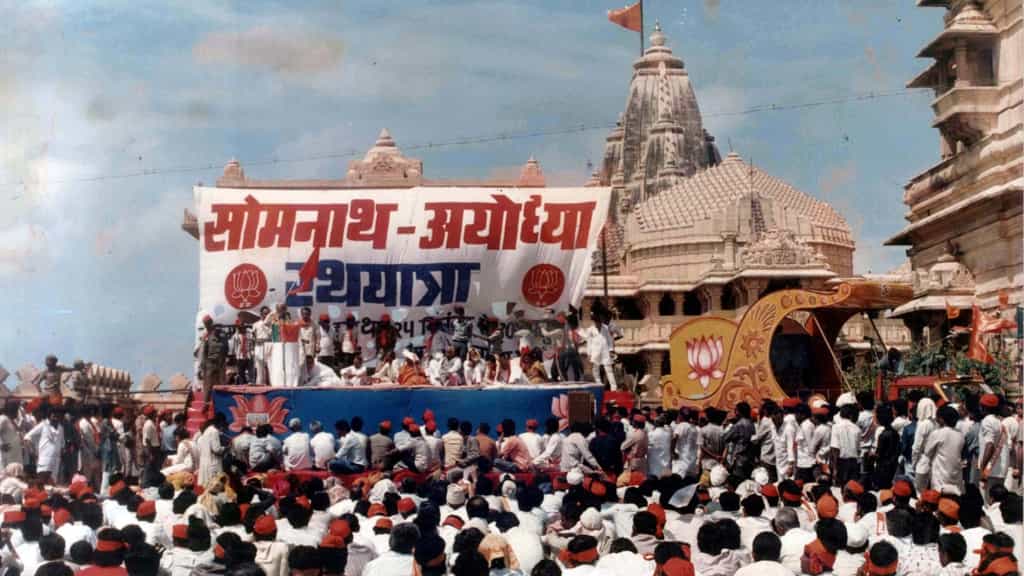
However, the narrative of Somnath as the site of the first Muslim invasion has lingered. The symbolic importance of Somnath for the Sangh Parivar in recent decades is attested by the fact that BJP stalwart L K Advani’s first Rath Yatra in favour of the Ram Temple in Ayodhya was launched from Somnath on September 25, 1990.
Somnath was not just an ideological landmark for the BJP on account of memories surrounding Mahmud Ghazni, but also became an entry point for Hindutva into mainstream politics at a time when the party was a relatively minor political force.
It had been under a Congress government that the Somnath Temple was reconsecrated in May 1951, and it was India’s first Home Minister Sardar Vallabhbhai Patel, who died before this event, who had taken a keen interest in the temple’s reconstruction project. The first President of India Rajendra Prasad presided over the temple’s reconsecration ceremony despite then Prime Minister Jawaharlal Nehru’s bid to dissuade him from doing so as it was not an official government event.
For the Sangh Parivar, it was at once a story of Islamic invasions and “overlap” of Sardar Patel’s stance with the Hindutva position, apart from being a symbol of Nehru’s distaste for a public religious event attended by state functionaries.
Modi said as much in his Monday statement. “The then Prime Minister, Pandit Jawaharlal Nehru, was not too enthused with this development (Somnath Temple’s inauguration event). He did not want the Honourable President as well as Ministers to associate with this special event. He said that this event created a bad impression of India. But Dr Rajendra Prasad stood firm and the rest is history,” the PM wrote.
It is not that only the Sangh Parivar hardliners seized on the Somnath theme.
Former PM late Atal Bihari Vajpayee also deployed it in a famous speech on Hindutva ideologue V D Savarkar that he delivered in Pune in the mid-1980s. Vajpayee recalled that as Minister of External Affairs in the Janata Party government, he had gone to Afghanistan and expressed his desire to visit Ghazni, the capital of Mahmud’s empire. His hosts, Vajpayee said, were surprised and wondered what he would see in an insignificant place like Ghazni. “I could not tell them the full thing. Ghazni has been a thorn in my flesh since I read in adolescence about a plunderer who came from there. I wanted to see that place called Ghazni… It’s a small village. There were huts there at one time, but a plunderer gathered a band of plunderers and came to plunder the golden bird (sone ki chidia),” Vajpayee said on the occasion.
Editorial Context & Insight
Original analysis & verification
Methodology
This article includes original analysis and synthesis from our editorial team, cross-referenced with primary sources to ensure depth and accuracy.
Primary Source
The Indian Express