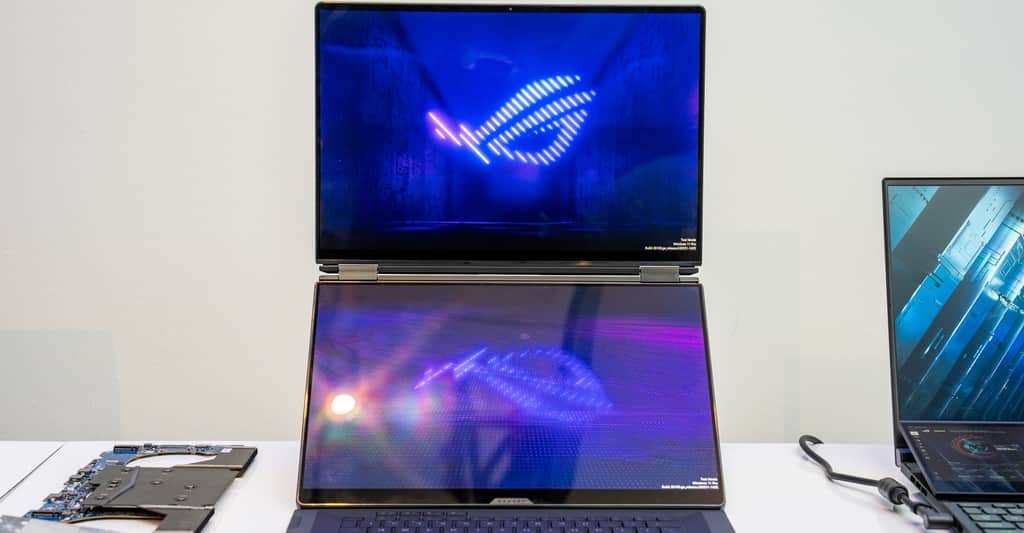
The Asus ROG Zephyrus Duo is back, but for CES 2026 both its screens are going full edge-to-edge — like a Zenbook Duo built for gaming. The original Zephyrus Duo was a quirky keyboard-in-the-front-club member, with a 15.6-inch main display and a 14.1-inch-wide, skinny touchscreen crammed between the hinge and side-by-side keyboard and trackpad. The new model features two full-size 16-inch 3K 120Hz OLED HDR displays that can reach 1,100 nits of peak brightness and a detachable keyboard / trackpad you can use wirelessly or over the bottom display.
And since this multi-screen monster is a gaming laptop, it offers Intel Panther Lake and Nvidia RTX 50-series GPUs (up to the RTX 5090). Pricing isn’t finalized, but it’s expected to launch in mid-to-late Q2 2026.
The new Zephyrus Duo is basically a double Zephyrus G16, so it’s a little chunkier at 0.77 inches / 19.6mm thick, and it weighs 6.28 pounds / 2.85kg. The detachable keyboard deck allows you to use its dual screens in two-up or side-by-side dual-screen positions, tent mode, flat mode, or as a normal single-screen laptop. Like the G16, it has a plethora of ports including HDMI 2.1, USB-C / Thunderbolt 4, USB-A, and a full-size SD card slot.
I got a glimpse of the new Zephyrus Duo at an early preview event, and holy hell am I excited for this thing. We’ve long been big fans of Asus ROG Zephyrus laptops here at The Verge, because they’re so versatile as travel-friendly laptops that are great for both work and gaming. The thought of taking that same formula and turning it into a multi-display setup for new levels of multitasking sounds incredibly compelling. (Battlefield 6 on one screen and WordPress and Slack on the other, anyone?)
As for the conventional ROG Zephyrus G14 and ROG Zephyrus G16 gaming laptops, they’re getting a modest but nice-sounding refresh with Intel Panther Lake chips. The design remains mostly unchanged, with RTX 50-series GPUs on offer, but the slash lighting on the lid is now 35 LED segments instead of just seven — and it can now show the battery level. The hinges are easier to open, the OLED displays are now factory-calibrated and HDR-compatible (reaching up to 1,000 nits of brightness), and the bottom panel is redesigned for better cooling that Asus claims enables improved performance.
Also, the G14 now sports a full-size SD card slot (hooray for us photographers) and will be available for the first time with Intel as well as its usual AMD options. The new G14 and G16 don’t have official pricing yet, but they’re both expected in mid-to-late Q2 2026 like their dual-screen cousin.
Follow topics and authors from this story to see more like this in your personalized homepage feed and to receive email updates.
Editorial Context & Insight
Original analysis & verification
Methodology
This article includes original analysis and synthesis from our editorial team, cross-referenced with primary sources to ensure depth and accuracy.
Primary Source
The Verge