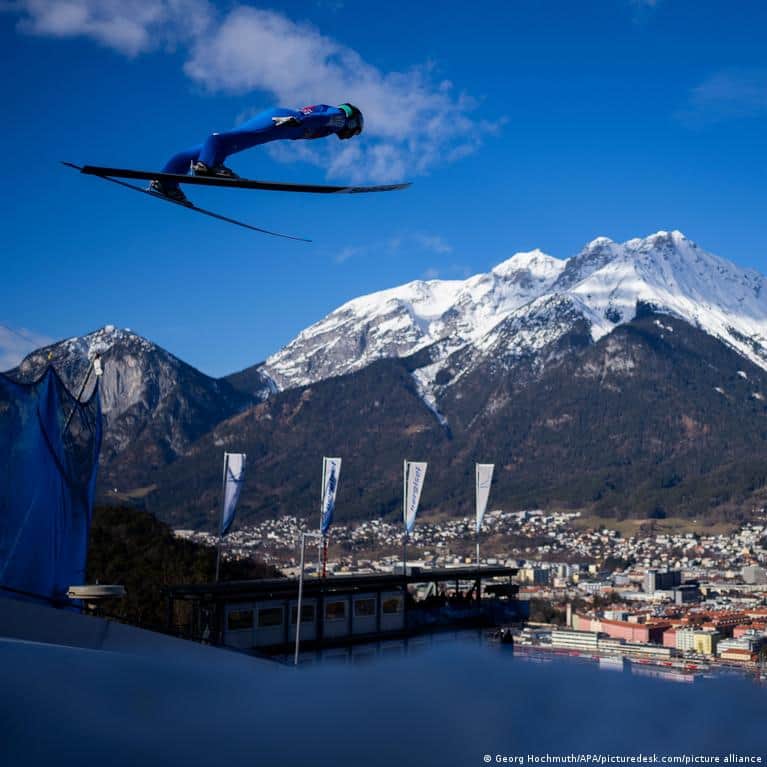
A ski suit that's too short, a second insole hidden in a sock, and banned fluorinated wax on the skis. The latest edition of the Four Hills Tournament, the sporting highlight of the ski-jumping season for fans in Germany, Austria and Switzerland since 1953, has been marred by several cases of cheating and disqualifications.
Slovenia's Timi Zajc, who had been expected to be in the hunt for the overall victory, was disqualified in each of the first two Four Hills Tour events because his jumping suit was found to be too short. He was subsequently barred from competing in the final two events.
Slovenian team officials claimed to have been caught by surprise by the offense, but not all were buying it.
"It really infuriates me," said Austria's sports director, Mario Stecher. "For me, this is absolutely manipulation."
Germany's Sven Hannawald, who swept the Four Hills Tournament in the winter of 2001-2002, called Zajc's actions "disrespectful and stupid."
The regulations about the ski suits are set out in great detail by the sport's governing body (FIS), including which seams are permitted, and that it must always be between two and four centimeters away from the body at defined points.
This is because if the suit is too loose, it offers more surface area for lift during the jump – helping the athlete attain greater distances. The same effect occurs with suits that are too short, which stretch during the jump. The stretched portions of the suit also create greater lift.
This issue has plagued ski jumping for several years. At the 2022 Winter Olympics in Beijing, five female jumpers were disqualified in the mixed team event due to non-compliant suits.
Among them was Katharina Althaus, costing Germany what many thought was a certain medal. At the time, however, it wasn't the athletes who came in for criticism, but the controls, which had suddenly become much more rigorous.
"The checks were different than at previous World Cup competitions. It simply happened without warning," complained Althaus at the time.
The ski jumper, who now goes by Katharina Schmid – since her 2023 marriage – had previously worn the non-compliant suit at other competitions, including in Beijing, without any objections.
This transgression seems almost trivial in comparison to what went on as part of last March's "Trondheim affair" at the World Ski Championships.
A video surfaced showing ski suits being altered with a sewing machine in a hotel room the day before the World Championship jump on the large hill, in the presence of the then-Norwegian head coach, Magnus Brevig. An additional seam, made with a stiffer thread, was added to make the suit more stable and provide more lift.
"We manipulated or altered the suits so that they violated the regulations," Brevig conceded, after having initially denied any wrongdoing.
Several Norwegian jumpers were suspended. Head coach Brevig, an assistant coach, and another staff member all lost their jobs. The FIS responded by introducing a "zero-tolerance policy" regarding suit deviations.
Therefore, it is surprising that the Norwegians once again made negative headlines this winter. Halvor Egner Granerud, the 2022-23 Four Hills Tournament winner, was disqualified during the qualification for the New Year's jump in Garmisch-Partenkirchen on December 31. His jumpsuit was two millimeters too long in the leg area.
During the already completed women's Two Nights Tour, which consisted of jumps in Oberstdorf and Garmisch, Norwegian Anna Odine Strom was found to have a second insole inserted into her socks. That's not allowed either.
Norway's head coach, Christian Mayer, subsequently explained that Strom had been suffering from a hip misalignment since a fall. However, the necessary medical certificate for the second insole was only submitted belatedly by the federation.
This, and the fact that the unauthorized insole was hidden in a sock, leaves former ski jumper Hannawald "speechless." The fact that they weren't transparent with the FIS and only provided the explanation after the discovery speaks volumes, he said.
"Hiding it in a sock is exactly the point: after that, you can come up with all sorts of excuses," said Hannawald. "So, are they trying to pull a fast one on us?"
Despite all the controversy, the Four Hills Tournament was completed on Tuesday – in Bischofshofen, Austria. Domen Prevc's second-place finish there, along with second place in Innsbruck and victories in Oberstdorf and Garmisch-Partenkirchen gave the Slovenian the overall victory.
Prevc won with a total of 1,195.6 points, ahead of two Austrians, Jan Horl (1,153.3) and Stephan Embacher (1,123.5). However, Domen becoming the second Prevc to win the Four Hills (older brother Peter won it in 2015-16) may not be what this year's edition will be mainly remembered for.
This article was originally published in German.
Editorial Context & Insight
Original analysis & verification
Methodology
This article includes original analysis and synthesis from our editorial team, cross-referenced with primary sources to ensure depth and accuracy.
Primary Source
Deutsche Welle