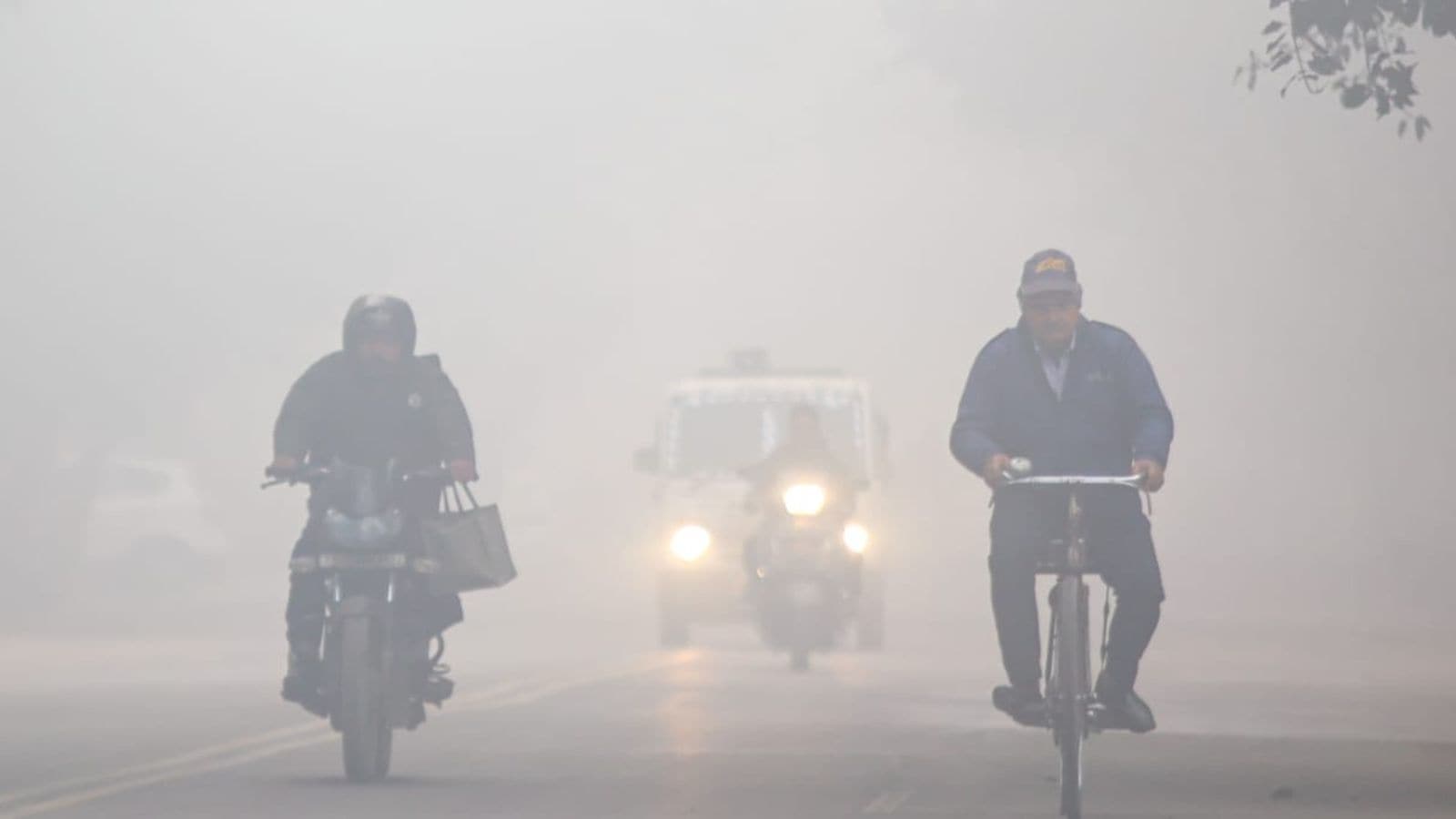
Despite remaining hazardous, air quality showed marginal improvement from the previous day, when AQI had touched 633 during peak hours. (Express Photo by Praveen Khanna)
Delhi’s air quality remained in the ‘very severe’ category Saturday, as data from the Centre-run Early Warning System (EWS), under the Ministry of Earth Sciences, showed AQI at 356 at 11.15 am. However, the private monitoring platform aqi.in recorded the Air Quality Index (AQI) at 447, categorising it to the ‘severe+’ category.
Despite remaining hazardous, air quality showed marginal improvement from the previous day, when AQI had reportedly touched 633 during peak hours, according to aqi.in
AQI (Air Quality Index) around the area is 270, categorised as ‘Poor’, as claimed by CPCB (Central Pollution Control Board).
The variation in readings is due to differences in monitoring methods, parameters, device locations and averaging mechanisms used by various agencies to assess air quality.
Under India’s AQI scale, readings between 0 and 50 are considered good with minimal health impact, while 51–100 (satisfactory) may cause minor breathing discomfort to sensitive individuals. AQI levels of 101–200 are classified as moderate and can cause discomfort to people with lung or heart ailments. A reading of 201–300 is categorised as poor, 301–400 as very poor, and anything above 400 as severe, which can affect even healthy individuals and trigger respiratory illnesses.
Pollutant levels remained alarmingly high, with PM2.5 recorded at around 299 micrograms per cubic metre and PM10 at 400 micrograms per cubic metre. According to the World Health Organization, 24-hour exposure to PM2.5 should not exceed 15 micrograms per cubic metre, while PM10 should be limited to 45 micrograms.
Trends of AQI over the last 12 hours (Source: aqi.in)
According to aqi.in estimates, breathing Delhi’s air under current conditions is equivalent to smoking about 13.6 cigarettes a day, an indicator often used to communicate health risk severity.
Earlier this week, AQI had crossed the 600-mark on December 23, touching 634, before dropping to 263 on December 25, briefly improving to the poor category.
The continued pollution crisis has triggered sharp opposition attacks on the Delhi government over air quality management. As the four-day winter session of the Delhi Assembly is scheduled from January 5 to 8, the Delhi government is likely to address the concerns over deteriorating air quality.