


Key takeaways
- “Protect our water,” “Water for people not AI,” “Don’t mess with our water,” declare protest signs from Texas to New Mexico to Arizona.
- Many data centers rely at least partly on water to absorb heat from air or surfaces, and then cause cooling as it evaporates, just like…
- But while there’s little doubt that data centers are consuming significant amounts of energy, water consumption is more complicated.
What happened
“Protect our water,” “Water for people not AI,” “Don’t mess with our water,” declare protest signs from Texas to New Mexico to Arizona. Angered by water use, energy consumption and pollution, locals are increasingly protesting the rapid expansion of data centers in the United States as tech companies work to rapidly expand capacity for AI.
Many data centers rely at least partly on water to absorb heat from air or surfaces, and then cause cooling as it evaporates, just like sweating keeps our bodies cool. The processors inside data centers can reach internal temperatures of up to 176 degrees Fahrenheit, for the same reasons that an overtaxed laptop heats up.
But while there’s little doubt that data centers are consuming significant amounts of energy, water consumption is more complicated. Claims circulating online bring scant clarity, ranging from articles claiming that chatbots can consume 500 ml of water per query to some online commentators declaring AI’s water issue to be nonexistent. And the consumption data from large tech companies themselves are often incomplete and inconsistent.
The heated water is then fed into a cooling tower that removes the heat but also loses some of the water to the atmosphere. This evaporative cooling uses a lot of water, says Eric Masanet of the University of California, Santa Barbara, who researches data center sustainability. But the energy-hungry processors inside AI data centers generate so much heat that it’s hard to remove it with air alone.
That’s why many tech companies—including Amazon, Microsoft and Google—use a more efficient technique called liquid cooling. In this method, a system of pipes filled with water, sometimes mixed with temperature-regulating chemicals, runs on top of the hardware, cooling the processors directly rather than cooling the entire data center.
Why it matters
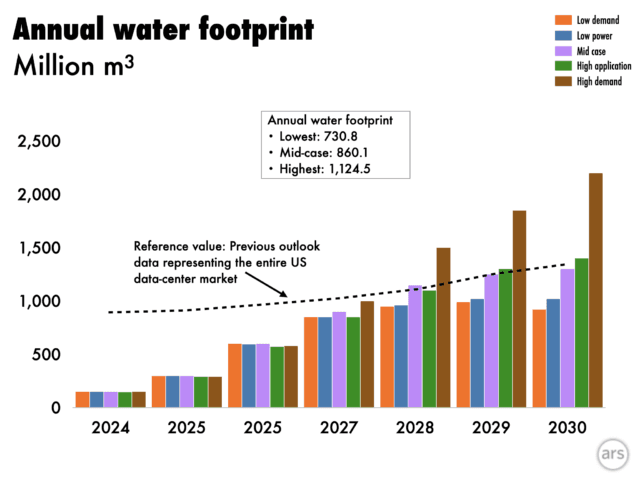
Experts stress that, overall, data center water consumption pales in comparison to the usage by industries like agriculture and some kinds of manufacturing. Researchers have estimated that data center cooling systems consumed 66 billion liters of water in 2023, less than 1 percent of the nation’s total consumption.
That figure could considerably rise with the rapid buildout of AI data centers, however—which may not be a big problem for water-rich regions but could significantly add to local water stress in drought-strapped places like New Mexico and Arizona. Fortunately, engineers say there’s a host of things that can be done—and are being done—to reduce the strain on local water resources.
“There are many good ideas out there,” says energy systems expert Fengqi You of Cornell University. ” Recent advances in AI technology have already reduced water demand for many data centers.
Electrical and computer engineer Shaolei Ren of the University of California, Riverside, says that an estimate he made based on GPT-4, an earlier version of the model powering ChatGPT, as recently as 2024—that drafting a short email would consume 500 milliliters of water—is already outdated because AI models have become more efficient.
Still, these numbers factor in not just cooling, but also a greater amount of water used to generate the electricity that powers data centers. Much of that comes from burning coal or gas, with water being used to cool steam back into liquid after it’s been used to spin the electricity-generating turbines.
In other words, AI’s water consumption can be significantly reduced by shifting to solar and wind, which require little to no water to operate, You says.
You adds that companies should site data centers in areas less prone to drought and with ample renewable energy sources, like regions in Montana, Nebraska, parts of Texas and South Dakota, instead of constructing new data centers in water-stressed places, such as in Arizona, New Mexico and Southern California. Strategic siting along with other measures could reduce AI’s future water footprint by up to 86 percent, he says.
Advances in cooling technologies are also helping. The newest data centers that specialize in AI are already more water-efficient than their predecessors. Pre-AI data centers use fans to carry away the heat from processor-filled racks, then use chilling systems funneling cool water through the building to cool the warm air down again.
What to watch
And because this is a closed-loop system, no water is lost: The heated fluid can be cooled down by exposing the pipes to the outside air, if conditions are cool enough, or an air-conditioner-like system, which uses energy. But when it’s extremely hot or humid, the centers need to bring online extra, more effective methods that involve water; one of these is to mist the air around the pipes.
Mechanical engineer Vaibhav Bahadur at the University of Texas at Austin says that most AI data centers in Texas only use this kind of water-based cooling for the hottest parts of the summer.