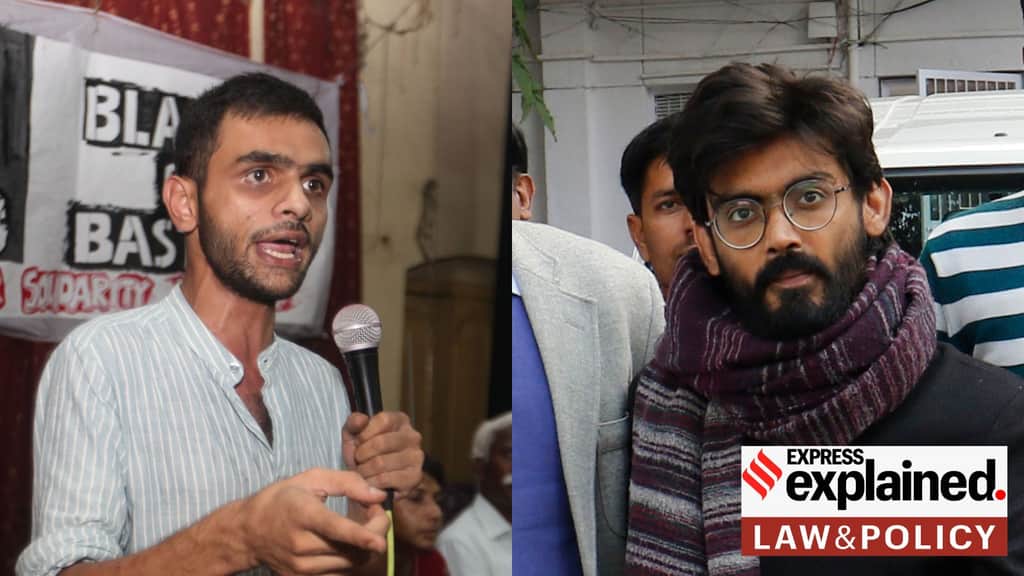
Umar Khalid (left) and Sharjeel Imam were denied bail by the Supreme Court on Monday. (Photo: Express archives)
The Supreme Court on Monday (January 5) granted bail to five of the seven accused in the 2020 Northeast Delhi riots. It denied bail to Umar Khalid and Sharjeel Imam.
“The record discloses that all the accused do not stand on equal footing as regards culpability. The allegations against the principal accused indicate a central and directive role in conceptualising planning and coordinating the alleged terrorist act, whereas the material against certain co-accused reflects conduct of a subsidiary or a facilitative nature,” a Bench headed by Justice Aravind Kumar said.
Essentially, the ruling created a hierarchy of offenders, even when all the accused are booked under similar charges and examined their roles individually. The accused have all been charged under terror charges in the stringent Unlawful Activities (Prevention) Act (UAPA), Arms Act and various provisions under the penal law.
Central to this case are two primary issues: what constitutes a “terrorist act” and who determines that, and whether prolonged incarceration before a trial can begin can be justified under anti-terror law. The bail case by Khalid and other accused had also become emblematic of the delays in the system.
Apart from the immediate consequences for the accused, the bail order also accepts an expansive definition of a “terrorist act.”
Section 15 of the UAPA defines a terrorist act as an act done “with intent to threaten or likely to threaten the unity, integrity, security, economic security, or sovereignty of India or with intent to strike terror or likely to strike terror in the people or any section of the people in India.”
However, the provision qualifies that striking terror is by use of “bombs, dynamite or other explosive substances or inflammable substances or firearms…or any other means.”
The prosecution’s case is that a “chakka jam” that Khalid and the other accused allegedly conspired to organise would also fall under the definition of “any other means.” Senior Advocate Kapil Sibal, who appeared for Khalid, argued that advocating for chakka jams or road blockades is a legitimate form of protest in a democracy. The thrust of the arguments by the accused is that since the provision talks about violent means, “any other means” should be read only as other violent means.
The Supreme Court, while deciding the bail application, examined this definition and agreed with the prosecution’s interpretation.
“The means by which such acts may be committed or not confined to the use of bombs, explosives, firearms, or other conventional weapons alone. Parliament has consciously employed the expression court by “any other means of whatever nature” which expression cannot be rendered otiose. The statutory emphasis is thus not solely on the instrumentality employed but the design, intent, and effect of the act,” the court said.
Editorial Context & Insight
Original analysis & verification
Methodology
This article includes original analysis and synthesis from our editorial team, cross-referenced with primary sources to ensure depth and accuracy.
Primary Source
The Indian Express