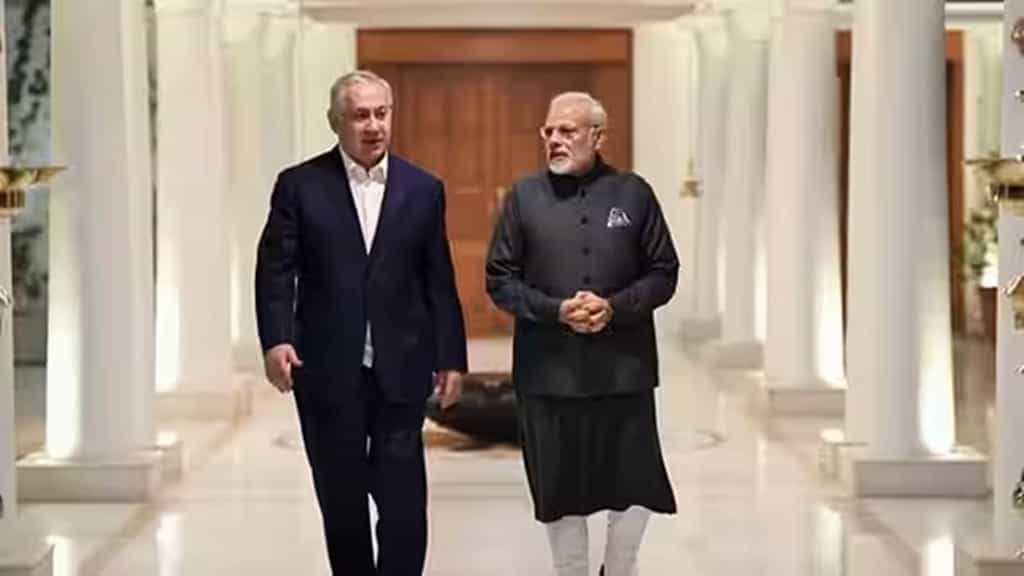
In his first telephone call in the new year and the second within a month, Israel’s Prime Minister Benjamin Netanyahu Wednesday briefed Prime Minister Narendra Modi on the implementation of the Gaza Peace Plan.
It is learnt that the two sides are also discussing plans to schedule Netanyahu’s visit to India, which will be his first since 2018. In a post on X, Modi said they also reaffirmed their shared resolve to fight terrorism with greater determination.
“Glad to speak with my friend, Prime Minister Benjamin Netanyahu and convey New Year greetings to him and the people of Israel,” Modi said.
“We discussed ways to further strengthen the India-Israel Strategic Partnership in the year ahead,” he said.
Modi said they also exchanged views on the regional situation.
According to a statement from the PMO, Prime Minister Narendra Modi “received a telephone call” from Netanyahu. “The two leaders warmly exchanged New Year greetings and wished the people of both countries peace and prosperity. They identified shared priorities to further strengthen the India-Israel Strategic Partnership in the year ahead, guided by shared democratic values, deep mutual trust and a forward-looking vision,” it said.
It also said that they reiterated their zero-tolerance approach towards terrorism in all its forms and manifestations and reaffirmed their commitment to fight this menace.
“PM Netanyahu briefed the PM on the implementation of the Gaza Peace Plan. PM reaffirmed India’s consistent support for efforts towards a just and durable peace in the region,” it said.
They also exchanged views on regional and global issues of mutual interest. The two leaders agreed to remain in touch.
On December 10, Modi got a call from Israel’s Prime Minister Netanyahu, where Modi had reaffirmed India’s support for efforts towards a just and durable peace in the region, including early implementation of the Gaza Peace Plan.
Before that, Modi and Netanyahu last spoke in October when he had congratulated the Israeli PM on the progress made under the Gaza plan.
Netanyahu has long touted his “personal chemistry” with global leaders during his election campaigns, with images of his meetings with Trump, Russian President Vladimir Putin and Modi, splashed across the ruling party Likud’s headquarters during one such campaign.
On October 9, after Israel and Hamas agreed to a long-awaited ceasefire and hostage deal, with the US playing a central role in the process, Prime Minister Modi had said, “We welcome the agreement on the release of hostages and enhanced humanitarian assistance to the people of Gaza. Reaffirmed that terrorism in any form or manifestation is unacceptable anywhere in the world.”
The Gaza agreement was the result of indirect talks held in Egypt in the initial stage of Trump’s 20-point framework to bring peace to the Palestinian enclave. The talks were held just a day after the second anniversary of Hamas’s cross-border attack that triggered Israel’s devastating assault on Gaza.
Delhi, which was extremely supportive of Israel after the October 7 attacks by Hamas, had been nuancing its position over the last year-and-a-half as the death toll of Palestinians have been rising due to Israel’s military offensive. However, it has sought to keep a balance — calling for the war to end but not being overtly critical of Israel’s actions under Netanyahu.
Editorial Context & Insight
Original analysis & verification
Methodology
This article includes original analysis and synthesis from our editorial team, cross-referenced with primary sources to ensure depth and accuracy.
Primary Source
The Indian Express