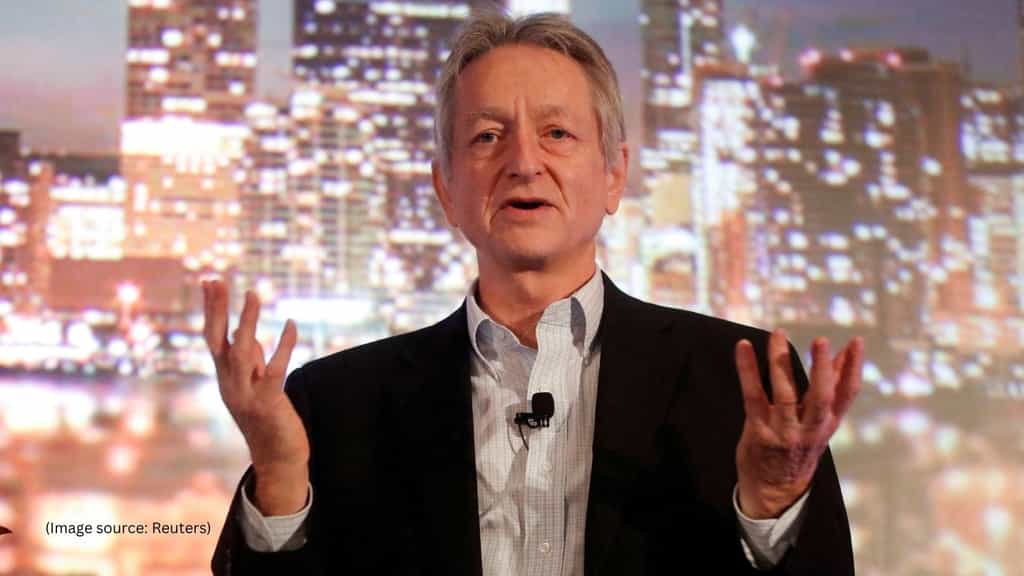
Hinton criticised AI companies for prioritising short-term financial gains over the long-term consequences of the technology
Geoffrey Hinton, the trailblazing computer scientist often called the “godfather of AI”, has warned that artificial intelligence is likely to deepen inequality by driving profits up while pushing many workers out of jobs.
In an interview with the Financial Times, the Nobel Prize–winning researcher reflected on his decision to leave Google, shared his concerns about how AI is being developed, and spoke candidly about how he uses the technology. Along the way, he offered a stark assessment of who stands to gain – and who could lose – as AI becomes more powerful.
“What’s actually going to happen is rich people are going to use AI to replace workers,” Hinton said in September. “It’s going to create massive unemployment and a huge rise in profits. It will make a few people much richer and most people poorer. That’s not AI’s fault, that is the capitalist system.”
Those remarks echoed what he told Fortune in August 2025, when he criticised AI companies for prioritising short-term financial gains over the long-term consequences of the technology.
So far, there hasn’t been a dramatic spike in layoffs. But signs are emerging that AI is quietly narrowing job opportunities, particularly at the entry level, where new graduates usually begin their careers. A New York Federal Reserve survey at the time suggested companies adopting AI were more inclined to retrain staff than let them go, though it also indicated layoffs could increase in the months ahead.
Hinton has repeatedly said healthcare is likely to be spared from the worst employment fallout. Speaking on the Diary of a CEO YouTube series in June 2025, he argued that greater efficiency could actually expand care rather than eliminate jobs. “If you could make doctors five times as efficient, we could all have five times as much health care for the same price,” he said, adding that demand for healthcare is effectively limitless when cost is not a barrier.
Still, he believes many routine and repetitive roles are at risk, while jobs requiring deep expertise or complex judgment are more likely to endure.
In the FT interview, Hinton also pushed back against OpenAI CEO Sam Altman’s proposal of a universal basic income as a response to AI-driven disruption. He said such measures fail to address “human dignity” or the sense of purpose people derive from work.
Beyond economics, Hinton has long raised alarms about AI’s existential risks. He has estimated a 10 per cent to 20 per cent chance that advanced superintelligent systems could ultimately threaten human survival if left unchecked.
As he sees it, AI dangers fall into two broad categories: the possibility that the technology itself becomes uncontrollable, and the harm that could arise when it is used by people with malicious intent. In his FT conversation, he warned that AI could lower the barriers to creating bioweapons and criticised what he described as the Trump administration’s reluctance to regulate the field, contrasting it with China’s more aggressive stance.
At the same time, Hinton acknowledged AI’s enormous potential for good, stressing that the future remains deeply uncertain. “We don’t know what is going to happen, we have no idea, and people who tell you what is going to happen are just being silly,” he said. “We are at a point in history where something amazing is happening, and it may be amazingly good, and it may be amazingly bad.”
On a lighter note, Hinton spoke about how AI shows up in his own life. ChatGPT, he said, is his preferred tool, mainly for research. But he also recounted a more personal use case: a former girlfriend once used the chatbot during their breakup “to tell me what a rat I was”. Hinton took it in stride, joking that he disagreed with the assessment and had since moved on.
Editorial Context & Insight
Original analysis and synthesis with multi-source verification
Methodology
This article includes original analysis and synthesis from our editorial team, cross-referenced with multiple primary sources to ensure depth, accuracy, and balanced perspective. All claims are fact-checked and verified before publication.
Primary Source
Verified Source
The Indian Express
Editorial Team
Senior Editor
Dr. Elena Rodriguez
Specializes in India coverage
Quality Assurance
Senior Reviewer
Fact-checking and editorial standards compliance