On its final day, St. Anna's is almost full again. A choir is singing and the small organ is supporting them. But this is the last mass in the small Catholic church in Gildehaus, a district of Bad Bentheim near the German-Dutch border. In future, the building will no longer be a place of worship.
Towards the end of the service, the demise of this church becomes achingly real. Worshippers from the congregation open the altar and remove the relics. These are small relics of a saint, be they bone fragments or pieces of textile, which are always incorporated into the altar of a consecrated Catholic church.
The decommissioning of churches is an emotional affair. "It affects the heart and the eyes. It's moving," Catholic pastor Hubertus Goldbeck tells DW, wiping the beginnings of a tear from the corner of his eye.
What his small congregation is going through is something that many devout Christians across Germany are also facing. When churches shrink, they also have to give up buildings.
To view this video please enable JavaScript, and consider upgrading to a web browser that supports HTML5 video
The number of church members in Germany is falling rapidly. In 2024 alone, the two major churches lost over a million Christians due to people leaving the church or dying. Currently, more than 45% of Germans still belong to either to the Protestant Church in Germanyor the Catholic Church. Thirty years ago, that figure stood at almost 69%. This is why churches are now being deconsecrated or desacralized.
Since 2000, hundreds of Catholic and Protestant churches were decommissioned. In response to a DW inquiry, the German Bishops' Conference informed of the closing and decommissioning of 611 Catholic churches between 2000 and 2024. The Protestant Church estimates that some 300 to 350 churches were permanently shut in the same period; more precise figures are not available.
And what happens to former houses of worship? In some cities, especially in Berlin, growing Orthodox Christian congregations have taken over church buildings. But that remains the exception. They are often sold. In the capital alone, several large church buildings are currently up for sale. And it's not unusual for churches to be demolished.
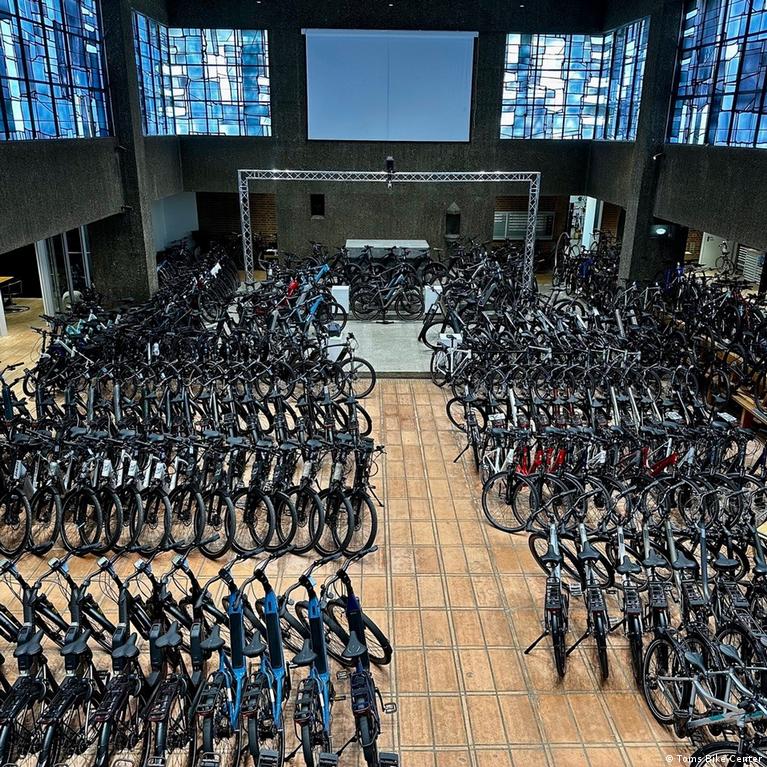
Some are repurposed. In Jülich, a town between Cologne and Aachen, bicycles are now sold in the former Catholic St. Rochus Church. Thomas Oellers moved his business, Toms Bike Center, into the church building.
Oellers tells DW that the parish approached him and asked him if he could imagine running his business in the church. It is the church where he himself was baptized and took Communion, and where he often attended church services. On the exterior, the listed building has changed remarkably little.
In Wettringen, just north of Münster, an abbey has been transformed into a "soccer church” where footballs are knocked about. In Kleve, the former Protestant Church of the Resurrection serves as a boxing arena. Former churches now house pubs, libraries and book stores. Entire cloisters have even been turned into hotel complexes. In Düsseldorf, a hotel has retained its traditional name Mutterhaus (Mother House) in a nod to its original use as a convent for nuns.
In times of housing shortages, there are more and more cases of architects converting church buildings into residential buildings. In Berlin, Rostock, Trier, Cologne and Wuppertal, for example.
One of the earliest large complexes is the Lukas-K-Haus in Essen. The Protestant St. Luke's Church, built in 1961, was deconsecrated in 2008 and converted into apartments between 2012 and 2013. At the bottom of the stairwell, two plaques now hang: one from 1959 and the other from 2012. And the abstract-colored windows there are still the original church windows.
Alexandra Schröder has lived in the old church since its repurposing. "No one would have thought that I would be living above an altar, " she says. For her family, it was simply practical at the time as the apartment had several bedrooms and there were good schools nearby. That was the deciding factor.
One floor below is a physiotherapy practice. Director Jessica Günther explains that she came across the converted church building by chance while looking for new premises. She says the building has a "nice, calm feeling" that is good to work in. She knows that the steps inside her practice once led up to the altar but doesn't want to overstate the importance of that.
But one of her patients is positive about this. It is an expression of faith to "help people in need," Stefan Hebenstreit tells DW. Even if the buildings are no longer churches, using them as a daycare center or a physiotherapy practice is "very practical." Hebenstreit, a practicing Christian who has suffered several strokes, says this slowly and thoughtfully.
To hear anything critical about the church conversion, you have to speak to people on the surrounding streets who have lived around St. Luke's for decades. One misses the sound of the bells. Another regrets that the clocks on the church tower have stopped forever.
The two major churches have official commissions and papers on the issue of repurposing churches. Researchers concern themselves with the question too. And yet the specific neighborhood itself is often pivotal.
Art historian Klaus-Martin Bresgott from the cultural office of the Protestant Church in Germany and a group of architecture students investigated how important former church premises can be for a neighborhood and a residential area, using the example of a large church in Berlin.
The Protestant Church no longer needs the huge St Stephen's Church (Stephanuskirche) in the district of Wedding. The building, which was erected between 1902 and 1904, was always too big in fact. But back then, people liked to build big. Today, the church is closed and in such need of refurbishment that you are no longer allowed to go inside even wearing a hard hat.
Bresgott and the students did not examine the building first, instead they interviewed people in the neighborhood, which has the reputation of being an area with social problems. One thing is clear: The neighborhood lacks public space, opportunities to gather, play sports or engage in cultural or community activities.
Times always change and sometimes churches are considered more important. other times they were unimportant, says Bresgott to DW.
"We know that during the Napoleonic Wars, churches served as horse stables for decades. But they remained standing." For him, St. Stephen's Church is a perfect example of how a church that was too big in the first place could still serve society. "We must not immediately panic and say: close down, give up, " he warns.
This article was originally written in German.
While you're here: Every Tuesday, DW editors round up what is happening in German politics and society. You can sign up here for the weekly email newsletter, Berlin Briefing.