Warning. This column contains good news, when it is an (un)truth widely acknowledged that only grim stories attract public attention. News must be something someone somewhere doesn’t want printed, says the old maxim. Well, battalions of interests want to suppress good news: the overwhelmingly Tory or Reform UK press and antisocial media sites don’t want any stories to surface that might do credit to a Labour government.
Among this deluge of disinformation and malevolence, when asked, a sour and disengaged electorate struggles to think of anything good this government has done. True, the prime minister and his cabinet are partly to blame for failing to tell their story, paint their picture, draw us a map of where they are going and why. They too often do good by stealth, afraid of what the right and business might say if they dare trumpet the strong social justice themes that drive most of what they do. But lay out what the government has done and there it is, plain as a pikestaff. There have been blunders, missteps, bad timing and wrongheaded manifesto pledges, but follow the money to define its identity. What has Labour raised from whom and how was it spent? That’s what historians will look for.
Labour inherited destitute, austerity-stricken public services that voters expected to be healed overnight by a “change” government, despite a stagnant economy, deep debt, unfunded policies and an empty Treasury. Forget Harold Wilson’s verity that a week can be a long time in politics – a year and a half is not very long for the radical changes the government has made already.
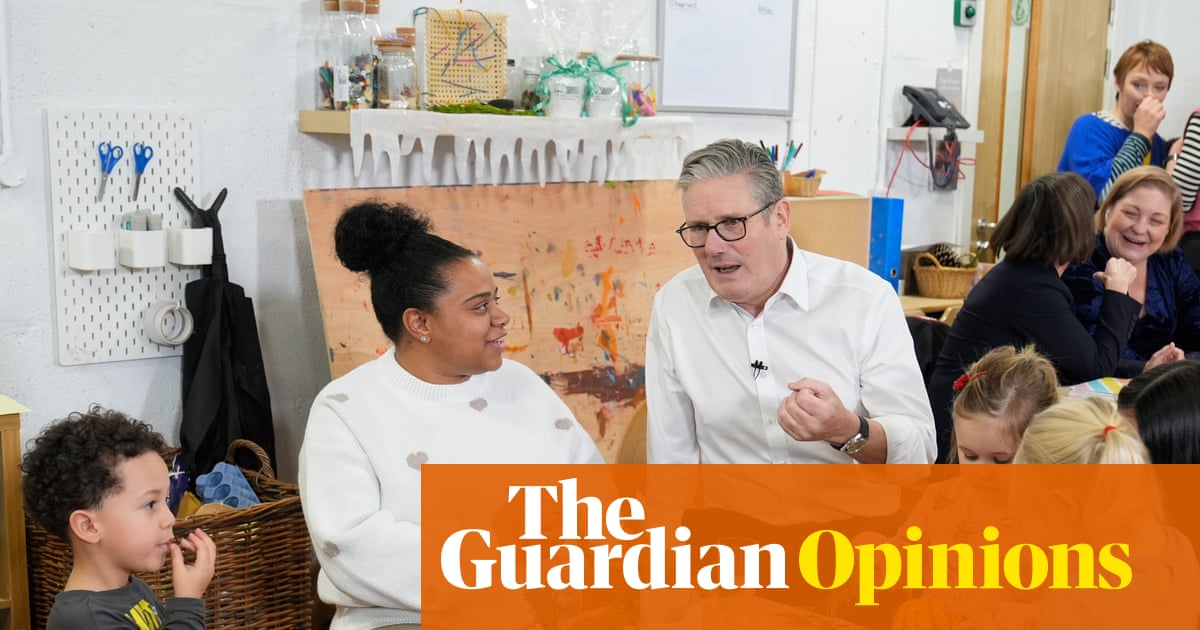
The list has to begin with Labour’s forever priority: children come first – this time with free breakfasts, cheaper uniforms and 500,000 more qualifying for free school meals in England, and 550,000 due to be lifted out of poverty across the UK with the abolition of the pernicious two-child limit. Nurseries for all is a liberation for families – and crucially a great educational boost, so let’s welcome 1,000 new Best Start family hubs in England, resurrecting the Blair-Brown flagship Sure Start policy. Many may not notice, but unsurprisingly I’m told Labour’s own polling finds that families with young children certainly do, when free childcare makes some half a million English families as much as £7,500 a year per child better off. It may take time to percolate, but these policies are monumental. Also in England you can add to that the restoration of arts to the school curriculum, and the start of a revived youth service with 250 youth centres, new FE colleges, extra construction courses and apprenticeships. This is familiar Labour turf: children come first.
Other forever Labour beliefs are becoming visible, too: the railways are being renationalised, with rail and bus fares frozen in England, and pay-per-mile road pricing for all electric cars by 2028, to help promote public transport. The Employment Rights Act is a founding Labour principle, vastly improving working conditions in England, Scotland and Wales: how were zero-hours contracts ever permitted where people get no notice of their hours or wages each week, unions are barred from workplaces and workforces fired and rehired on worse pay? A new chapter has begun for millions of workers.
Of course, business and its press protest – as they do about a UK minimum wage raised by 6.7% in year one, plus another 4.1% in April. That’s a shift in power towards the workforce, after decades of money and muscle transferred to employers, causing soaring inequality. The government braved tidal waves of industry anger when employers, not workers, were made to pay an extra £25bn in national insurance. Yet the message of a pro-worker government fails to reach its target. Instead, a belligerent head of Unite is now joined by an even more anti-government new Unison leader, making a threat to Labour that, “never again will we prop up politicians hostile to unions”, despite this being the most pro-union government since 1979.
The NHS staggers on – but with more than 2,000 extra GPs and 170 new community diagnostic centres, waiting times have started to fall. Net migration has fallen steeply by two-thirds (which may not be good news), but small boat arrivals rising is bad news. Wages have risen by more than prices, but people don’t feel it yet. The Renters’ Rights Act protects 11 million private tenants in England from no-fault evictions. On spending, the largest sums have gone to the NHS, the target of building 1.5m new homes in England, and on green energy investment (£63bn). Animal welfare always gets a boost under Labour, who have now picked a useful fight with pro-hunting Reform and the Tories.
The right to die will pass for England and Wales, thanks to government efforts. The turn towards Europe accelerates, including rejoining Erasmus – the EU’s education and training programme – last week. Recognising the state of Palestine took too long, but no other UK government did it. For all Donald Trump’s extreme racist abuse of mayor Sadiq Khan, London’s air quality has reached legal clean limits for nitrogen oxide for the first time, crime in the capital keeps falling (except for phone theft), and in recent years Khan has surpassed his own targets for building council homes.
For flavour, Wandsworth, once Margaret Thatcher’s flagship borough, now has its first Labour council since 1978, its mayor declaring: “As a borough of sanctuary and a safe haven for people who have fled war and persecution, let’s show these youngsters some warmth and love,” as he topped up donations to give every refugee child a £50 Christmas gift, unafraid of Reform-spread refugee hate.
There’s plenty more, but what’s the use when this is the most unpopular government led by the most unpopular prime minister ever? (Note that the last four PMs have all been the most unpopular during their tenure). Loathing of leaders and politicians is widespread across Europe, opening the gates to demagogues. Blame the near stagnation since the financial crash all those years ago – but there are glimmers of better times from the Guardian’s economics editor, Heather Stewart, and the Financial Times economics writer Chris Giles, who says: “The UK economy is not nearly as bad as you’ve been told”. The doom is overdone.
What’s missing, as cabinet ministers now say more loudly, is that red thread signalling the nature of this government. Wavering and wobbling, Keir Starmer and Rachel Reeves were never sure about daring to tell that story, peppering it with Reform-wooing distractions. Late, as ever, Labour seems to be shunning the Maurice Glasman/Morgan McSweeney formula of tacking right on some social policies, realising that twice as many voters are fleeing leftwards as right.
Too much is still left undone. Where is electoral reform to protect the democratic future? More than 4 million children are poor, the young are losing hope of owning a home, public services are struggling and everything needs money that isn’t there. This often feels like an unhappy country – angry, grudging, cynical. But don’t underestimate a government that’s doing far more than it gets credit for.