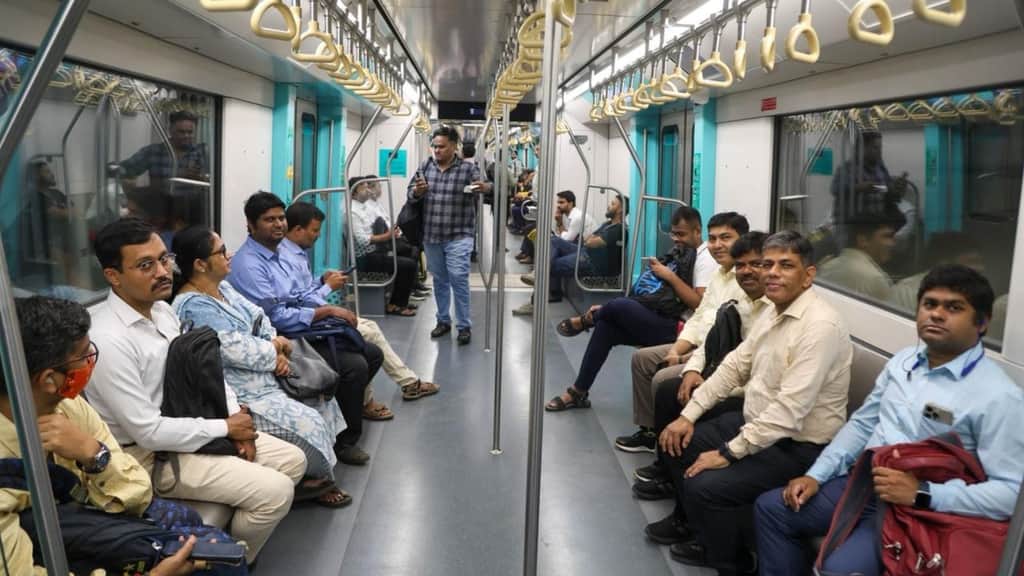
Three months on, Mumbai’s underground Aqua Metro (or Line 3, Colaba-Bandra-SEEPZ) is nowhere close to having a functional mobile network in its underground stations and tunnels. Commuters continue to bear the brunt of the network blackout, which is absolute in the stations between Worli and Colaba, while the stalemate continues between telecom service providers and the Mumbai Metro Rail Corporation Limited (MMRCL).
Only Vodafone Idea (Vi) and BSNL offer connectivity in restricted sections of the Metro line, which opened to the public on October 8, 2025. While Jio and Airtel users face network outage across the whole line, Vi claims to have network from Aarey to Acharya Atre Chowk station, Worli. Its users have complained of issues from Worli to Cuffe Parade. Meanwhile, a parallel situation is playing out at the Navi Mumbai International Airport (NMIA).
The root of the disagreement in the Metro line’s case stems from the third party contracted by the MMRCL to provide in-building solutions (IBS), i.e. neutral telecommunications infrastructure, in the stations 20 feet below ground. To connect to this infrastructure, telecom companies claim that the third-party, ACES India Private Limited, is demanding commercially unviable rates.
Despite multiple meetings between all players, including the Department of Telecommunications (DoT), a solution is not in sight.
“MMRCL has expressed its intent to discuss and come to a resolution, but telecom companies have refused to come around and agree to pay a reasonable cost for the infrastructure investment that has gone into it. It is their subscribers that are inconvenienced,” said a senior MMRCL official, adding, “The rates that the third party is demanding account for three things – the physical infrastructure and installation, daily operation and maintenance costs, and the charges committed to MMRCL.”
Telcos slam ‘extortionate’ rates Major telecom operators, however, have called these rates “monopolistic and extortionate.” They say that setting up their own telecom infrastructure along the underground line would be far cheaper for them.
The gap is substantial, running to several millions of rupees,” said Lt Gen Dr SP Kochhar, the director general of the Cellular Operators’ Association of India (COAI), the telecom industry body.
A source from one of the major telecom operators said ACES has claimed a capital expenditure of Rs 118 crore, whereas internal estimates by telecom service providers (TSP) peg it at around just one-fourth of that cost, at Rs 30 crore. “The rates being demanded by Mumbai Metro and their vendor were initially Rs 13 lakh per station, which they have now reduced to Rs 5.5 lakh per station. On the other hand, TSP’s internal working shows that Rs 39,000 per station per TSP per month will cover the required capex and a 10 per cent management fee,” said the source.
MMRCL objected to this, calling the TSP’s estimate an underestimation. While the metro rail corporation termed the demanded charges as reasonable and customary for providing Right of Way (RoW) within their premises, telecom companies pointed to MMRCL’s perspective of telecom services as a revenue-making avenue, instead of an essential utility.
Notably, when ACES India Private Limited, a subsidiary of Saudi-based ACES Co, was awarded the 12-year contract to provide telecom infrastructure for Line 3 in 2023, a nod was made to the higher licence fee generated per station – approximately 2.5 times more than any other Metro line in the country. In an earlier statement by the MMRCL, director Ashwini Bhide had remarked, “The non-fare box revenue generated by Metro Line 3 through this initiative [will be the] highest in India.” Another official had noted “achieving the highest annual premium in the country to date for In-Building Solutions.”
For public transport systems, non-fare revenue – including advertising, station naming rights, in-building solutions, etc – is essential for keeping fares low and reducing dependence on government, i.e. taxpayers’ money. The TSPs disagreed.
“Across the world, telecom operators do not pay recurring fees for providing mobile signals meant for public use. Telecom connectivity inside such large premises is increasingly treated as public digital infrastructure, an essential service and Right-of-Way obligation, not a revenue source. Hence, we believe firmly that this should be maintained here as well,” said Kochhar.
The source from a major TSP echoed, “First and foremost, Mumbai Metro should not see telecom connectivity as a source of revenue but as an essential utility required for the convenience and safety of passengers and staff of the Metro. Once that change in mindset comes, all the problems will be immediately resolved.”
The MMRCL official defended this and said, “ACES India Pvt Limited was chosen through a tendering process in line with the rules. Neither are we allowing the third party to overcharge the telecom operators, as we aim to serve the same set of citizens who are commuters as well as customers of the TSPs.”
‘Telcos finding quoted rates high, given lower footfall’ Offering a perspective, a source with knowledge of the matter said, “Telcos are paying comparable rates at other stabilised Metro lines and airports in Mumbai, Delhi, Bengaluru, etc, where the footfalls are high.” Explaining the reluctance in the case of Line 3 and the NMIA, he added, “Footfalls take some time to ramp up and steady in newly commissioned transport projects, hence the telcos are finding the rates quoted to be high given the relatively lower footfalls.”
He added that the mandate to ACES India Pvt Ltd to set up 5G-ready telecom infrastructure from the get-go along this unique, fully-underground, 33.5-km corridor meant a higher capex, resulting in higher charges to the TSPs. “This has resulted in a stalemate with the telcos refusing to pay charges for lower footfalls and the transport corporation not wanting to let go of critical non-fare revenue for operational viability,” he said.
In the meantime, the three major telecom operators continue to wait on permission from MMRCL to lay their own network infrastructure along the underground metro line, pending for over eight months now.
“As per the Telecommunications Act, 2023, and new RoW rules, a public authority cannot deny provisioning Right of Way to TSPs in a public place,” Kochhar had said in April, which he reiterated. He noted that global best practices, across Europe, the USA, Singapore, Japan, South Korea, the UAE and Australia, discourage the monetisation of essential telecom infrastructure serving the public, especially access that is exclusive or anti-commercial. The source from a TSP said, “Despite the telecom companies’ willingness to spend money on setting up the network, Mumbai Metro is not willing to give ROW permissions, stating that it is an operational metro system, which is not a valid reason, since in other operational metro systems, new networks continue to be installed.”
‘New rules are unclear’ Adding to the complexity, the MMRCL official said that the contract with ACES was finalised before the new rules came into force in January 2025.
“The investment into telecom infrastructure has to be recovered, and the new rules are not clear as to how to navigate such an instance,” said the MMRCL official, noting the complications of retroactively applying new rules to a contract signed under past rules. A similar sequence of events is repeating in the case of the Navi Mumbai International Airport. The DoT rules leave some room for interpretation, agreed the source.
“The other underground metros and tunnels in the works in Mumbai may face the same problem if it is not sorted,” said the official. “MMRCL is hopeful a resolution will emerge.”
A possible solution could be, said the source with knowledge of the matter, “The stakeholders need to come together to discuss and agree on rates which are viable at the current footfalls, and which can be scaled up to fair market rates as the footfalls stabilise, with the objective of providing a seamless mobile network to the passengers at the earliest.”
Completely cut off in an emergency: Commuter While commuters have taken to joking about Line 3 as a space for a digital detox, the absolute suspension of the network has raised worries about emergency situations.
“The bare minimum required from telecom operators we consumers pay for is a few bars of network so that calls can be made or received. In case of emergencies, I am completely cut off from my loved ones and vice-versa till I exit the station,” said Shahid Shaikh, 33, a Jio user who makes the journey from his home in Mumbai Central to work at Marol a couple of times a week, going offline for over an hour of the round trip. “As there are only a few telecom operators in the fray, it feels like we consumers have little in the way of choice and are taken for granted. I was sympathetic to the network issues in the beginning, but I now feel that if it isn’t resolved within a week or two, I will make the switch to Vi.”
A spokesperson from Airtel said the situation is stuck at a stalemate over ACES’s rates, but deferred answering other questions. Jio and Vi did not respond to the queries.
Editorial Context & Insight
Original analysis & verification
Methodology
This article includes original analysis and synthesis from our editorial team, cross-referenced with primary sources to ensure depth and accuracy.
Primary Source
The Indian Express