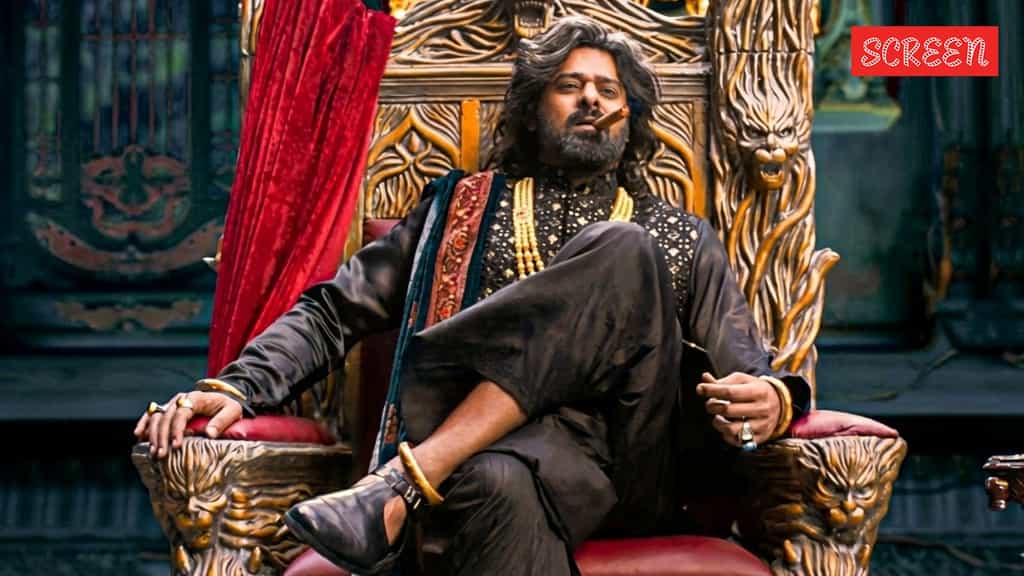
The Raja Saab movie review: At about two-thirds into Maruthi’s latest film, you feel that the writer-director is onto something quite sophisticated. Raju, the protagonist (Prabhas), is facing off against Kanakaraju, the antagonist (Sanjay Dutt), in a clash that is as epic as it could be, but the catch is that the two are barely in the same room at the same time. They talk to one another, throw challenges, and engage in a battle of one-upmanship that involves fighting crocodiles, evading deadly pyrotechnics, and so much more, all without any form of physical contact. A game of minds is the chosen method for Maruthi’s saga, which, incidentally, is unfolding between a grandfather and his grandson.
At the outset, The Raja Saab is a delectable offer that has so much going on in its favour. It’s the coming-of-age story of a young man looking to find his doting grandmother’s lost reputation. It’s a motley-crew comedy set inside a haunted palace and featuring some ridiculous, yet fun, contrivances. It’s a rom-com when it wishes to be, a Harry Potter or Chronicles of Narnia kind of ‘magical’ adventure at other times, and also a sci-fi, ‘mystical’ thriller that brims with bold ideas and promises. Prabhas, too, is well in his element to handhold us through the whopping 3-hours-and-10-minutes-long ride.
Yet, as the cliche painfully goes, the ideas, the promises and the delectable offers buckle under the weight of their own pressure, leaving behind a mess that is so tangled up that you couldn’t fathom its origins or its destination. The Raja Saab is a film whose potential goes grossly unrealised because of an oversight, one that ignores its novelty until very late, as well as a sloppy, outdated approach that simply seems lost from start to finish.
The film takes on a fairly complex subject matter, but it could have easily afforded itself clarity and coherence had the intent been well-defined. It also runs with the responsibility (or burden) of catering to a massive ‘pan-India’ fanbase, but with the superstar himself apparently in the mood to try something different, there was an equal chance to set a new precedent for today’s expensive moviemaking. However, even with an audience that feels willing to be lenient and forgiving, the film comes off as incredibly casual and unfocused. The central conflict of the story has parallels with multiple other works from across the world, including Venkat Prabhu’s Maanaadu (2021). A cerebral connection brings Raju and Kanakaraju together, with the equation being very straightforward: the former is locked inside a mansion belonging to the latter, and the only way Raju can get out is by beating the villain at his own game.
Kanakaraju is an evil sorcerer who has a great lust for wealth and immortality, and the way he gets things done is by hypnosis. Raju, on the other hand, is a happy-go-lucky bachelor who has not one but three romantic interests, and he is technically a huge misfit to take on this wielder of the dark arts. Enter Dr. Padmabhushan (Boman Irani), a famed psychologist/paranormal expert who guides Raju through the process of ‘self-hypnosis’ and accessing one’s own psychic chakras, while Kanakaraju looms terrifyingly large over him. Metaphysical realms get crossed, overlapped and confused between the good and the bad, and the hero must draw on every inch of his inner powers to finish off the villain. In other words, Raju has to ‘out-hypnotise’ Kanakaraju.
Unlike Maanaadu, though, the ‘concept’ of The Raja Saab is far from being accessible to the viewer. The writing in this case would have required a neat yet quick setup that encompasses the story conceit, emotional core, character introductions, and so on, while simultaneously ensuring that the film’s USP is neither prematurely revealed nor delayed in its delivery. These sequences are also tasked to make sure that the accessibility of the plot isn’t confused for ‘dumbing down’. But Maruthi’s screenplay does the exact opposite, and gets carried away. It loses almost the entire first half without communicating anything of value. Raju’s relationship with his grandmother, Gangamma (Zarina Wahab), is tender and heartfelt, but we don’t get to fully understand the intensity of the backstory that the woman comes with.
His falling in love with Bessy (Nidhhi Agerwal), a postulant on the verge of becoming a nun, is illogical yet amusing, but it has no bearing whatsoever on the story at large. Kanakaraju gets a solid scene pre-interval that visually captures his manic desire to be rich and heinous, but the writing still doesn’t help in registering his identity and motives. By the time he finally enters the fray and clashes with Raju, so much of the runtime has already been squandered on frills that the story’s meaty parts are left buried and underdeveloped.
Prabhas’ film The Raja Saab is a Telugu horror-comedy.
Characters flutter in and out abruptly, and the biggest issue with The Raja Saab lies in the glaring lack of justification; the lack of justification to both why certain people exist in the plot, and why certain things happen to them in the proceedings. Malavika Mohanan’s Bhairavi comes into the mix with purpose, owing to her own familial links with Gangamma and Kanakaraju. But she is cruelly reduced to being an ‘arm candy’, to an extent that her only job is to wear elegant sarees (on a horror-adventure trip in the jungle, mind you!) while longing for the hero’s love and attention. Samutharakani plays the part of Gangaraju, a man integral to the mystery, but his essence is so undermined that you might not even remember that such a character existed in the first place. Riddhi Kumar forms the triad of heroines who fight over the hero, underlining the infuriating, archaic and, frankly, misogynistic romance setup of the film; this portion, indeed, is most baffling of all.
The pity is that it all cannot be written off plainly, especially when you know that the film boasted to be much more than what it is ultimately. Maruthi’s previous work has lent him a trademark, of sorts, and it shows in the ease and conviction with which he treats comedy. Prabhas is spunky and instantly relatable as Raju, and the actor arguably delivers one of his most grounded performances in recent times. His on-screen rapport with actors VTV Ganesh, ‘Prabhas’ Sreenu, Sathya and Venkata Prabhu Prasad is a pleasure to watch, with their portion hinting at a Prema Katha Chitram kind of a journey inside a spooky mansion. But it lasts only fleetingly, and the sheer disjointedness of the narrative ensures that it slips into a corner sooner than later.
Some of the emotional scenes, featuring Zarina Wahab, too, are engaging. The veteran actor gets a handful of potent sequences to her name, and Maruthi’s filmmaking briefly comes into its own during a climactic stretch. The VFX work deserves praise, and though it is effective only in isolation, it still reminds us that a majority of the creative effort has gone into that aspect, much more than the crucial writing process. Thaman S’s score manages to elevate certain moments, but could never be the saving grace.
The Raja Saab is an unintended labyrinth that has a few bright spots scattered across. Had the film capitalised on its strong premise and used simplicity to lean into it, the other shortcomings could have been merrily overlooked. Instead, in total contrast, it pushes the limits of frivolity and makes one unconvincing decision after another throughout its length, as though it is testing its audience’s loyalty.
This lack of self-awareness eventually hurts the film itself, as even Prabhas’ affable presence and a unique ‘mass’ idea couldn’t save it from spiraling out of control. At the most, it offers a small selection of scenes featuring the superstar in a most relatable form, and that may be the film’s only lasting impression.
The Raja Saab movie cast: Prabhas, Sanjay Dutt, Malavika Mohanan, Nidhhi Agerwal, Riddhi Kumar, VTV Ganesh, ‘Prabhas’ Sreenu, Sathya and Venkata Prabhu Prasad The Raja Saab movie director: Maruthi The Raja Saab movie rating: 2 stars
Editorial Context & Insight
Original analysis & verification
Methodology
This article includes original analysis and synthesis from our editorial team, cross-referenced with primary sources to ensure depth and accuracy.
Primary Source
The Indian Express