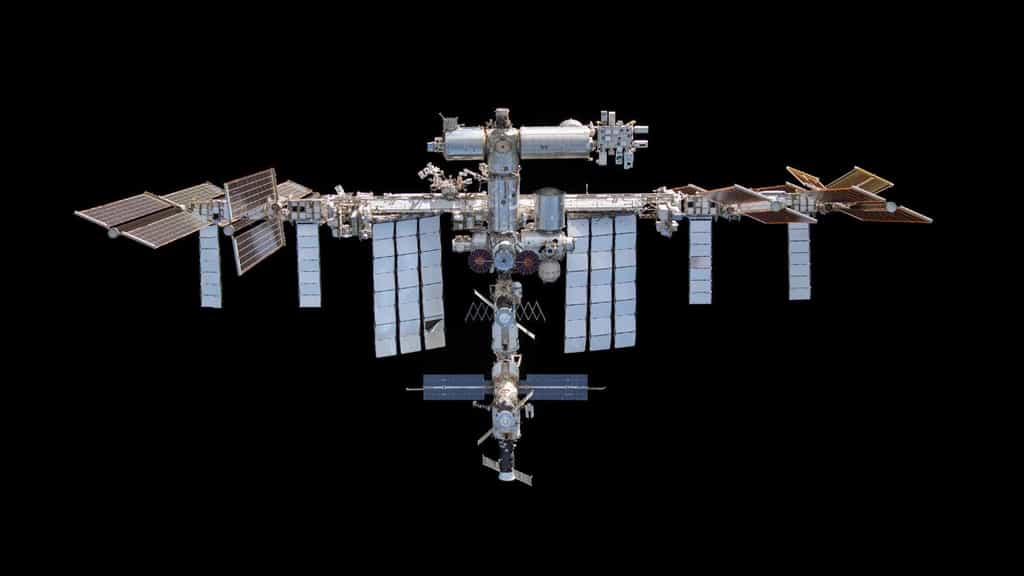
Over 280 astronauts from 26 nations have visited the station, with 170 hailing from the United States. Spanning 356 feet in length, the ISS is larger than a six-bedroom house, offering amenities like six sleeping quarters, two bathrooms, a gym, and a unique bay window with a 360-degree view. (Image: NASA)
For the first time in the history of the International Space Station (ISS), a crew will return to Earth due to a medical condition. Nasa has announced that it will bring four astronauts home from the ISS earlier than anticipated. Though the SpaceX Crew-11 mission was impacted by the unprecedented decision, the organisation clarified that there is no emergency.
The announcement was made on January 8, after Nasa confirmed that one member of the Crew-11 team experienced a medical issue while in orbit. Officials said that the astronaut is in stable condition and is not in immediate danger. However, Nasa determined that the most appropriate course of action was to accelerate the crew’s return so the individual could receive more comprehensive medical evaluation and care on Earth.
“This is not an emergency de-orbit,” Nasa Administrator Jared Isaacman said during a press briefing. He explained that while Nasa always maintains the capability to carry out an urgent return if needed, this situation does not warrant that level of response. Instead, the agency concluded that the full range of diagnostic and treatment options required for the condition is not available aboard the ISS.
Crew-11 is made up of Nasa astronauts Zena Cardman and Michael Fincke, Japan Aerospace Exploration Agency astronaut Kimiya Yui, and Roscosmos’ Oleg Platonov. The four launched to the ISS on August 1, 2025, aboard the SpaceX Crew Dragon Endeavour spacecraft and were nearing the end of their planned six-month mission when the medical concern emerged.
Nasa officers indicated that the timing played a role in the decision. According to Isaacman, the crew has already completed nearly all of its mission objectives, and the next scheduled ISS mission, Crew-12, is expected to launch within weeks. With the spacecraft ready and suitable weather windows approaching, Nasa judged it an appropriate moment to adjust the return timeline in the interest of crew health.
The medical issue first came to light a day earlier, on January 7, when NASA announced the postponement of a scheduled spacewalk that was to be carried out by Cardman and Fincke. At the time, the agency cited a “medical concern” without providing further detail.
On Thursday, Nasa’s chief health and medical officer, Dr James Polk, clarified that the issue was not related to spacewalk activities or any operational task.
“This was not an injury sustained during operations,” Polk said during a press meeting, noting that the challenges of diagnosing certain medical conditions are compounded by the microgravity environment and the limited diagnostic tools available on the ISS. For privacy reasons, NASA has not disclosed which crew member is affected or the nature of the condition.
While the announcement may sound dramatic, Nasa officials noted that the absence of a prior medical evacuation from the ISS is unusual rather than reassuring. Statistical models suggest such situations could be expected once every few years, Polk said, making this first occurrence more a reflection of careful planning and preparedness than a cause for alarm.
Details of the Crew-11 return schedule have not yet been finalised, though Nasa said an update is expected in the coming days. After the crew departs, the ISS will likely operate temporarily with a reduced crew of three: Nasa astronaut Christopher Williams and Russian cosmonauts Sergey Kud-Sverchkov and Sergei Mikayev, who arrived aboard a Soyuz spacecraft in late November.
Williams will be the only American on the station during that period, a responsibility Nasa officials said he is fully prepared to handle. With extensive ground support from mission control teams around the world, the agency remains confident that operations and research aboard the ISS will continue safely until the next crew arrives.
Editorial Context & Insight
Original analysis & verification
Methodology
This article includes original analysis and synthesis from our editorial team, cross-referenced with primary sources to ensure depth and accuracy.
Primary Source
The Indian Express