UPSC Weekly Quiz is a current affairs-based quiz on relevant topics from the past week, curated for the aspirants of competitive examinations. Attempt the weekly quiz every Saturday and find answers to the MCQs with explanations.
🚨 Click Here to read the UPSC Essentials magazine for December 2025. Share your views and suggestions in the comment box or at manas.srivastava@indianexpress.com🚨
With reference to the ‘eurozone’, consider the following statements: 1. Currently, 25 out of 27 EU members are members of the eurozone.
2. It refers to the geographic and economic region comprising those members of the EU that have fully adopted the euro as their official currency.
3. Membership in the eurozone eliminates currency exchange costs within the region.
4. All EU member states are eligible to join the eurozone. How many of the statements given above are correct?
— Bulgaria, the poorest member of the European Union (EU), became the 21st member of the eurozone, bringing it closer to full European integration. This comes amidst marked political instability and widespread domestic opposition, especially by pro-Russian parties. Hence, statement 1 is not correct.
— The Maastricht Treaty of 1992, which established the European Union, paved the way for: (i) The formation of a common economic and monetary union, which is the European Economic and Monetary Union
(ii) The adoption of a common currency, which would be accepted as the sole legal tender, the euro.
(iii) A unified central banking system, which established the European Central Bank (ECB).
(iv) A common economic region.
— The eurozone, or officially the euro area, refers to the geographic and economic region comprising those members of the EU that have fully adopted the euro as their official currency. Hence, statement 2 is correct.
— Bulgaria’s admission to the eurozone makes it the 21st nation out of 27 EU members to do so. The remaining six use their own currencies instead.
(i) The euro allows consumers in its member nations to compare prices with other members, boosting competitiveness.
(ii) Members enjoy price stability within the region, as the ECB typically targets a 2% inflation rate.
(iii) Membership in the eurozone also eliminates currency exchange costs within the region, and members are insulated from external shocks owing to the sheer size of the eurozone economy. Hence, statement 3 is correct.
— All EU member states – barring Denmark, which has availed an opt-out – are required to join the eurozone, and satisfy certain “convergence criteria”, which ensure that the aspiring member converges with the other members in economic and legal terms. Hence, statement 4 is not correct.
Therefore, option (b) is the correct answer.
The Sabarimala Temple was recently in the news due to the probe into alleged malpractices involving the gold and valuables. It is located in: — The SIT initially reported two cases regarding missing gold from the “dwarapalaka” idols and the door frames of the temple’s sanctum sanctorum to the court, it has now stated in a report submitted to the vigilance court in Kollam that the scandal is not limited to two artefacts.
With reference to the carbon border adjustment mechanism (CBAM), consider the following statements: 1. The European Union implemented the CBAM in its definitive regime from January 1, 2026.
2. In its current form, CBAM would apply a carbon-related charge to the import of goods.
3. Fertilisers have been excluded from the CBAM.
— The European Union on January 1 began implementing the world’s first carbon tax under the carbon border adjustment mechanism (CBAM), which has antagonised much of the developing world, including India, as the controversial trade-environment measure will impose a levy on carbon-intensive goods entering the EU.
— CBAM will apply in its definitive regime from 2026, with a transitional phase of 2023 to 2025. Hence, statement 1 is correct.
— In its current form, CBAM would apply a carbon-related charge to the import of goods from the power sector and energy-intensive industrial sectors, such as cement, steel, aluminium, oil refinery, paper, glass, chemical and fertilisers from countries with lower environmental ambitions and regulations than the European Union. However, it has provisions for the bloc’s lawmakers to expand the list of items that will bear a levy. Hence, statement 2 is correct and statement 3 is not correct.
— India largely exports aluminium, iron and steel to the EU, which are expected to be impacted due to the regulation.
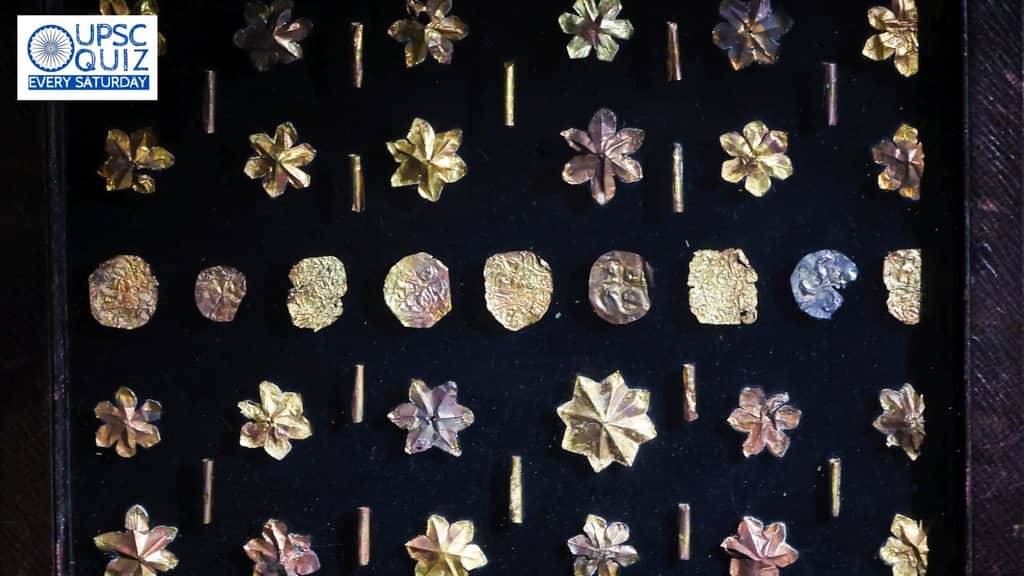
The Piprahwa Gems were unearthed in 1898 by William Claxton Peppé, an English estate manager, at: (a) Tawang Monastery, Arunachal Pradesh
(b) Kapilvastu Buddha Stupa, Uttar Pradesh
— The antiquities include a collection of 349 gemstones, which were unearthed in 1898 by William Claxton Peppé, an English estate manager, at a Buddhist stupa (Kapilvastu Buddha Stupa) in Piprahwa, a village in UP’s Siddharthnagar district, near the border of Nepal.
— Most of the gems and precious metals, comprising nearly 1,800 pearls, rubies, topaz, sapphires, and patterned gold sheets, went to what is now the Indian Museum in Kolkata. However, a fifth of the total find, including duplicates of the main collection, was retained by Peppé.
— These gems were passed down for generations in the Peppé family and were put up for auction by Chris Peppé in 2013. The gems had been listed for auction last May by Sotheby’s Hong Kong, which had an estimated selling price of over $100 million.
Which of the following have been connected by the Indian Railways to the rest of the grid?
— The railways also crossed the new Pamban Bridge — India’s first vertical-lift railway sea bridge — over the azure waters of the Palk Strait, connecting Rameswaram to the Indian mainland in the South. And in the West, the first-ever rail car was run on the newly laid 102-km track from Vaitarna to Jawaharlal Nehru Port (JNPT) on the ambitious Western Dedicated Freight Corridor (WDFC).
— Kohima and Gangtok are not yet connected to the main grid.
With reference to the Cetacean morbillivirus, consider the following statements: 1. It is infectious among marine mammals.
2. It impacts the respiratory and neurological systems and can lead to mass strandings and deaths.
3. The virus does not transmit through direct contact or respiratory droplets.
4. Cetacean morbillivirus had not been detected in Arctic waters.
— A team of scientists has now come up with an innovative method to study whales. The researchers have used drones to collect samples from the breath of wild whales living in the Arctic. This helped them to detect a disease-causing virus linked to mass strandings of whales and dolphins worldwide. It is the first time that the virus — called cetacean morbillivirus — has been found circulating in Arctic waters. Hence, statement 4 is not correct.
— Cetacean morbillivirus is infectious among marine mammals such as dolphins, whales, and porpoises. Since its discovery in 1987, this virus has been responsible for numerous outbreaks across the world, especially in the North Atlantic and the Mediterranean. It impacts the respiratory and neurological systems of the marine mammals, and can lead to mass strandings and deaths. The virus can jump between species through direct contact and respiratory droplets. Hence, statements 1 and 2 are correct and statement 3 is not correct.
— Cetacean morbillivirus had not been detected in Arctic waters for the longest time. Now, by testing the blow samples, the scientists involved in the new study have found it in two humpback whale groups in northern Norway, a sperm whale showing poor health, and a stranded pilot whale.
With reference to the exchange traded funds (ETFs), consider the following statements: 1. An ETF pools a group of securities into a fund and can be traded like an individual stock on an exchange.
2. In 2025, Indians’ investments in gold and silver ETFs witnessed a decline.
3. Gold and Silver ETFs together constitute a very low share of the total passive fund flow.
— An exchange-traded fund (ETF) is a fund that pools a set of securities and may be traded on an exchange similarly to individual stocks. Hence, statement 1 is correct.
— ETF share values fluctuate throughout the trading day, whereas mutual funds only trade once a day after the market closes.
— Indians’ investments in gold and silver exchange traded funds (ETFs) — mutual funds that invest in these commodities — have indeed been on the rise. Data from the Association of Mutual Funds in India (AMFI) shows that inflows into just silver ETFs in September stood at Rs 5,342 crore. A year earlier, the inflows were likely much smaller considering AMFI didn’t even disclose the number back then. Hence, statement 2 is not correct.
— “Gold and Silver ETFs together constitute 71.9 per cent of the total passive fund flow, highlighting investors’ growing preference for precious metals as a portfolio diversifier amid global market volatility,” AMFI had said in its monthly note for September. Hence, statement 3 is not correct.
— Conventional rice farming involves preparing nurseries where the paddy seeds are sown and raised into young plants. These seedlings are then uprooted and replanted 25-30 days later in the main field, which is about 10 times that of the nursery seedbed area.
— The normal crop duration after transplantation is 90-100 days, going up to 120 days and more in some varieties. Over a typical 90-100-day cropping period, the field is kept under flooded conditions for the first 65 days or so.
— The continuous flooding – maintaining a water depth of 4-5 cm – is done mainly to suppress weeds. The standing water creates an anaerobic environment, depriving the weed seeds of oxygen to germinate and grow. The need for such flooding reduces after 65 days, when the paddy crop’s vegetative growth and tillering stage is completed, and the panicles (flower clusters from which the grains develop) start forming inside the stem.
— Under AWD, the paddy fields, instead of being constantly flooded, are periodically dried out before re-flooding. The idea is to disrupt the waterlogged anaerobic conditions conducive to methane-producing microbes.
With reference to the staphylococci, consider the following statements: 1. They are spherical viruses.
2. They are found on skin and mucous membranes.
3. They can cause infections, ranging from minor skin issues to severe illnesses like pneumonia.
Which of the statements given above is/are correct?
— Staphylococci are spherical bacteria, also known as “staph.” They are found in clusters on the skin and mucous membranes, including inside our nasal passages. Hence, statement 1 is not correct and statement 2 is correct.
Methicillin-resistant Staphylococcus aureus (MRSA) bacteria colourised scanning electron micrograph of methicillin-resistant Staphylococcus aureus (MRSA) bacteria (gold) interacting with a human neutrophil [NIAID’s Rocky Mountain Laboratories (RML) in Hamilton, Montana]. [Photo: Unsplash]
— They can cause infections ranging from simple skin problems (boils, pimples) to serious illnesses such as pneumonia, sepsis, or MRSA (methicillin-resistant Staphylococcus aureus, an antibiotic in the penicillin family). They can cause wound infections, soft tissue infections, styes, burns, endocarditis (inflammation of the heart’s inner lining), and septicaemia. Hence, statement 3 is correct.
— They enter the body, often through wounds or contaminated items, with transmission through direct contact or shared items. The most alarming bit about the study is that we are breathing many kinds of staphylococci, particularly in crowded areas, slum clusters, densely populated areas and around some hospitals. It is found in both animals and humans and we release them into the air when we breathe or cough. The higher the particulate matter (PM2.5, PM10), the higher the number of bacteria that sticks to them. The particles act as carriers for bacteria, facilitating their transport in the atmosphere, enhancing their toxicity or ability to invade host cells and triggering respiratory infections.
— The government has banned the manufacture, sale and distribution of nimesulide, a common pain and fever medication, in all oral “immediate release” formulations above the dosage of 100 mg, saying it poses a health risk.
— In a notification, the Ministry of Health and Family Welfare said the Central government is “satisfied that the use of all oral formulations containing Nimesulide above 100 mg in immediate release dosage form is likely to involve risk to human beings and that safer alternatives to the said drug are available”. It said it is “necessary and expedient in the public interest to prohibit the manufacture, sale and distribution of the said drug in the country for human use.” The notification specifically listed, “All oral formulations containing Nimesulide above 100 mg in immediate-release dosage form.”
Stay updated with the latest UPSC articles by joining our Telegram channel – IndianExpress UPSC Hub, and follow us on Instagram and X.
Editorial Context & Insight
Original analysis & verification
Methodology
This article includes original analysis and synthesis from our editorial team, cross-referenced with primary sources to ensure depth and accuracy.
Primary Source
The Indian Express