2025 was a successful year for the Azerbaijan-Armenia reconciliation process. On 8 August, the two sides signed essential documents in Washington, when their leaders met at the White House. Expressing their commitment towards peace, they are aiming to end decades of conflict and move toward full normalization. This process will continue next year.
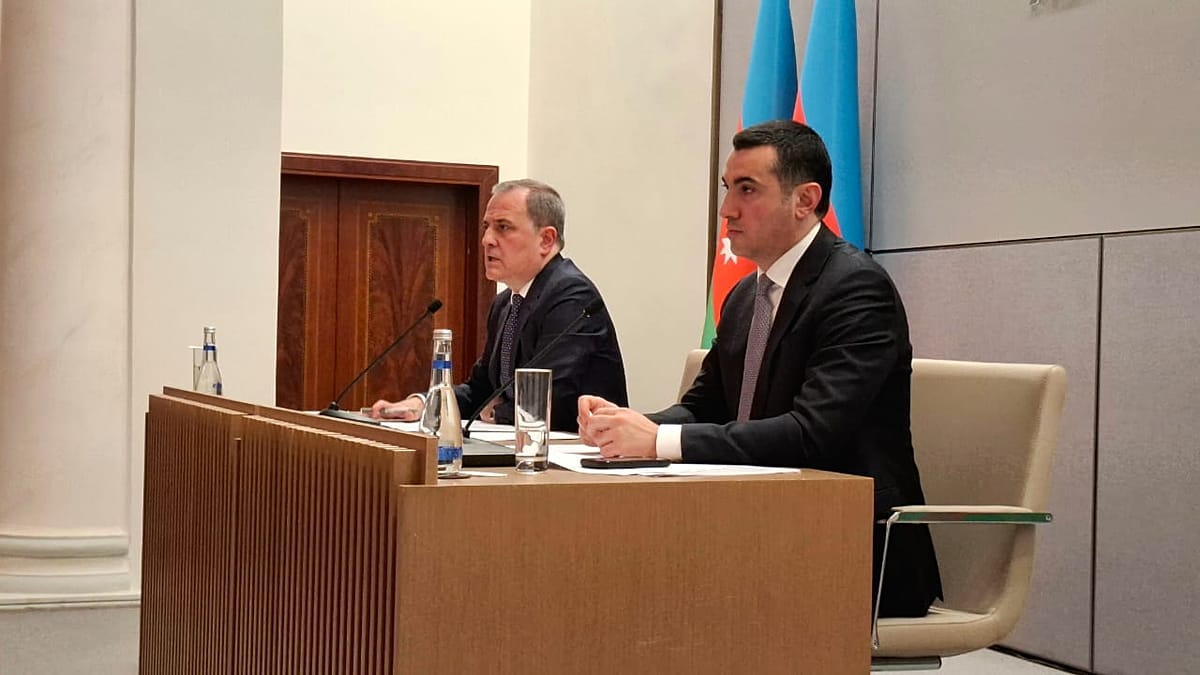
Baku outlined what to expect in the Azerbaijan-Armenia normalization process next year during the annual press conference held by the Azerbaijan Foreign Ministry. Talking to the press, Minister of Foreign Affairs Jeyhun Bayramov clarified issues, including petroleum exports, applied tariffs, border delimitation and mutual visits of Azerbaijanis and Armenians.
Recently, Azerbaijan began exporting fuel to Armenia by rail through Georgia, marking the first such export in decades.
"We are currently creating something from scratch”, Bayramov told the journalists. “The Armenian side's appeal was related to oil products, and the Azerbaijani side accepted it”.
Speaking about the possibility of expanding economic relations, he added that when Azerbaijani oil entered Armenia, there were calls against it on the Armenian side, but they were “marginal”. Overall, Jeyhun Bayramov considers trade between Azerbaijan and Armenia possible in other areas as well.
The first train carrying fuel produced in Azerbaijan was delivered to Armenia crossing the Georgian border, which initially proved difficult, the minister explained. "The tariff proposed by Georgia was very high. This raised questions on the Azerbaijani side, because the proposal did not correspond to existing practice. However, as soon as the Georgian leadership learned about the issue, they intervened and the situation changed. The issue of tariffs was resolved, and tariffs in accordance with market conditions are being agreed between companies."
The Georgian side has officially confirmed that no fee will be charged for the first time of transit, while the fee for future transportation has not yet been announced.
There are still outstanding issues on the ground and one of those is infrastructure of TRIPP (Trump Route for International Peace and Prosperity) – an initiative aimed at connecting the countries and regions.
Although an agreement to establish a rail connection between the western regions of Azerbaijan and the Nakhchivan Republic was reached in 2020, but the second Karabakh War halted proceedings. Currently, Azerbaijan is creating all necessary infrastructure for this project.
To connect the rails, Armenia also needs to develop this infrastructure on its territory. To enable this, Armenia is engaged in bilateral negotiations with the United States. These talks focus on creating the legal framework, regulatory mechanisms, and institutional setup necessary for the project’s implementation. Regarding the Azerbaijani side, Bayramov told the journalists that “in 2026, the railways will reach the Armenian border”.
But trade is not the only area showing positive dynamics between the countries. Over the past few months, there have been several mutual visits at expert level, bringing hope for further expansion of these contacts in the future.
"Experts and international centres have already visited Armenia and Azerbaijan twice. Certain progress has been observed in the direction of cooperation and mutual understanding as a result of these visits. We expect these processes to continue in 2026," the minister reported.
Meanwhile, the border delimitation process continues as part of ensuring security and long-term peace, both in meetings and on the ground. About 12 kilometers of the Azerbaijani-Armenian border have already been delimited. During this period, significant progress has been made, and related regulations have been approved.
All sides agreed that the delimitation process will be carried out from North to South starting from the Azerbaijan-Armenia-Georgia trilateral border point and ending at the Azerbaijan-Armenia-Iranian border. “The delimitation process will be carried out in parts. The enclave-exclave issue will find their solution in the context of the delimitation process,” the minister concluded.