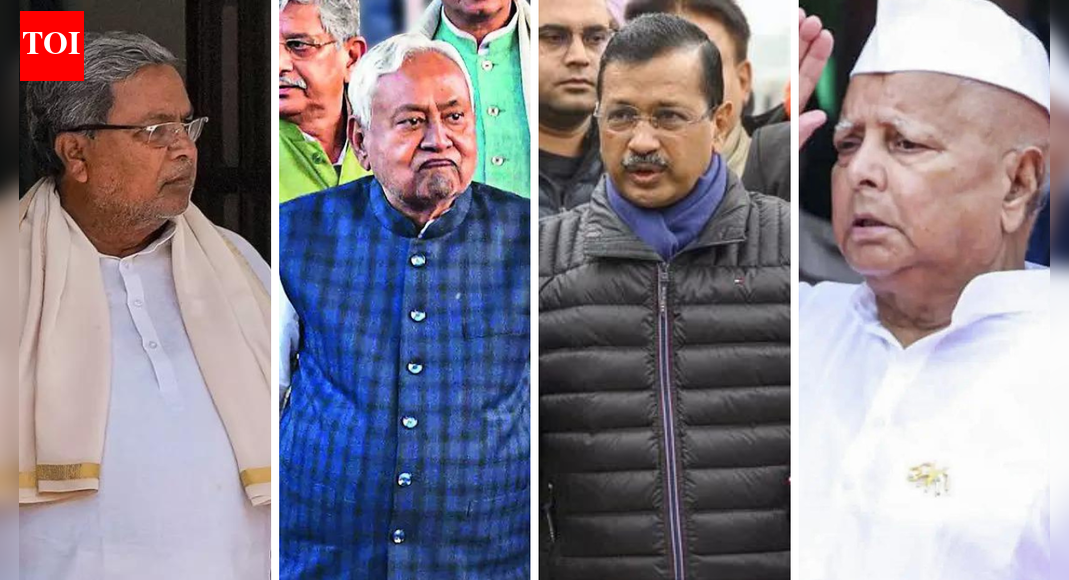
NEW DELHI: It has been a year bookended by elections. It started with the intense campaigning for the Delhi assembly elections and ended with the surprising results of Bihar. In between, there were parliamentary showdowns, infights and figures emerging and fading away from the centre stage.In 2025, while several heavyweights failed to live up to expectations, many asserted their place back in, proving themselves the dark horses of Indian politics.The year was also a reminder that power is rarely static — and that survival often matters as much as victory.
So, who were the winners and losers in politics in 2025? Here's a look.
Nitish KumarAhead of the Bihar assembly elections, the opposition was in a hurry to write the political obituary of chief minister Nitish Kumar.
Throughout the campaign, Nitish’s former deputy and RJD scion Tejashwi Yadav claimed that the chief minister was "mentally unfit" and "too old" to govern the state.Additionally, political pundits were also skeptical about Nitish’s return. They flagged anti-incumbency and infighting within the NDA to argue that the odds were stacked against him.
However, the results presented a different picture. Bihar once again handed a sweeping mandate to the NDA, extending Nitish Kumar’s two-decade-long hold on power.
The NDA secured a thumping majority, winning 202 seats in the 243-member House.Within the NDA, the BJP emerged as the strongest performer, securing 89 seats -- its best-ever result in the state -- followed by Nitish Kumar’s JD(U) with 85 seats.SiddaramaiahAs the Congress government reached the halfway mark in Karnataka on November 20, talk of a secret agreement became public. Several MLAs and MLCs from deputy chief minister DK Shivakumar’s faction camped in Delhi to press the party high command to honour the “deal” and make him chief minister for the next two and a half years.DKS added fuel to the speculation after he confirmed the “secret deal,” claiming that there had indeed been “a confidential understanding on leadership transition among five or six leaders” soon after the Congress won a landslide in the 2023 elections.
This triggered one of the most cordial tussles between chief minister Siddaramaiah and his deputy. The two leaders even sat down for breakfast meetings to reach an understanding, but the question over the chief ministerial post remained unanswered.For now, the standoff appears to have eased. Siddaramaiah seems to have bought more time from the high command, while DKS appears to have chosen to wait it out, with both leaders refraining from making any public remarks on the issue.Nitin NabinBihar MLA Nitin Nabin’s elevation as the working president of the Bharatiya Janata Party was a rise that few saw coming. While political pundits were speculating about the names of bigwigs with strong RSS links, Nabin’s appointment marked a major organisational shift at the top of the ruling party.Although he is only 45 years old, Nabin is a five-term MLA and has handled several key organisational responsibilities. He served as the Bihar president of the Bharatiya Janata Yuva Morcha from 2016 to 2019 and managed the BJP’s Lok Sabha and assembly campaigns in Sikkim in 2019, before being appointed co-incharge of Congress-ruled Chhattisgarh in 2021.At a time when the Congress was considered the frontrunner to retain power in the 2023 Chhattisgarh assembly polls, Nabin’s inputs to the BJP leadership predicted victory, which ultimately came true.Caste arithmetic also aligns with Nabin’s elevation as party president. The choice of Nabin, an upper-caste Kayastha -- a community that constitutes barely 0.6% of Bihar’s population and is considered politically insignificant in the state -- is significant because Kayasthas are among the key castes in West Bengal, where assembly elections are scheduled for May next year.Welfare schemes targeting womenPolitical mobilisation of the women vote bank through welfare schemes saw its peak in the 2025 Bihar assembly elections.
Just days ahead of the elections, Prime Minister Narendra Modi rolled out the Mukhya Mantri Mahila Rojgar Yojana, which credited Rs 10,000 to the bank accounts of 1.2 crore women. Additionally, social security schemes like free electricity up to 125 units and a pension increment were also announced by chief minister Nitish Kumar in the run-up to the elections.
This translated into the polling booths as women voters outnumbered men and shattered turnout records.
While the overall turnout stood at 66.91 per cent, an extraordinary 71.6 per cent of women cast their votes -- nearly nine percentage points higher than the 62.8 per cent turnout among men.This overwhelming participation tilted the mandate toward the NDA, boosted by welfare schemes for women. The contrast between the two alliances was simple: the NDA had already delivered the benefit, while Mahagathbandhan’s offer remained a campaign promise.
For many women, that difference -- money already in the bank versus a promise of future help -- mattered.Chirag PaswanAt a time when stars are not aligning for Dalit leaders like Mayawati and Jitan Ram Manjhi, Lok Janshakti Party (Ram Vilas) chief Chirag Paswan emerged as the third hero in the NDA's success in Bihar.LJP(RS) won 19 out of 29 seats, propelling the NDA past the 200-seat mark.
Chirag’s dominance in Bihar and within the NDA was evident even during the seat-sharing talks, when his party got a fair share despite only one of its 143 candidates winning during the 2020 assembly polls.
His bargaining power came from the 2024 Lok Sabha elections, when LJP(RV) won all five seats it contested.
CongressThe fortune wheels did not spin for Congress this year either, as 2024 was marred with poll routs and infighting for the party. Wounded by the defeats in Haryana and Maharashtra in 2024, the grand old party continued its lackluster performance in 2025.It began with the poll rout in the Delhi assembly elections, where Congress could not win even a single seat.
In addition to the poll results, it also suffered an alliance breakup as collateral damage after the Aam Aadmi Party decided to walk away from the INDIA bloc.In the Bihar assembly elections, Congress experienced its steepest decline after it managed to win only six seats. Rahul Gandhi travelled over 1,300 kilometres to galvanise voter support but fell flat in comparison to the local issues that resonated more strongly with Bihar's electorate.Meanwhile, the party encountered another crisis in Karnataka after a tussle broke out between Siddaramaiah and DK Shivakumar over the chief ministerial post. Although the situation seems defused for now, the party is sitting on a ticking time bomb that may detonate soon.Moreover, several Congress leaders flagged serious problems within the party. One of them was former Odisha MLA Mohammed Moquim, who wrote to Sonia Gandhi, calling for an “open-heart surgery” in the party and flagging a growing disconnect between the leadership and its workers.
In his letter to Sonia Gandhi dated December 8, ex-Odisha MLA Mohammed Moquim highlighted six consecutive election losses in Odisha and three in the Lok Sabha while also questioning the selection of Mallikarjun Kharge as the party's leader, claiming that the 83-year-old veteran “is unable to resonate with India's youth.”Lalu clan2025 was a year of autumn for the Lalu clan. Lalu Yadav, along with his family and party, had to suffer setbacks throughout the year.
In the Bihar elections, the party only won 25 seats in the assembly elections, registering one of its poorest performances.Soon, things went south on the family front as well. Just days after the poll results, Rohini Acharya -- the second of RJD chief Lalu Prasad's nine children and the donor of the kidney that saved him -- announced that she was quitting politics and “disowning” her family.
Reportedly, Rohini had a heated argument with her brother Tejashwi Yadav over RJD's assembly election disaster.
She also alleged she was accused of donating a “dirty kidney” to her father after “extracting crores of rupees and a Lok Sabha ticket.”Earlier, Lalu had expelled his eldest, Tej Pratap Yadav, from the party for six years after he shared a photo with a woman on Facebook and claimed he had been in a relationship with her for 12 years.Later, Tej Pratap went on to form his own party -- Jan Shakti Janta Dal -- which drew a blank in the assembly elections.Prashant KishorPrashant Kishor, once hailed as India’s top election strategist, entered the Bihar polls as a political aspirant and walked out as its biggest loser.After a two-year padyatra across Bihar and massive media hype around Jan Suraaj, Kishor positioned himself as a transformative alternative to both the NDA and the Mahagathbandhan. However, Jan Suraaj did not manage to win a single seat, losing security deposits in the majority of the constituencies where it fielded candidates.However, PK has repeatedly said that he won’t back down. His next test comes much sooner than 2030 -- the panchayat elections in 2026 -- where he may attempt to make a comeback.Arvind KejriwalAfter two sweeping victories in 2015 and 2020, Kejriwal's AAP was swept out of power in the 2025 Delhi assembly elections. Of the 70 assembly constituencies, the BJP clinched 48 seats, while AAP managed to secure only 22.Adding insult to injury, Kejriwal also lost the New Delhi seat to BJP's Parvesh Verma.
Rising to power as an anti-graft crusader, Kejriwal found himself embroiled in corruption cases days ahead of the elections.After walking out of jail on bail, Kejriwal resigned from the top post, seeking validation from the public of Delhi. The union territory, however, refused to give the stamp of 'Mr Clean' to Kejriwal.DK ShivakumarDespite pulling every trick in the book, DK Shivakumar failed to replace Karnataka chief minister Siddaramaiah.
After the tussle came out in the open, DKS made several trips to Delhi, but the high command has not budged.
DKS checked all the criteria to become the Karnataka CM. He generated funds for the party during the elections, and Vokkaliga seers -- one of the strongest sects in Karnataka -- are also backing him. Additionally, the majority of Congress MLAs are on his side.Despite this, DKS has decided to take a step back, obey the party high command and wait for the right time to come as the high command huddles in Delhi to deliver an answer.Honorable mention: Shashi TharoorThrough his charm and “Tharoorosaurus,” Congress MP Shashi Tharoor remained in the headlines throughout the year. Another reason he grabbed eyeballs was his standoff with his own party on different occasions. Despite being a member of the CWC, the Thiruvananthapuram MP skipped several important party meetings and refused to toe the party line on multiple issues. This irked many senior leaders of the grand old party, leading to repeated to-and-fro exchanges on social media platforms and in media bites.It all began after Shashi Tharoor emerged as one of the prominent voices articulating New Delhi’s position following the Pahalgam terror attack and India’s Operation Sindoor. Later, the Centre invited him to lead an Indian delegation as part of a global outreach after Operation Sindoor, even as the Congress was raising tough questions for the government. This did not go down well with his party colleagues, who accused him of cosying up to the BJP.However, just ahead of the Kerala assembly elections, the Congress is finding it difficult to take strict disciplinary action against a popular leader in the state, effectively giving Tharoor a free lane to drive on the wrong side.Now, it is yet to be determined whether Tharoor came out as a winner or a loser after the tug-of-war session with his own party.