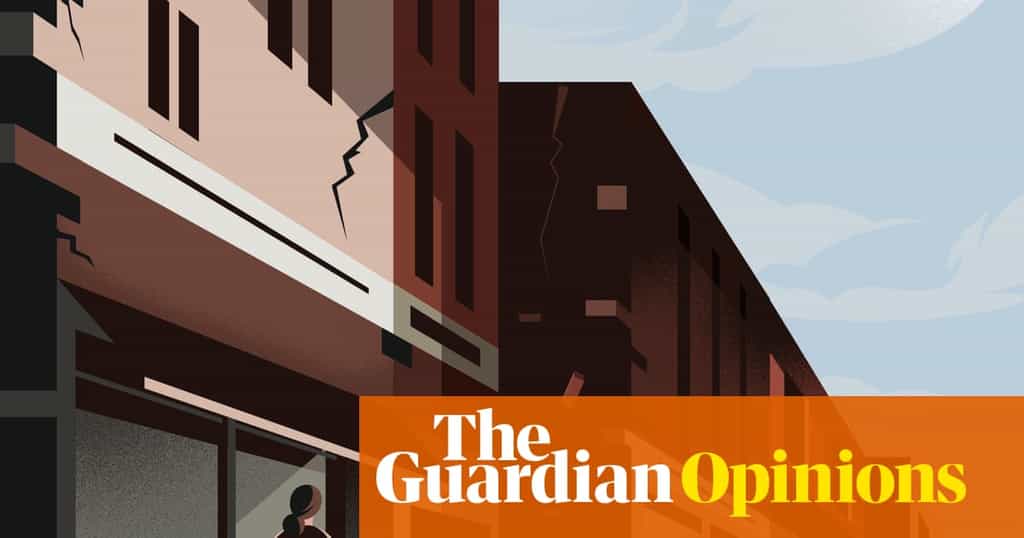
Over Christmas, thousands of people must have had much the same experience: a trip to see friends or relatives somewhere familiar, and the realisation that a once-thriving town centre is dangerously close to the economic point of no return, and a future of eerie silence.
The massed emptying-out of places has been going on since the crash of 2008, but the latest chapter of the story is dramatic. In 2024, the UK lost about 37 shops a day: almost 13,500 retail stores closed for good – including branches of Lloyds Pharmacy, The Body Shop and Ted Baker – which was a rise of 28% on 2023. What we know so far about 2025 is of a piece: thousands of shops owned by major retail businesses closed their doors, and the list is full of equally familiar names – among them Fired Earth, New Look and the beauty chain Bodycare. Even some of the high street’s staples are on their way out, as evidenced by the closure of Poundland shops, and news that even charities are leaving: Cancer Research UK, for example, plans to close about 90 of its shops by May, with up to 100 more to go by April next year.
Ghostly memorials to past closures remain empty: witness the huge buildings that are still vacant after the implosion of Debenhams in 2021. But perhaps the most heartbreaking stories are those of archetypal local businesses that weathered plenty of past economic storms, but have now given up. Trowbridge, the county town of Wiltshire, has a perfect example: the wonderfully named HJ Knees, a home and electrical business that has traded for nearly 150 years, but has now closed its physical outlet on a local trading estate, where it moved from the town centre 12 years ago. The reasons? The rise of online shopping, rising business rates and, according to the store’s general manager, a lack of support for independent retailers.
Woven into the fate of town and city centres is something that a lot of progressives avert their eyes from. As many high streets have become dead zones, organised criminals have moved in. Late last year, the National Crime Agency launched a month-long series of raids on 2,734 high-street shops, seizing more than £10.7m in suspected criminal proceeds. It pointed out how much this part of the illicit economy is about “modern slavery and unsuitable living and working conditions”. The security minister, Dan Jarvis, talked of “dodgy shops as fronts for serious organised crime, money laundering and illegal working”.
This has presented yet another opportunity to the chancers in charge of Reform UK, who have been campaigning for more than a year about what they call a “high street emergency”. In 2024, the party’s deputy leader, Richard Tice, said that many recently opened barber shops were “fronts for money laundering and drug money” – and it was no coincidence that he made this claim at a launch for the party’s immigration policies. Back in November, the Sunday Times ran a long article headlined “Why the next election will be fought on our corrupted high streets”; research by the community-focused “think-do tank” Power to Change shows that Reform’s popularity strikingly correlates with the state of town centres.
The government well knows this, and is trying to help. The Pride in Place programme run by the Ministry of Housing, Communities and Local Government doesn’t target high streets specifically, but it includes boosting councils’ compulsory purchase powers to revive empty and decaying premises, and developing rent auctions that should bring new businesses’ costs down to a more affordable level. There is talk of empowering local authorities to “say no to new betting shops, vapes stores and fake barbers”. Some of the most deprived places in the UK are to receive £20m each for local regeneration. The plan is in essence a more imaginative iteration of the Tories’ old levelling up drive: the key problem is that it’s limited to only a small proportion of the places that urgently need to turn themselves around – and, pretty much by definition, no match for the economic storms that constantly rip through local economies.
There are two other big issues stifling attempts to revive places. One is Rachel Reeves’s habit of making the lives of grassroots businesses even harder: most notably, the hike in employers’ national insurance contributions. Given the importance of the hospitality industry to reviving many town centres – and the continuing demise of so many British pubs – there is also something mind-boggling about the fact that before its recent U-turn, the government was set on putting up business rates by 76% for the average hostelry, compared with 4% for large supermarkets (not unreasonably, shops and music venues are now loudly calling for the policy reversal to also apply to them). The other key difficulty centres on one of the UK’s defining issues: after so many years of cuts, local councils can barely meet their most basic responsibilities, let alone lead the reinvention of the places they run.
This is all hard, complicated stuff. The idea of most urban centres as retail wonderlands is long dead, and even after long years of decline, we still have only vague ideas of what the future ought to look like: bringing public services and education into former shopping districts, shifting a lot of the focus of housing policy from the periphery of towns into their old centres, and thinking seriously about local economies’ use of art and culture. But there are inspirational examples of how to begin to change places. Some are big projects with grand designs: in Stockton-on-Tees, for example, they have revived the town’s theatre, the Globe (the German electronic music pioneers Kraftwerk are playing there in the summer, which is quite a coup), and demolished a huge old shopping centre to make way for a new urban park, three times the size of Trafalgar Square, that will open in May.
Other stories are a bit less spectacular, but arguably even more inspiring. At Power to Change, a lot of attention is focused on the “ocean city” of Plymouth, and a brilliant social enterprise called Nudge, which has spent the past eight years putting long-empty buildings in the middle of the city to new uses. A former YMCA now houses 22 businesses; a large former shop is now a space for community groups, choir rehearsals and adult education; there are plans to use a huge space that was a cinema and nightclub before falling empty for 15 years for work spaces, exhibitions and a new music venue. It takes a hard-won mixture of philanthropic funding, social investment and public money to make these things real; achieving similar feats in more hollowed-out places would be challenging, to say the least. But what the story boils down to is clear: a lesson in letting people on the ground get on with it, not vainly pulling rusty levers in Whitehall.
We should never overlook these issues: people’s sense of a world rapidly spinning out of control, and the anger and bitterness that arise from it, are closely connected to the fate of the places where they live, and the very 21st-century stories – of corporate flight, organised crime and how online consumerism kills human contact – that define them. Unless that changes, the UK’s mood of stroppy resentment, and the rise of the nasty opportunists who trade on it, will only fester.
Editorial Context & Insight
Original analysis and synthesis with multi-source verification
Methodology
This article includes original analysis and synthesis from our editorial team, cross-referenced with multiple primary sources to ensure depth, accuracy, and balanced perspective. All claims are fact-checked and verified before publication.
Primary Source
Verified Source
Opinion | The Guardian
Editorial Team
Senior Editor
Dr. Elena Rodriguez
Specializes in Opinion coverage
Quality Assurance
Associate Editor
Fact-checking and editorial standards compliance