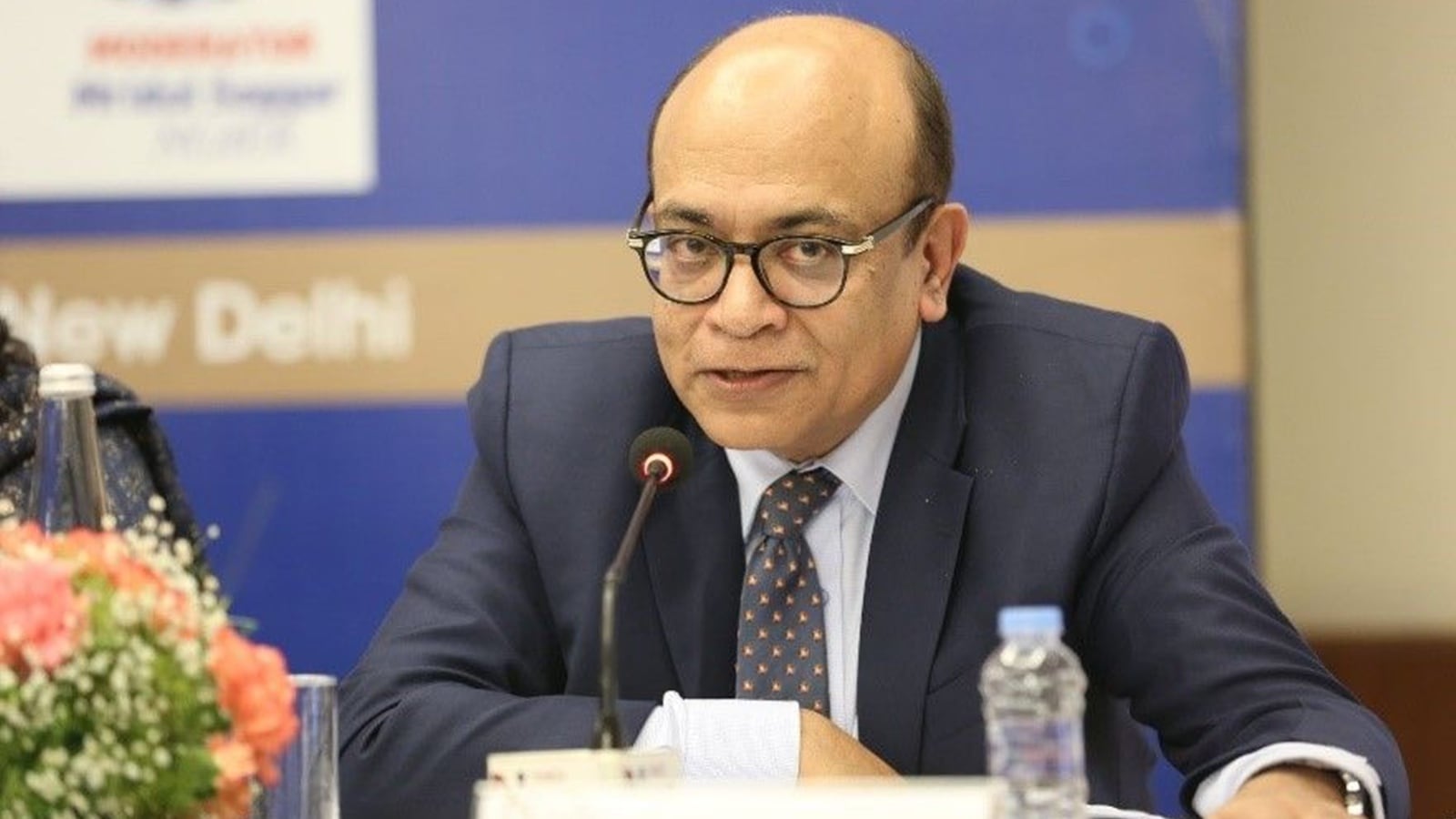
The International Monetary Fund’s (IMF) assessment of India’s official statistics should improve significantly once the ongoing review of the key macroeconomic indicators is complete, according to Mridul Saggar, Chairman of the Technical Advisory Committee on the Index of Industrial Production (IIP).
“We started this workshop with a note about IMF assessment. You wait for next year’s assessment – I am sure there will be a remarkable change in the assessment,” Saggar said on Tuesday at a workshop organised by the Ministry of Statistics and Programme Implementation (MoSPI).
Last month, the IMF had retained its overall ‘B’ grade on India’s official statistics and ‘C’ grade for the GDP data, while acknowledging the government’s ongoing effort to update data such as GDP and Consumer Price Index (CPI).
Noting that the IMF’s three main concerns had to do with the old base of the GDP, the lack of double-deflation method to compute real GDP, and statistical discrepancies, Narendra Kumar Santoshi, MoSPI’s Director General of Central Statistics, said at the workshop that the new data series were addressing these issues to the “best possible extent”. Commenting specifically on the new CPI series, which will be released on February 12, 2026, Santoshi said it will be “fully aligned with international standards”.
As part of the statistical overhaul, MoSPI is changing the basket of goods and services on which CPI inflation is calculated, along with several other methodological alterations. Currently, a basket based on the 2011-12 household consumption expenditure survey is used; this will be updated to a 2023-24 basket, with the base year being updated to 2024 from 2012. Further, GDP data is also set for a big revision, with the base year moving to 2022-23 from 2011-12 as well as new data sources being used to more accurately measure the final value of goods and services.
According to MoSPI Secretary Saurabh Garg, while its too early to comment on the impact of the various changes being made to the new GDP series – which will be released on February 27, 2026 starting with data for October-December – “we don’t expect much changes from what our previous expectations are”. BN Goldar, Chairman of the Advisory Committee on National Accounts Statistics responsible for making suggestions to revise the GDP data, added at the workshop that “we will produce as good an estimate as possible”.
The two latest GDP growth prints of 7.8 per cent for April-June and 8.2 per cent for July-September have led to economists raising questions about certain methodological aspects. While Chief Economic Advisor V Anantha Nageswaran said at the workshop that “half-baked” questions sow seeds of doubt in people’s mind about the numbers, Niti Aayog Vice Chancellor Suman Bery said it was important to have a “series of fierce and knowledgeable critiques” of the GDP methodology as that would lead to improvements. “I think the Indian public is owed a responsible discussion so that after this enormous amount of work, the issues of – within a range – the credibility of the data can be set aside,” Bery said.
As part of the IIP revision, which is used to calculate industrial growth, MoSPI has already released a discussion paper in which it has proposed to swap from its sample factories that have shut down with new ones. On Tuesday, officials from the statistics ministry said it is also being discussed if the fixed panel of factories used to calculate industrial production can be expanded every year. Another discussion paper on the same will be published for comments.
“The main criticism of the IIP has been divergence in NAS (National Accounts Statistics) growth, ASI (Annual Survey of Industries) growth, and IIP growth. But it should be noted that the ASI frame is revised and updated every year and using this frame ASI estimates are compiled. But for IIP, we have a fixed panel of factories… Some factories get closed and new factories may emerge with significant production, or a factory which was not selected in the base year may become a significant producer of an item. To account for this underestimation by IIP…it is proposed to augment the factories annually in the IIP compilation and align it with ASI numbers,” Ankita Singh, a Deputy Director General in MoSPI, said.
Mridul Saggar, head of the IIP review committee, added that the thinking at the moment was to add new factories in the panel only once a year and only in cases where it’s a “very significant effect coming from entirely new production processes or new, substantive production that might get missed. So, that call will have to be taken once a year and not as a rule, but as an exception, was our thinking.”
However, when asked if changes being made for the new IIP series will put to bed the criticism the data attracts, Saggar and Ila Patnaik – a member of the IIP review committee and Aditya Birla Group’s Chief Economist – said that was unlikely to be the case.
“To imagine that anything will solve all the problems is never going to be true because new ones will arise… The rapid change that you are seeing in the economy, it has to lead to new issues. When we look at what the rest of the world does or the guidance we have from international best practices, sometimes we actually don’t have that kind of guidance because no other country which is at our level of per capita income and so poor is growing so rapidly… But I think we are making a lot of progress,” Patnaik said.