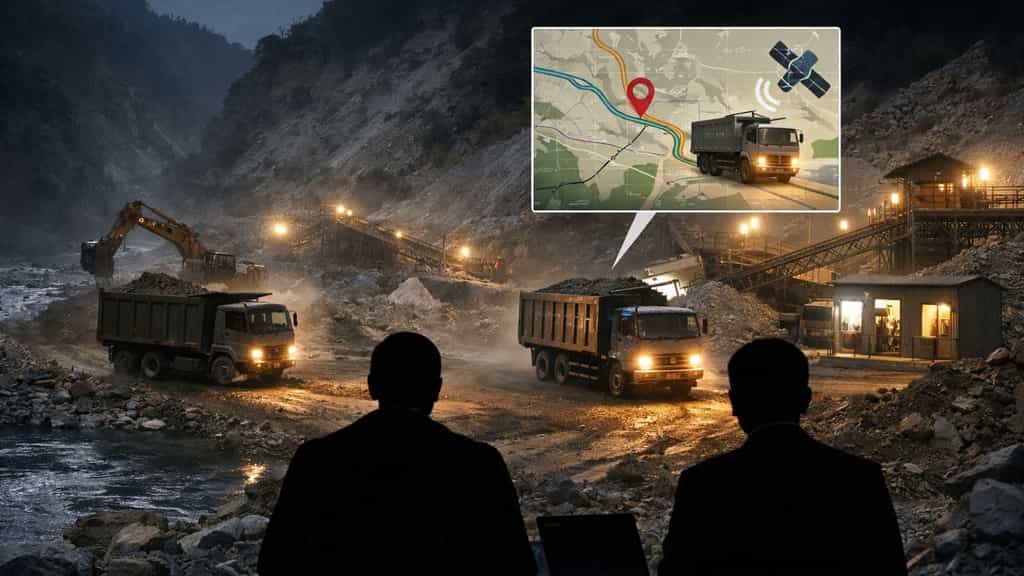
The Uttarakhand High Court has expressed serious dissatisfaction over the continued use of mining transport vehicles without GPS tracking in Bageshwar district, and has directed state officials to urgently find a technological solution and submit a detailed report to the court by January 13.
A bench of Chief Justice G Narendar and Justice Subhash Upadhyay was hearing a public interest litigation related to illegal mining and transportation of minor minerals in the district.
“The Secretary, Mining shall call upon the IT Department of the Uttarakhand Government and seek solution for the same and submit a report in this regard before this Court by 13.02.2026,” directed the bench.
The Uttarakhand High Court observed that unless all three systems were interconnected and GPS enabled, the department would not achieve the “desired results” in curbing illegal transportation of minerals. (File Photo)
The case stems from reports of alleged extensive and unregulated mining activities in both leased and non-leased areas of Bageshwar district, which allegedly led to land subsidence, cracks on hill slopes, landslides, choking of rivers and water bodies, and large-scale ecological degradation.
In 2025, the court took suo moto cognisance of the matter and, during the course of the hearing, was informed that a state-level committee headed by the additional director, Department of Geology and Mining, had inspected 61 mines and submitted a report flagging serious violations, including dumping of mining waste into rivers.
On being questioned, the district mining officer informed the court that applicants themselves filled in transport particulars online and did not opt for GPS enabling of the vehicles.
The bench was critical of this practice, remarking that it would “definitely not assist the department in any manner in regulating illegal transportation” of minerals.
Advocate Dushyant Mainali, amicus curiae in the matter, had submitted a report earlier which made a number of recommendations, including enabling the vehicles used to move mined material to be GPS enabled.
The court referred to Rule 7(2)(b) of the Minor Mineral Transportation Rules, which mandates that all vehicles used for transporting minerals must be GPS-enabled.
However, the bench noted that despite the clear requirement, vehicles without GPS were still being used on the ground.
“It is a matter of fact that presently even vehicles which are not GPS enabled are being used for transportation,” the court observed, questioning the effectiveness of enforcement by the authorities.
The bench further pointed out that merely insisting on GPS-enabled vehicles would not serve any meaningful purpose unless the entire monitoring system was technologically integrated.
The court noted that the e-Rawanna portal, weighbridges, and transport vehicles were operating independently, without any interlinking.
An e-Rawanna is an electronic transit pass system used by several state governments in Uttarakhand to regulate the transport of minerals from mining sites. It serves as a digital delivery challan required for the legal dispatch and movement of raw materials.
The court observed that unless all three systems were interconnected and GPS-enabled, the department would not achieve the “desired results” in curbing illegal transportation of minerals.
Another major concern flagged by the court was the inconsistent time granted for transportation through e-Rawannas for the same distance.
The bench recorded that for identical routes, permits were being issued with travel times ranging from one hour to five hours, and in some cases, even more.” Such discrepancies, the court said, compelled judicial intervention in the matter.
Editorial Context & Insight
Original analysis & verification
Methodology
This article includes original analysis and synthesis from our editorial team, cross-referenced with primary sources to ensure depth and accuracy.
Primary Source
The Indian Express