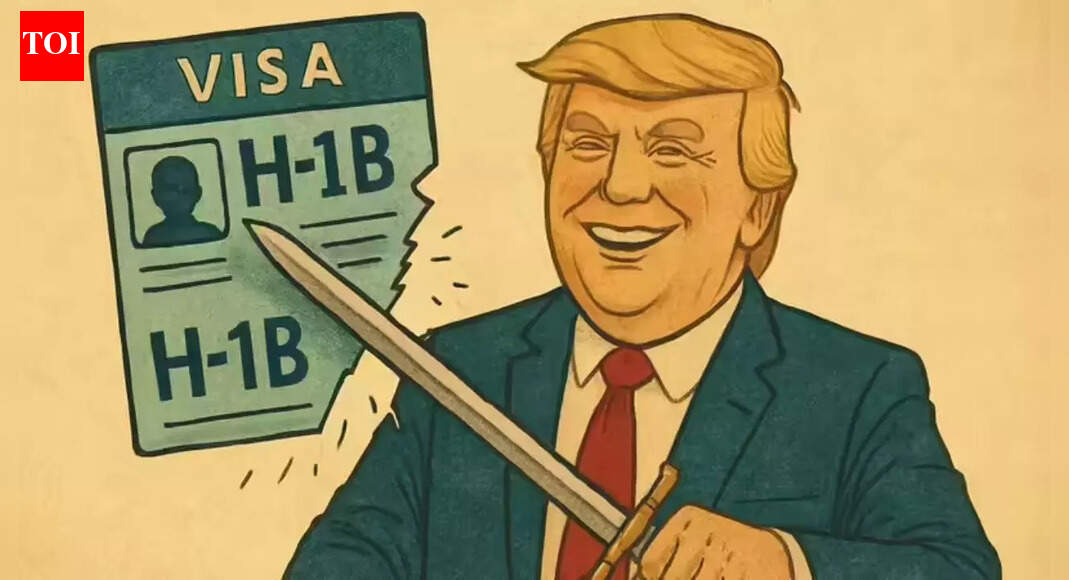
NEW DELHI: After US President Donald Trump's proposal to impose a $100,000 entry fee on new H-1B visa applications, the Department of Homeland Security (DHS) has announced a major overhaul of the visa selection process replacing the long-standing random lottery system with a wage-weighted selection model.In a statement on Tuesday, the department said it is amending rules governing the H-1B visa programme to "implement a weighted selection process that will increase the probability that H-1B visas are allocated to higher-skilled and higher-paid" applicants, with the stated aim of protecting the wages, working conditions and job opportunities of American workers.The new guidance comes amid an intensifying crackdown by the Trump administration on immigration, both legal and illegal including the H-1B programme, which US companies rely on to hire foreign talent.
Indian professionals form one of the largest groups of H-1B visa holders in the United States.
The H-1B programme allows US employers especially technology firms to hire foreign workers in specialised fields. Visas are typically valid for three to six years.Until now, total H-1B fees generally ranged between $2,000 and $5,000. Under Trump’s order, the fee for new H-1B applications would jump to $100,000, dramatically raising hiring costs for employers.
Under the current system, H-1B visas are allocated through a random lottery after electronic registrations, as demand far exceeds the annual quota of 85,000 visas (65,000 regular cap plus 20,000 for advanced degree holders).That system will now change.Under the new rule, H-1B visas will no longer be allocated purely by chance. Instead, registrations will be weighted based on wage levels set by the US Department of Labour (DOL).
Applicants offered higher salaries will have a better chance of selection.The new rule, released on Tuesday night, will take effect from February 27, 2026, ahead of the FY 2027 H-1B cap registration season. H-1B e-registrations typically open in March.
US Citizenship and Immigration Services (USCIS) said the existing lottery system was prone to abuse. USCIS said the random lottery allowed some employers to flood the system with lower-wage applications, hurting American workers."The existing random selection process of H-1B registrations was exploited and abused by US employers who were primarily seeking to import foreign workers at lower wages than they would pay American workers," USCIS spokesman Matthew Tragesser said, PTI reported."The new weighted selection will better serve Congress' intent for the H-1B program and strengthen America's competitiveness by incentivising American employers to petition for higher-paid, higher-skilled foreign workers.
With these regulatory changes and others in the future, we will continue to update the H-1B program to help American businesses without allowing the abuse that was harming American workers," he added.USCIS said the reform is part of a broader effort to strengthen the integrity of the H-1B programme and aligns with other changes, including Trump’s proclamation imposing an additional $100,000 per visa."As part of the Trump Administration's commitment to H-1B reform, we will continue to demand more from both employers and aliens so as not to undercut American workers and to put America first," Tragesser added.
Trump’s renewed crackdown on immigration and H-1B visas is expected to impact Indian IT majors, particularly Tata Consultancy Services (TCS) and Infosys, according to an analysis.A Bloomberg News study said the impact would be especially sharp for international staffing firms that act as intermediaries for US companies seeking H-1B talent. These include Tata Consultancy Services Ltd., Infosys Ltd. and Cognizant Technology Solutions Corp.This year, Amazon emerged as the largest recipient, with over 10,000 visas approved, followed by TCS, Microsoft, Apple and Google. California continues to host the highest number of H-1B workers.
Indian nationals form the largest group of H-1B visa holders. In the fiscal year ending September 2024, 80,449 of the 1.41 lakh H-1B approvals (57%) were for Indian beneficiaries, according to USCIS. However, analysis by the National Foundation for American Policy (NFAP) suggests the new system will heavily favour senior professionals.
The probability of selection would rise 107% for Level IV wage earners, but fall 48% for Level I workers.This means entry-level professionals and recent international graduates from US universities with many of them Indians, could face steep barriers.From December 15, the US State Department began enhanced screening and vetting of H-1B and dependent H-4 visa applicants, including checks of their social media profiles.The tighter scrutiny has also led to several H-1B visa interviews across India being postponed and pushed back by months, leaving many applicants who travelled to India for visa stamping stranded.While the administration argues the new system will curb abuse and protect American workers, the combined effect of higher fees, wage-based selection and tighter vetting is likely to reshape the H-1B landscape, making it tougher for younger professionals to enter the US workforce and potentially pushing more work offshore.Supporters of the H-1B programme argue it is crucial for hiring healthcare professionals and educators, drives innovation, and supports economic growth in the US by filling specialised roles. Critics, however, claim the visas are often used for entry-level roles rather than highly specialised positions. They argue that companies can suppress wages by classifying jobs at lower skill levels, even when the hired workers have significant experience.