UPSC Essentials brings to you its initiative for the practice of Mains answer writing. It covers essential topics of static and dynamic parts of the UPSC Civil Services syllabus covered under various GS papers. This answer-writing practice is designed to help you as a value addition to your UPSC CSE Mains. Attempt today’s answer writing on questions related to topics of GS-3 to check your progress.
🚨 Click Here to read the UPSC Essentials magazine for December 2025. Share your views and suggestions in the comment box or at manas.srivastava@indianexpress.com🚨
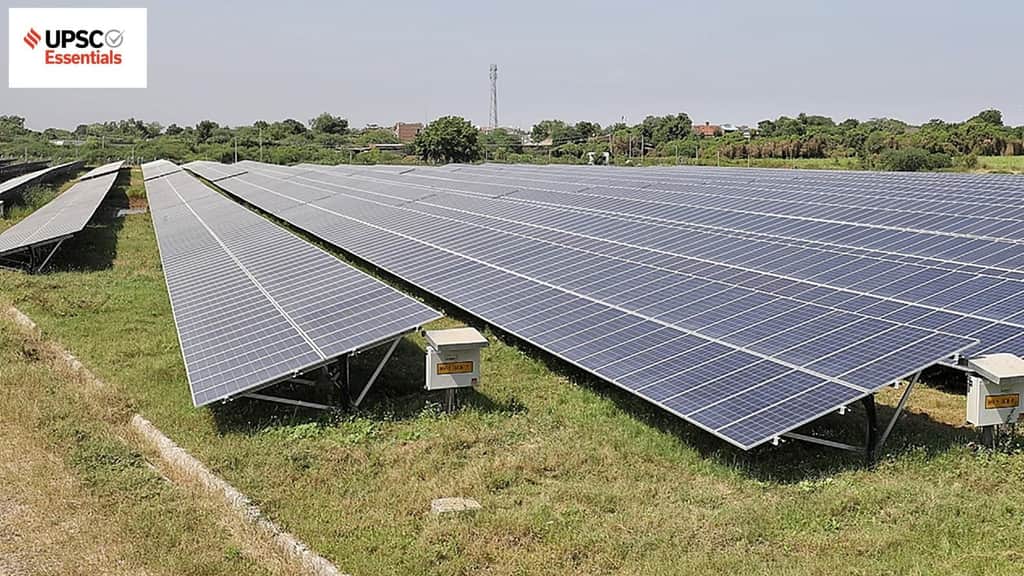
Despite significant growth in domestic solar module manufacturing, India continues to import a large share of photovoltaic modules and cells. Discuss the structural bottlenecks in domestic clean energy manufacturing supply chains.
Discuss the role of nanotechnology, particularly nanobots, in transforming targeted cancer treatment. What are the scientific principles that make nanobots effective in precision therapy?
Relevance: This question aligns with GS-III focus on science & technology and health innovation, especially emerging technologies with societal impact. It evaluates understanding of how cutting-edge research translates into precision healthcare and public health outcomes.
Note: This is not a model UPSC answer. It only provides you with thought process which you may incorporate into the answers.
— For years, India relied on Chinese imports to meet its solar requirements. Despite the increase in domestic capacity, India imported almost 66 GW of modules and cells in 2024, with exports marginally declining.
— Despite increasing module assembly, India continues to rely on imported solar PV cells and modules due to deep structural gaps in the upstream supply chain (polysilicon, ingots, wafers, cells), high costs from imported machinery and consumables such as silver paste, a lack of skilled workforce, and policy inconsistencies.
— Competitive auctions have driven tariffs to record lows, making renewable power among the cheapest sources of electricity in India. However, the financial ecosystem has stress points. DISCOMs struggle with unpaid dues. In some states, attempts to renegotiate contracts after auctions have raised concerns. Such uncertainty can undermine investor confidence.
— Around 60 GW of renewable projects remain constrained by inadequate transmission infrastructure. Without sufficient grid expansion, clean power cannot flow to where it is needed.
— When grid operators reduce renewable output due to transmission or stability issues, it adds another layer of complexity. Developers often receive no compensation for curtailed power, making financial modelling difficult and raising the cost of capital.
— The National Green Hydrogen Mission aims to produce 5 million metric tonnes of green hydrogen annually by 2030. Pilot projects are already underway in steel, refining, and transportation, sectors where direct electrification is difficult.
— India currently consumes about 5 million tonnes of grey hydrogen, produced from fossil fuels. Yet the economics remain challenging. Current production costs of $4.1–$5.0 per kg are several times higher than conventional hydrogen.
— Infrastructure for storage, transport, and end-use applications is nascent, requiring investment on a scale that may exceed production costs. The sector faces a chicken-and-egg dilemma: Industries hesitate to retrofit without guaranteed supply, while producers hesitate to invest without confirmed demand.
— In 2024, domestic companies added 25.3 GW of new module capacity, nearly doubling national manufacturing strength. The PLI scheme, central to this shift, encouraged investment and signalled India’s intent to become more than just a consumer of global technology.
— The power sector needs protection of contractual sanctity. Transmission networks must expand in step with generation capacity, and curtailment risks need clearer frameworks. For green hydrogen, realistic timelines and demand-creation will be crucial.
What are the impediments in marketing and supply chain management in developing the food processing industry in India? Can e-commerce help in overcoming these bottlenecks? (2015)
Discuss the impact of FDI entry into Multi-trade retail sector on supply chain management in commodity trade pattern of the economy. (2013)
Relevance: The question links India’s renewable energy expansion with issues of energy security, Atmanirbhar Bharat, and industrial competitiveness under GS-III. It tests the ability to analyse structural constraints in manufacturing, a recurring UPSC theme in energy and economic development.
— Current cancer therapies are limited by the challenge of delivering medicines deep inside tumours while sparing healthy tissue, a barrier that must be overcome to realise the promise of targeted and personalised medicine.
— The magnetic nanorobots, which can travel through blood, dense tissue and even cells. It has the potential to transform cancer care through targeted, minimally invasive therapies that reduce side effects, shorten recovery and lower costs.
— The nanorobot mimics the movement of bacteria with a little helix-shaped tail. It functions like a propeller in a boat or a corkscrew as they travel through different media. As the helix turns, the object moves forward like a coiled spring. In our device, the helix has a little magnet attached to it to create magnetic fields that mimic the drilling motion.
Nanobot attaching to a cancer cell
— These nanobots function as nanoswimmers and effectively become a delivery truck to deliver the drug to the targeted tissue. Either the surface or the tip is coated with the drug. The bulk of the body is made with silica, which is compatible with the human body, while the magnetic material is iron, which tops the helical nanostructure, all of which are already in use in medical nanobots.
— The magnetic field transports the nanobot precisely to the targeted issue, after which it can best respond, based on its specific properties that can be defined according to the issue. The nanobot can preferentially bind itself to cancer cells after penetrating their environment without affecting non-cancerous tissues.
— For instance, the nanobot could use the magnetic field to treat hypothermia magnetically, in which it generates localised heat exceeding 42° C to destroy target cells while sparing healthy tissue.
— The nanobot has been effective against cancer cells and certain bacteria. So the nanobot itself can become a drug.
— It has worked efficaciously on ovarian and breast cancer cells, particularly in deep-set cancers in dense breast tissue, which may not be visible in even the most advanced scans.
Magnetic nanobots mimicking helical flagellum bacteria treating a cancerous cell
— The nanobots have already proven effective against bacteria, such as root canal treatments. A root canal infection happens when a stubborn and antimicrobial-resistant E.faecalis bacteria invade the tooth’s inner pulp, causing inflammation or decay. Nanobots in this instance have proven to be a pain-free alternative to the conventionally used sodium hypochlorite, the gold standard irrigant in root canal procedures.
— Nanobots do not require expensive, super-magnetic superconducting magnets like those used in MRI, and can rely on simple electromagnets, which are relatively easier to make and build.
— The real challenge is to make a market-friendly adaptation and find acceptability among both clinicians and patients.
How nanotechnology is effective in healthcare?
How does nanotechnology offer significant advancements in the field of agriculture? How can this technology help to uplift the socio-economic status of farmers? (2025)
What do you understand by nanotechnology and how is it helping in health sector? (2020)
Editorial Context & Insight
Original analysis & verification
Methodology
This article includes original analysis and synthesis from our editorial team, cross-referenced with primary sources to ensure depth and accuracy.
Primary Source
The Indian Express