

Key takeaways
- Record your own manipulation tasks in minutes with a handheld gripper, turn them into robot-ready datasets automatically, and help grow an o
- Teleoperating a robot to collect it can be expensive and demanding: first of all, it requires a robot.
- Just a human hand, a gripper, a camera, and a way to recover the 6-DoF trajectory of what the hand did.
What happened
Record your own manipulation tasks in minutes with a handheld gripper, turn them into robot-ready datasets automatically, and help grow an open, collaborative dataset for robot learning. Robot learning has a supply problem. We have capable policy architectures (transformer-based VLAs, diffusion and flow-matching policies, and even world models) and the GPUs to train them. What we lack is large, diverse, real-world manipulation data.
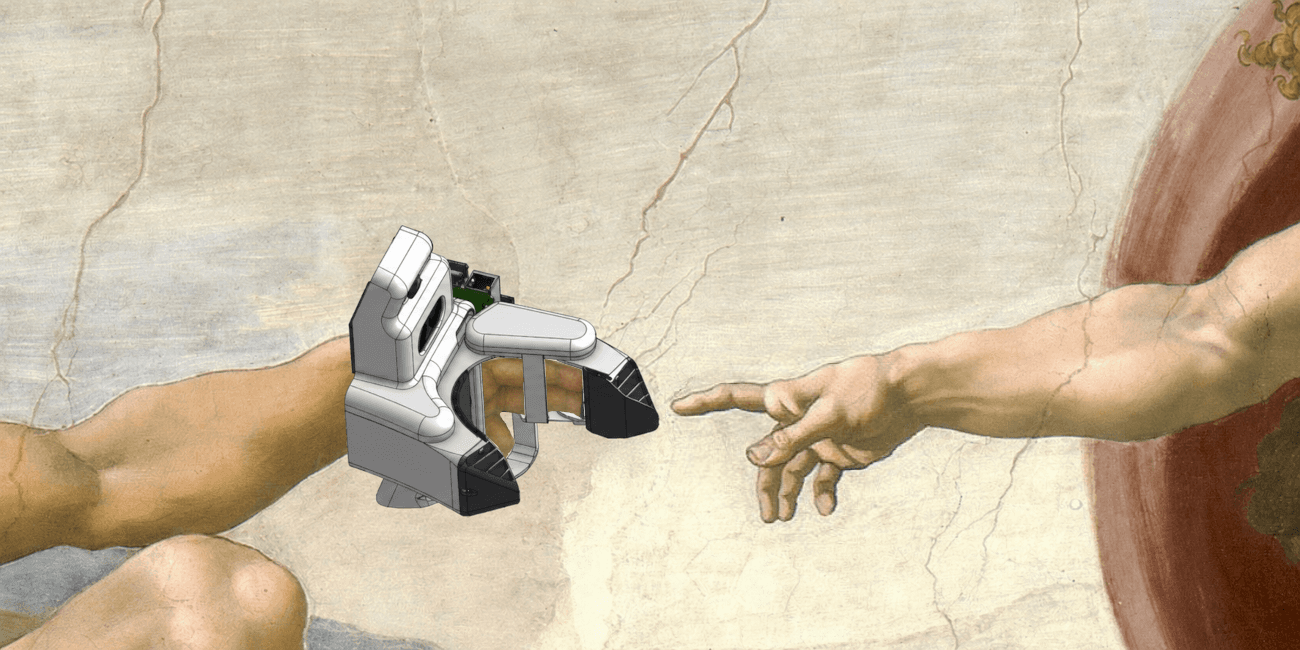
Grabette is something anyone can build on a workbench, use in the field, and contribute data from. We have been developing Grabette for months, and we feel it has become usable enough to share. We are excited to share it now with you! Grabette is a handheld gripper instrumented with everything needed to reconstruct a manipulation demonstration. It carries two cameras, each with a distinct job.
Splitting the two roles is deliberate: the cheap wide fisheye gives the policy the context-rich, wrist-camera-style view it needs, while the RGBD camera does the heavy lifting of robust 6-DoF tracking. And while Grabette records data during tasks performed by a user, it relies on its robotic counterpart to execute the movements it has learned after training. So, meet Gripette, the robotic arm end-effector twin of Grabette. Components.
Standard sensors you can buy, no closed pipeline, no fork lock-in. A Raspberry Pi, a standard Pi camera, an off-the-shelf OAK-D depth camera, magnetic encoders. The whole point is that anyone can build one from parts you can just order. Robot-agnostic by design. Nothing in the capture or the data format assumes a particular arm.
This release enables anyone to go from "I want to demonstrate a task" to "I have a training-ready dataset" quickly and without prior expertise. Press the button, and data from the observation camera, the tracking camera (color, depth, and IMU), and the gripper’s encoder joint values are recorded simultaneously, using a single shared clock
Why it matters
Teleoperating a robot to collect it can be expensive and demanding: first of all, it requires a robot. And depending on the teleoperation method, data collection can be tedious for the user if it takes hours and involve significant hardware and logistical challenges. That is difficult to scale with the wide variety of tasks and environnements required. But you don't need a robot to collect robot data.
Just a human hand, a gripper, a camera, and a way to recover the 6-DoF trajectory of what the hand did. Capture the demonstration and you have data a robot can learn from. That's what we're releasing today: Grabette, an open, low-cost system for recording manipulation data. Pick it up, record a task with your own hand, and get back a clean, robot-ready dataset.
No robot, no lab, no teleop rig. And that's the bigger goal: if recording a demonstration is as easy as shooting a video, anyone can contribute. We want Grabette to seed a large, open, collaborative manipulation dataset. One no single lab could ever build alone.
Grabette is directly inspired by the Universal Manipulation Interface (UMI) from Stanford: a handheld gripper with a fisheye camera that records demonstrations "in the wild", recovers camera trajectories with SLAM, and trains visuomotor policies from them. UMI proved the recipe works. Other (closed source) devices exists like Agibot's MEgo gripper, Genrobot's DAS gripper and Sunday Robotics skill capture glove.
Our goal was to make it effortless to use, to get the barrier from "I have a task" to "I have a trained model" as low as possible. Grabette is built into the modern open ecosystem: LeRobot for datasets, the Hugging Face Hub for sharing, and a processing pipeline you run from your browser with nothing to install.
What to watch
Demonstrations are stored as camera-local 6-DoF cartesian pose plus gripper state, the output is a standard LeRobot dataset on the Hugging Face Hub, so the same data can drive different robots and different learning methods. You will still need the matching Gripette gripper on your arm though.