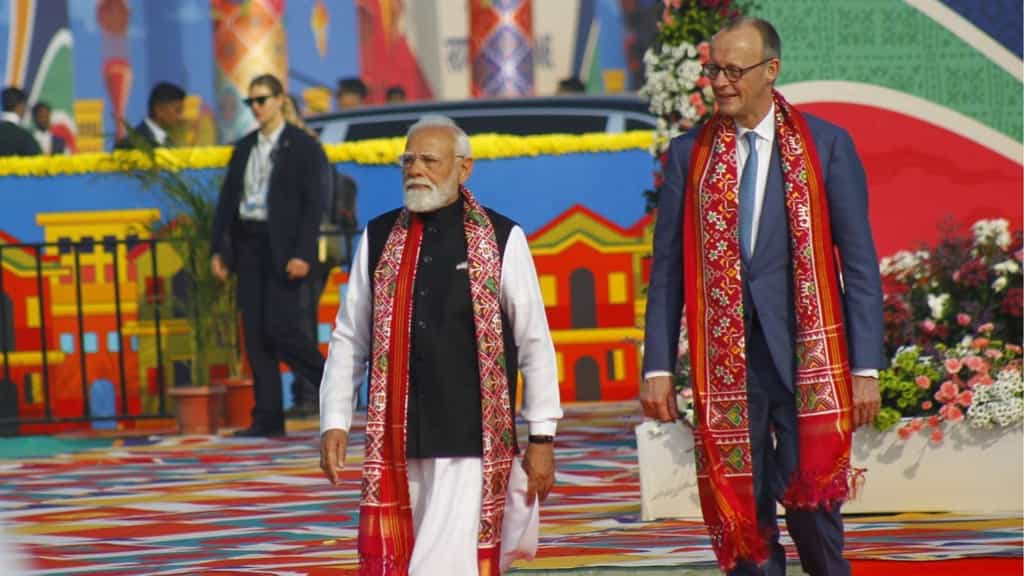
German Chancellor Friedrich Merz’s visit to India this week was not merely about raising ambitions for a relationship that has long performed below potential. Coming amid the twin disruptions unleashed by US President Donald Trump’s renewed unilateralism and Chinese leader Xi Jinping’s assertive statecraft, Merz’s engagement with Prime Minister Narendra Modi was about something larger: Creating new axes of international stability and sketching a fresh strategic geography — what we might call “the Indo-Europe”.
The limitations of Germany, Europe, and India are well known when set against the scale and power of the two dominant actors, the US and China. Yet, it is precisely by deepening their bilateral partnership — and by embedding it in a wider Indo-European framework — that Delhi and Berlin can secure greater room for themselves.
The immediate context is stark. Europe is being compelled to rethink long-standing dependencies — on Russian energy, Chinese supply chains, and American security guarantees. India confronts its own set of pressures: US trade coercion, excessive reliance on Russian weapons, and mounting Chinese challenges on its frontiers, in its neighbourhood, and across global institutions. The Modi-Merz talks produced tangible outcomes across trade and security. On commerce, both sides reaffirmed their resolve to conclude the long-delayed EU-India free trade agreement by the end of this month, when European leaders will be in Delhi as honoured guests for Republic Day.
On defence, Modi and Merz agreed to develop a joint roadmap for defence industrial cooperation. Germany has embarked on a massive programme of rearmament in response to Russia’s continuing war in Ukraine and growing doubts about long-term American commitment to European security. India, meanwhile, has been jolted into accelerating defence modernisation after recent military crises and the deepening Sino-Pakistani military nexus. Over the last four years, Germany has emerged as the world’s fourth-largest defence spender, after the US, China, and Russia. With plans to spend up to 3.5 per cent of GDP on defence, German military expenditure could approach $200 billion annually by the end of this decade, inevitably placing Berlin ahead of Russia in global defence rankings. The mobilisation of German industrial capacity for defence will turn it into a consequential military power for the first time since World War II. For India, partnership with a rearming Germany opens a rare opportunity to modernise its own defence industry through co-development and co-production.
A deeper trade and defence partnership with Berlin also resonates with the long arc of Indo-German engagement. A century ago, Germany figured high in India’s strategic imagination. During World War I, Imperial Germany viewed Indian nationalism as a lever against British imperial dominance. Through the Berlin Committee — later known as the Indian Independence Committee — and the so-called “Hindu-German Conspiracy”, German officials and Indian revolutionaries sought to exploit Britain’s wartime overstretch. Arms shipments were planned, Indian prisoners of war were mobilised, and revolutionary networks were stitched together across continents.
The most dramatic episode of that era was the 1915 expedition to Kabul, which helped establish the first Provisional Government of India in exile. The enterprise failed in its immediate objective, but demonstrated the importance of Indian nationalism seeking external partners to secure independence and expand strategic space.
The contrast with 2026 is sharp, but the underlying logic shows a certain continuity. After sheltering under American dominance for much of the post-war era, Germany is now assuming greater responsibility for Europe’s security. India, which turned to the US over the last two decades to balance China, is now hedging by deepening ties with Germany and Europe. In the past, India’s multipolar strategy relied heavily on engagement with Russia and China. Today, a weakened Russia and an assertive China mean Delhi must look to Berlin and Brussels to help stabilise the Eurasian balance and promote a multipolar world.
Neither India nor Europe can afford to rely solely on an inward-looking US to manage the risks arising from a tightening China-Russia continental alignment. This is where the Indo-European idea acquires real strategic meaning. It is not an alliance, nor an attempt to replace NATO or the Quad. Rather, it is a supplementary geometry — one that supports Washington’s own calls for greater burden-sharing in Eurasia and deeper collaboration among its partners. Indo-Europe, then, is about linking India’s demographic scale and market depth with Europe’s industrial strength and technological sophistication. Initiatives such as the India-Middle East-Europe Economic Corridor, cooperation on critical minerals and green hydrogen, and enhanced maritime awareness across the western Indian Ocean all point in this direction.
As Europe’s leaders prepare to deepen engagement with India, the challenge will be to give the Indo-European idea concrete meaning. The Modi-Merz talks have taken an important step in that direction. France is already a big factor in the Indo-Europe geography. Britain, which withdrew from Europe a decade ago, is reconnecting with the old continent and deepening ties with India. Delhi also has much to do with Poland, in Central Europe, and Italy in the Mediterranean. For India, the challenge is to implement the agreements signed and translate understandings with Europe into concrete outcomes.
Both India and Europe continue to see the US as an indispensable partner in securing Europe and balancing Asia and the Indo-Pacific. What the Indo-Europe seeks is resilience: The capacity to hedge against volatility without surrendering agency. India and Europe now define strategic autonomy not as equidistance or defiance, but productive diversification.
The writer is contributing editor on international affairs for The Indian Express. He is a distinguished professor at the Motwani-Jadeja Institute of American Studies, Jindal Global University and holds the Korea Foundation Chair in Asian geopolitics at the Council on Strategic and Defence Studies, Delhi
Editorial Context & Insight
Original analysis and synthesis with multi-source verification
Methodology
This article includes original analysis and synthesis from our editorial team, cross-referenced with multiple primary sources to ensure depth, accuracy, and balanced perspective. All claims are fact-checked and verified before publication.
Primary Source
Verified Source
The Indian Express
Editorial Team
Senior Editor
Dr. Elena Rodriguez
Specializes in India coverage
Quality Assurance
Associate Editor
Fact-checking and editorial standards compliance