An immersive audio-visual show on “The Great Calcutta Killings”, displays on the Ram Mandir movement — and a rusty brown ballot box: These are among the many features visitors can find in the museum at the newly inaugurated Rashtra Prerna Sthal in Lucknow.
It also highlights important “milestones” in the BJP’s history: the birth of the Bharatiya Jana Sangh and its journey to the present-day Bharatiya Janata Party, its role in the Ram temple movement, and its rise to power at the Centre.
Inaugurating the memorial on December 25 last year, Prime Minister Narendra Modi had unveiled towering 65-feet bronze statues of former PM Atal Bihari Vajpayee, Bharatiya Jana Sangh (BJS) founder Syama Prasad Mookerjee and Deendayal Upadhyaya.
While the memorial complex, where these statues are placed, was opened to the public the day after the inauguration, the museum opened last week.
Developed on a 6,300-sqm area, the two-storey museum comprises five galleries and 12 interpretation walls dedicated to three leaders and their contributions. In two rooms, orientation films on their lives are screened. The entry fee is Rs 50 per person.
On the ground floor, a major section is dedicated to incidents from Mookerjee’s role in Bengal — among the two regions, including Jammu & Kashmir, where he had played a key part.
For instance, a 3-minute-30 second audio-visual presentation highlights his opposition to the Partition, launched in response to Muhammad Ali Jinnah’s Muslim League agitation in 1942. “Very soon, it was realised that Congress was ready for Partition,” says the audio.
A rusty ballot box, described as “a powerful symbol of democracy”. (Express Photo)
The Muslim League, it says, demanded to make West Bengal an independent nation, separate from India and Pakistan. It adds that Mookerjee stood firmly against this. “Because of his hard work, Calcutta is today part of India and the entire West Bengal too,” the presentation states.
A touch-screen table also displays details, including photographs, of ‘The Great Calcutta Killings’, or ‘Direct Action Day’ of August 1946, and the Noakhali-Tipperah tragedy, when Calcutta (now Kolkata) witnessed a bloodbath which claimed thousands of lives.
Text on display also details his resignation from the Nehru Cabinet.
“On April 8, 1950, an agreement was signed between Prime Minister Jawaharlal Nehru and Pakistan’s Prime Minister Liaquat Ali Khan, assigning both governments the responsibility of protecting their respective minority populations and introducing a passport system between the two nations. According to… Mookerjee, this agreement was disastrous for the Hindus of East Pakistan (now Bangladesh) as it would make it difficult for them to seek refuge in India in the event of persecution. His fears soon came true… Finding the policy… unacceptable, Mookerjee resigned from the Cabinet in protest. Soon after, he founded the Bharatiya Jana Sangh…,” it reads.
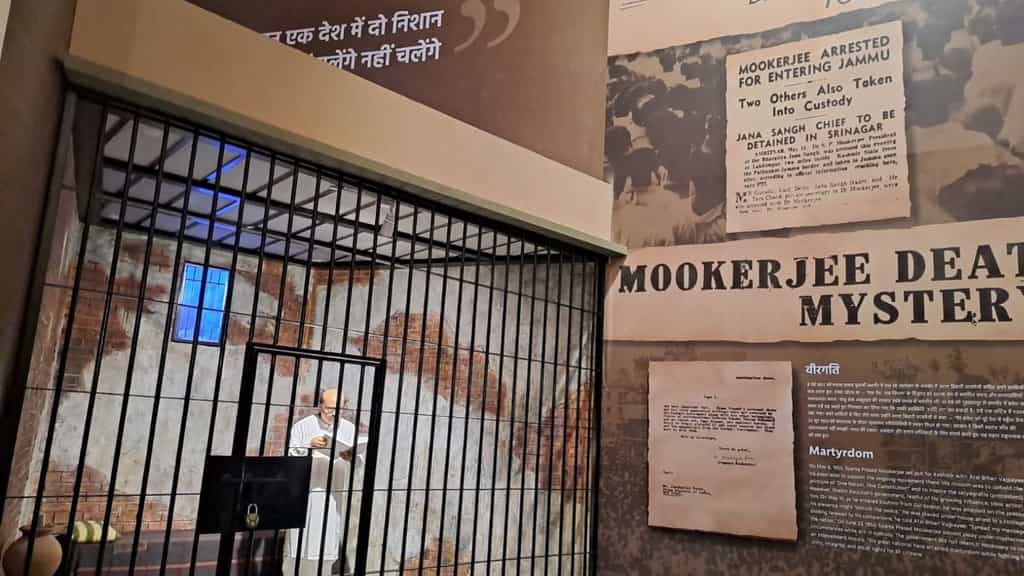
Then there is a wall dedicated to news clippings about Mookerjee’s “mysterious death”, next to an installation of him behind bars — he was jailed in Srinagar while protesting Nehru’s Kashmir policy.
One such headline reads: “Abdullah-Nehru “Conspiracy” over Mookerjee?”. Another says “West Bengal demands inquiry into Dr Mookerjee’s death”.
Another audio-visual show highlights how Vajpayee played a significant role in the Ram temple movement through his speeches and diplomatic means, while Lal Krishna Advani “spread the message of Rama to every household through his rath-yatra”.
One of the displays states that Vajpayee, in his speech on December 5, 1992, in Lucknow, had said: “There are sharp rocks at that place… The land will have to be levelled. It will have to be made suitable for sitting. Some construction work can be done there because arrangements have to be made for a Yagna (ritual sacrifice)”.
As a result of that movement, “a magnificent Ram temple has now been constructed at the Ram Janmabhoomi,” it reads.
The audio-visual show notes that as PM, Vajpayee had said he would make way for building the Ram temple after winning an absolute majority. “The BJP won an absolute majority in 2014 and Narendra Modi became PM. Following the values of Atal ji, Ram temple construction was completed in 2024,” it says.
Another display says India is on the path of world leadership. In 2014, the BJP came to power with an absolute majority under the leadership of Modi, and terrorism is now being countered with surgical strikes and Operation Sindoor, it adds.
The display reads: “Today the entire world is calling India a world leader. The BJP has fulfilled the long-standing demands of the people, such as the abrogation of Article 370 and construction of the Ram Temple. Uttar Pradesh, which can be called the heart of the country, has also been freed from years of opportunistic politics. Under the leadership of Yogi Adityanath, hooliganism ended and the stream of development began to flow”.
The rusty ballot box, meanwhile, has a simple piece of paper. It reads: “This ballot box once held the votes that decided the fate of every electoral candidate. It stands as a powerful symbol of democracy.”
Editorial Context & Insight
Original analysis and synthesis with multi-source verification
Methodology
This article includes original analysis and synthesis from our editorial team, cross-referenced with multiple primary sources to ensure depth, accuracy, and balanced perspective. All claims are fact-checked and verified before publication.
Primary Source
Verified Source
The Indian Express
Editorial Team
Senior Editor
Aisha Patel
Specializes in India coverage
Quality Assurance
Associate Editor
Fact-checking and editorial standards compliance