Take a look at the essential concepts, terms, quotes, or phenomena every day and brush up your knowledge. Here’s your UPSC current affairs knowledge nugget on ISRO’s launch vehicle for today.
(Relevance: UPSC has asked questions on ISRO’s launch vehicle. With the launch of the heaviest payload by Launch Vehicle Mark-3 (LVM3), it is crucial that you know about the important launch vehicles of ISRO for your Prelims and Mains examination.)
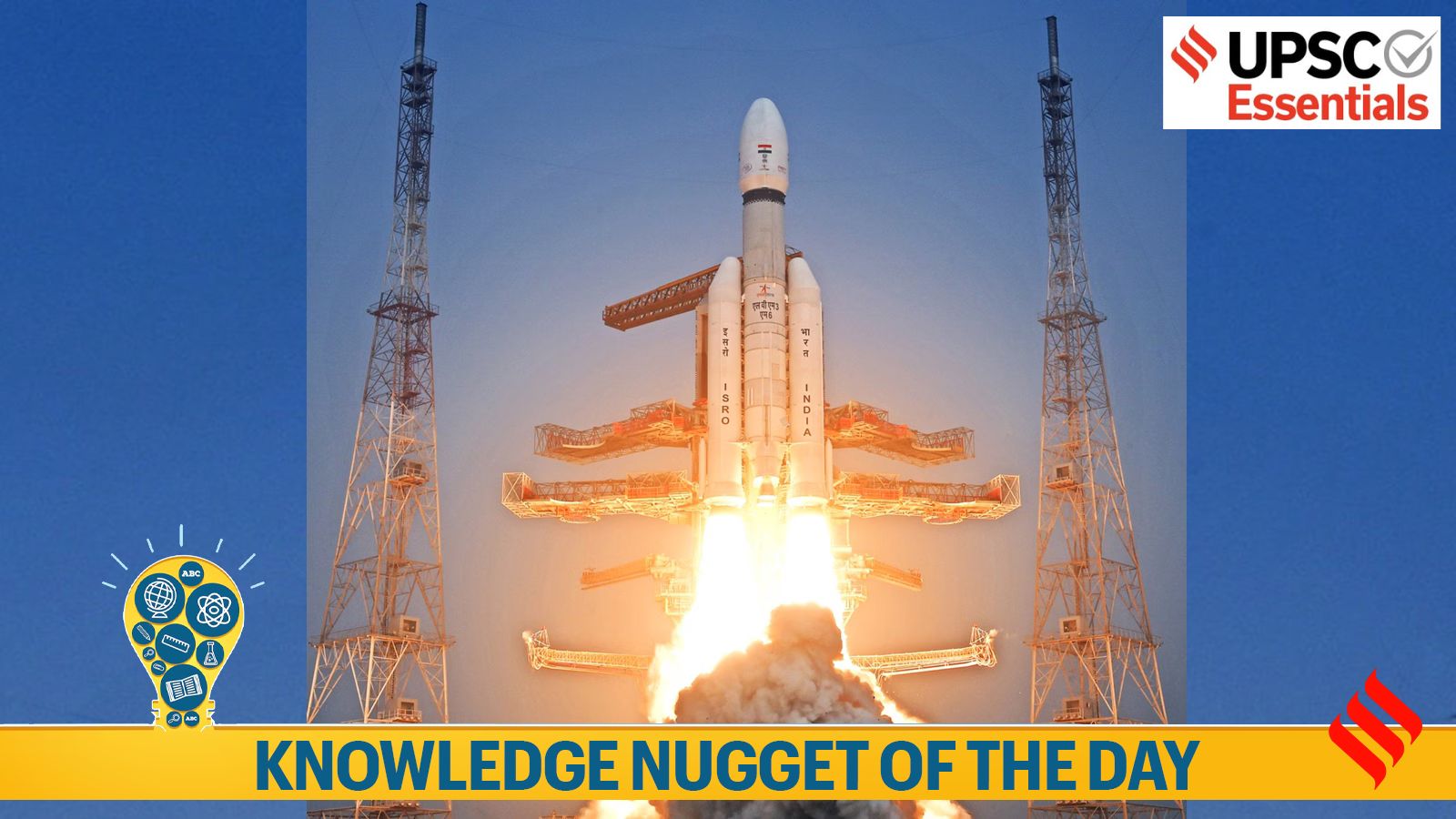
The Indian Space Research Organisation (ISRO )’s heaviest rocket LVM3-M6 has deployed its heaviest-ever satellite — BlueBird Block-2, weighing nearly 6,100 kg — on 24th December. The important thing about this launch was the demonstration of yet another new capability by ISRO, to launch very heavy satellites, weighing six tonnes or more.
The success of LVM3-M6 is significant for ISRO’s Gaganyaan mission, as well as increasing its lift-off capacity to carry the modules for the Bharatiya Antariksh Station, the space station envisaged by India. In today’s Knowledge Nugget, let’s look at the important launch vehicles of ISRO.
1. Satellite Launch Vehicle-3 (SLV-3) was India’s first experimental satellite launch vehicle which successfully launched Rohini Satellite into a Near-Earth Orbit on July 18, 1980. It became the base structure for major Launch Vehicles like Augmented Satellite Launch Vehicle (ASLV), Polar Satellite Launch Vehicle (PSLV), and Geosynchronous Satellite Launch Vehicles (GSLVs).
2. The PSLV is the third generation of Indian satellite launch vehicles. PSLV development started in 1982, and its maiden successful launch took place in October 1994. Most significantly, it marked India’s entry into the Big Rockets league, as it could carry a payload of up to 1,000 kg. It has also been called “the workhorse of ISRO” for consistently delivering various satellites into low Earth orbits (less than 2,000 km in altitude) with a high success rate.
An image of Mars clicked by Mangalyaan. (Photo: PTI)
3. Some of India’s most ambitious space missions have been launched using this rocket — Chandrayaan-1 rode a PSLV rocket in 2008, as did Mangalyaan, the Mars Orbiter mission, in 2013.
4. ISRO’s Small Satellite Launch Vehicle (SSLV) is a three-stage Launch Vehicle configured with three Solid Propulsion Stages. It is capable of launching Mini, Micro or Nano satellites (10 to 500 kg mass) to 500 km planar orbit. It has a liquid propulsion-based Velocity Trimming Module (VTM) as a terminal stage, which can help adjust the velocity as it prepares to place the satellite.
5. Geosynchronous Satellite Launch Vehicles (GSLVs) is the largest fourth-generation Indian launch vehicle. It is a three stage vehicle with four Liquid Strap-ons, a Solid Rocket Motor and also has a Cryo Upper Stage. It primarily aimed to solve two of the biggest limitations of PSLV: it can deliver a payload of about 1,750 kg to a lower Earth orbit, up to an altitude of 600 km from the Earth’s surface; and it can go a few hundred kilometres higher in Geostationary Transfer Orbit (GTO), though only with a reduced payload.
6. GSLVs have a higher capacity because sending satellites deeper into space requires greater power. Therefore, cryogenic engines consisting of liquid hydrogen and liquid oxygen are used in GSLVs as they provide greater thrust than the engines used in the older launch vehicles
7. Unlike their predecessor vehicles, GSLVs use cryogenic engines — they consist of liquid hydrogen and liquid oxygen — that provide far greater thrust than the engines used in the older launch vehicles.
8. LVM-3, earlier referred to as Geosynchronous Launch Vehicle Mark 3 or GSLV Mk 3, uses solid, liquid, as well as cryogenic-fuel based engines to put up to 8,000 kg in low earth orbit (up to an altitude of 2,000 km from Earth’s surface) and up to 4,000 kg in geosynchronous orbit (about 36,000 km). It is dubbed as ‘Bahubali’ for its weight capacity.
9. LVM-3’s first successful mission was in 2017, when it carried the GSAT-19 satellite, a communication spacecraft, into space. Subsequently, the same launch vehicle put the Chandrayaan-2, weighing 3,850 kg, outside the Earth’s atmosphere in 2019, and took Chandrayaan-3 into space in 2023.
10. ISRO is also in the process of building its heaviest rocket ever, and has named it Lunar Module Launch Vehicle (LMLV). It would be ready by 2035, and would be used for the lunar missions, including the first human mission to the Moon, planned by 2040.
Indian Space Research Organisation (ISRO) launches the BlueBird Block-2 communication satellite of AST SpaceMobile, USA, onboard its launch vehicle LVM3-M6 from the Satish Dhawan Space Centre, Sriharikota, Andhra Pradesh. (@isroofficial5866/Yt via PTI Photo)
1. The Bluebird Block-2, developed by the US company ASTSpace Mobile, is a part of a low-earth orbit constellation that will provide direct-to-mobile connectivity. It will be the largest-ever commercial communications satellite to be deployed in low Earth orbit (LEO). As the name suggests, LEO is an orbit that is relatively close to Earth’s surface. It is normally at an altitude of less than 1,000 km.
2. This means that, unlike conventional communications satellites, which beam their signals to specialised ground stations before disseminating data further, this constellation will be able to directly communicate with the phones we use. This constellation will enable 4G and 5G voice and video calls, texts, streaming, and data for “everyone, everywhere, at all times,” ISRO said.
With reference to India’s satellite launch vehicles, consider the following statements: (UPSC CSE 2018)
1. PSLVs launch the satellites useful for Earth resources monitoring whereas GSLVs are designed mainly to launch communication satellites.
2. Satellites launched by PSLV appear to remain permanently fixed in the same position in the sky, as viewed from a particular location on Earth.
3. GSLV Mk III is a four-staged launch vehicle with the first and third stages using solid rocket motors; and the second and fourth stages using liquid rocket engines.
Which of the statements given above is/are correct?
🚨 Click Here to read the UPSC Essentials magazine for December 2025. Share your views and suggestions in the comment box or at manas.srivastava@indianexpress.com🚨