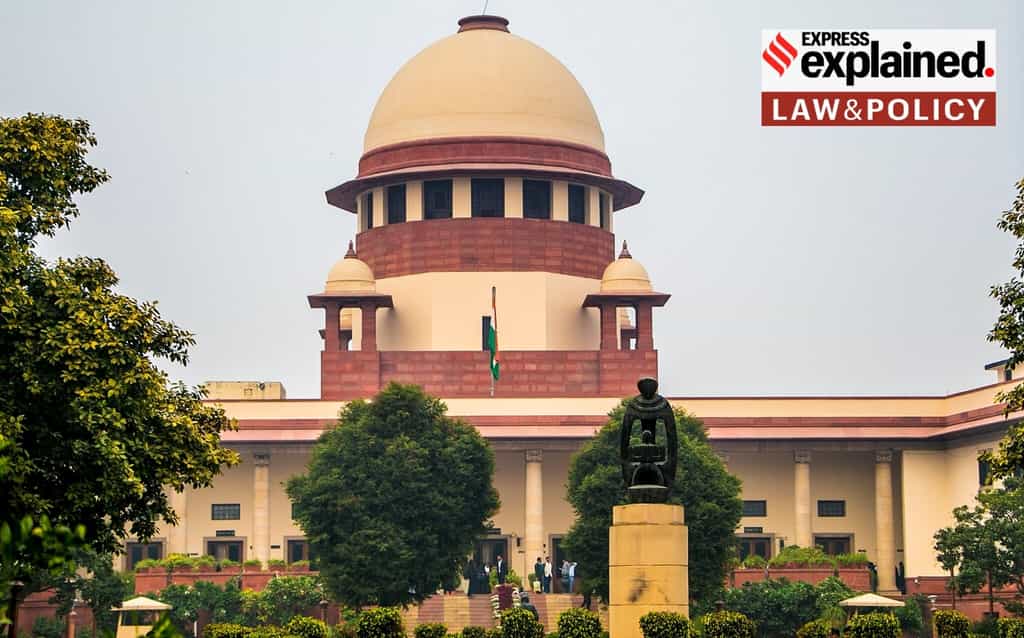
A two-judge bench of the Supreme Court delivered a split verdict Tuesday in a petition challenging the constitutionality of Section 17A of the Prevention of Corruption Act, 1988 (PCA).
The provision, introduced in 2018, mandates that police officers must seek the government’s approval before conducting any enquiry or investigation into a public servant for offences related to recommendations made or decisions taken in the discharge of official duties.
The petitioner, the Centre for Public Interest Litigation, had argued that the section creates a “shield” for the corrupt, effectively allowing the government to block investigations into its officials.
While Justice K V Viswanathan upheld the provision by “reading it down” to include an independent screening mechanism via the Lokpal, Justice B V Nagarathna struck it down entirely as unconstitutional. Due to the divergence in views, the matter has been referred to the Chief Justice of India to constitute a larger bench.
The judgment brings into sharp focus a permanent tension in administrative law: the pursuit of a balance between empowering agencies to catch the corrupt and safeguarding the honest civil servant from harassment.
Section 17A was introduced by the legislature to curb the “policy paralysis” that might arise when bureaucrats hesitate to take bold decisions due to fear that a bona fide error might later be construed as a corrupt act, leading to harassment by investigating agencies.
Justice Viswanathan, in his opinion, emphasised the necessity of this protection. Quoting Sardar Vallabhbhai Patel’s reference to civil servants as the “Steel Frame of India”, he noted that without a basic assurance of protection, “public servants will resort to a play it safe syndrome”.
“If honest public servants are not given a basic assurance that decisions taken by them will not be subjected to frivolous complaints, it is the nation that will suffer,” he wrote, arguing that striking down the provision would mean “throwing the baby out with the bathwater”.
Justice Viswanathan acknowledged a fatal flaw in the current operation of Section 17A: The power to grant or refuse approval lies with the government. This, he noted, violates the principle of independence required in corruption probes.
To save the law from unconstitutionality, he adopted a “constructive approach”. He ruled that while the requirement for prior approval is valid, the decision cannot rest solely with the government. Instead, he directed that the “screening” of complaints must be done by an independent body — the Lokpal at the Centre and Lokayuktas in the States.
Under this interpretation, when the government receives a request from the police for prior approval, it must forward it to the Lokpal. The Lokpal’s Inquiry Wing would then conduct a preliminary check.
“If the Lokpal finds a prima facie case it may forward the same to the Government which… will be obliged to follow the recommendation and proceed to grant the approval,” he held.
This mechanism, he argued, aligns the law with the need for independent scrutiny while retaining protection for officers.
Justice Nagarathna, in contrast, held that Section 17A is “contrary to the object and purpose” of the PCA. She argued that the provision “forestalls an enquiry and thereby in substance protects the corrupt rather than seeking to protect the honest”.
Justice Nagarathna criticised the idea that the government could be an impartial arbiter in granting approval for sanction. She pointed out the potential for “policy bias” and “conflict of interest”, noting that if a decision involves high-ranking officials or ministers, a subordinate officer cannot be expected to impartially grant approval for an investigation.
She further held the provision violative of Article 14 — which provides the fundamental right to equality — of the Constitution by requiring prior approval only for offences relatable to a “recommendation made or decision taken”. This was discriminatory, she decided, against lower-level officials who perform clerical tasks or file notings without making formal recommendations and won’t receive this protection.
She also disagreed with Justice Viswanathan’s attempt to save the law by involving the Lokpal. Terming his approach “judicial legislation”, she argued that the court cannot substitute the word “Government” in the statute with “Lokpal”.
She dismissed the government’s contention that Section 17A is a “gatekeeper” provision to filter out baseless allegations before an investigation begins as “putting the cart before the horse”. According to her, without a preliminary enquiry by the police, it is impossible to know if a complaint is genuine or frivolous.
She warned that the provision allows the government to hold a “Damocles’ Sword” over officials, forcing them to align with political executives or face the threat of investigation approval being granted.
A central point of contention in the split verdict was how the judges interpreted two landmark Supreme Court judgments: Vineet Narain v. Union of India from 1998 and Subramanian Swamy v. CBI from 2014.
In Narain, a three-judge bench of the apex court struck down an executive order that required the CBI to seek permission before investigating officers of the rank of Joint Secretary and above. In Swamy, a Constitution Bench of the court struck down Section 6A of the Delhi Special Police Establishment (DSPE) Act that had codified a similar protection for senior officers.
Interestingly, Justice Viswanathan had appeared in Swamy as Additional Solicitor General, having argued on behalf of the Union government for the constitutionality of Section 6A of the DSPE Act.
Justice Nagarathna viewed Section 17A as “old wine in a new bottle” — a resurrection of the provisions struck down in the earlier cases. She argued that the core holding of Swamy was that a “fetter” on the preliminary enquiry subverts the investigation process.
Quoting from the judgement, she noted: “If CBI is not even allowed to verify complaints by a preliminary enquiry, how can the case move forward?” She argued that Section 17A creates the exact same hurdle, merely extending it to all public servants rather than just senior ones.
“The reasons for striking down Section 6A… squarely apply to Section 17A,” she wrote.
Justice Viswanathan, however, distinguished the present case from the previous judgments. He argued that Swamy struck down Section 6A primarily because it discriminated between officers based on their rank — violating Article 14 of the Constitution. Section 17A, he wrote, applies to all public servants, removing the vice of discrimination.
He argued that the “spirit and essence” of Narain and Swamy was that the executive should not control the investigation. By introducing the Lokpal as the independent screener, he argued that this concern is addressed. He concluded that if an independent agency (Lokpal) does the screening, the law passes the constitutional test.
Editorial Context & Insight
Original analysis and synthesis with multi-source verification
Methodology
This article includes original analysis and synthesis from our editorial team, cross-referenced with multiple primary sources to ensure depth, accuracy, and balanced perspective. All claims are fact-checked and verified before publication.
Primary Source
Verified Source
The Indian Express
Editorial Team
Senior Editor
James Chen
Specializes in India coverage
Quality Assurance
Fact-Check Editor
Fact-checking and editorial standards compliance