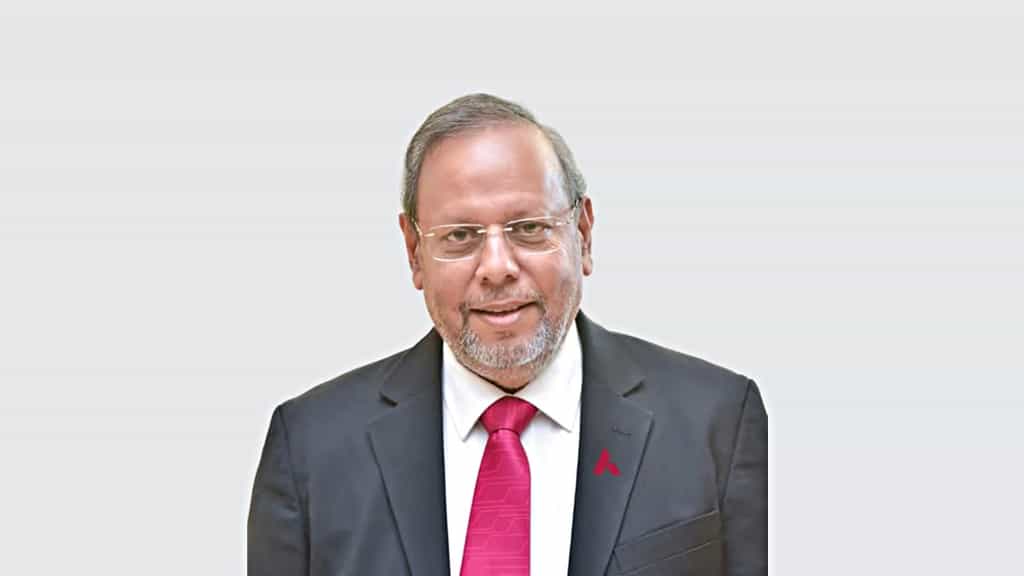
Viksit Bharat does not mean just achieving growth but also includes inclusive growth and sustainability, Prof S Mahendra Dev, Chairman of the Economic Advisory Council to the Prime Minister (EAC-PM), said Friday.
Speaking during the inaugural keynote session at the 7th Annual Economics Conference organised by Ahmedabad University, he said, “Quality employment is the most important component of inclusive growth. Issues like gig workers, women participation rates, creating employment for youth, technology including AI and employment, and improving education, health, nutrition are also part of efforts in reducing inequalities.”
Swadeshi doesn’t mean going back to the previous import substitution but to improve competitiveness, he added.
Prof Dev said, “There are global and domestic challenges and opportunities for raising higher growth, improving employment and achieving sustainability. Indian economy is resilient because of higher growth in domestic economy but a lot of work needs to be done. (There are) two long-term structural issues – one is structural transformation from agriculture to manufacturing. Labour intensive manufacturing is considered the solution for structural transformation in labour absorption and exports.”
“Despite global uncertainties, India has emerged as a global bright spot due to its reforms and policies, including structural change in the budget from revenue expenditure to capital expenditure, significant tax reforms (income tax apart from GST reforms), recent income tax abolished more than 280 sections, ease of doing business and degregulations, notification of labour codes, measures on quality control orders, 100 percent FDI in insurance, private sector in nuclear power,” said Prof Dev who was the director and vice-chancellor at the Indira Gandhi Institute of Development Research (IGIDR) in Mumbai from 2010-2022.
The second structural issue, he added, is in health, education and skills. “This is another long-term structural problem. The issues of quality and dichotomy in schools and higher education are well known. This is also important for growth. We have very good institutes in higher education but in primary level, learning outcomes are not good. similarly in health. The reasons for India’s resilience are three factors—political stability, macroeconomic stability and a large domestic economy. The only concern is global macroeconomic and geopolitical uncertainty,” he added.
On the two drivers of growth – investment rate and exports – Prof Dev said that private sector investment is crucial if you need to increase the investment rate (which is currently 31-32%) to 34 to 35 per cent. To increase the investment rate, India Inc has to make new investments instead of keeping the cash, while states have to make more efforts to invite Foreign Direct Investment (FDI) and domestic private investment, he stated.
Citing exports as one of the main drivers of growth and employment creation, he said that exports, however, constitute only 20 per cent of the GDP as 80 per cent of the Indian economy is based on domestic demand.
“Thus, as compared to global headwinds, there are many domestic tailwinds such as low inflation, rate cuts and CRR (Cash Reserve Ratio) cut by RBI (Reserve Bank of India). All the reform measures undertaken will have stimulus. These tailwinds may raise both rural and urban demand, by raising both investment consumption and some push to exports.
Speaking about global developments and challenges, Prof Dev listed industrial revolution 4.0, including AI that is automating and disrupting industrial processes; manufacturing becoming capital-intensive and skill-intensive; and global supply chains being restructured and often re-shored as advanced countries incentivise local production. He added that industrial policy has re-emerged globally as a central tool for economic strategy and there is a debate on whether we should have manufacturing or services.
“I feel that we need both manufacturing and services as complementary. The manufacturing sector has higher backward and forward linkages and also improves services. Some of the growth in the service sector is due to expanding manufacturing,” he added.
On reforms in the manufacturing sector, he said the government has so far abolished 40,000 unnecessary compliances and also scrapped over 1,500 obsolete laws, appointed two committees on deregulation, chaired by the present and previous cabinet secretary.
“Challenges in manufacturing in India is the ‘missing middle’. Among other things, the small size of firms with a majority operating at less than 10 workers is the major problem. Many others have between 10-50 workers. We must have many more middle-level manufacturing units with 200 to 500 workers,” Prof Dev highlighted.
Editorial Context & Insight
Original analysis & verification
Methodology
This article includes original analysis and synthesis from our editorial team, cross-referenced with primary sources to ensure depth and accuracy.
Primary Source
The Indian Express