Police officers shot dead a 33-year-old man at a hospital in Giessen, north of the financial capital Frankfurt, authorities said.
Hospital staff called the police saying a patient had threatened them with scissors, with police describing the man as being in psychological distress, the Hesse State Criminal Police Office (LKA) said in a statement.
Investigators said the man had attacked officers with the scissors, prompting them to open fire.
The man later succumbed to his wounds.
HateAid, a Germany-based non-profit that helps victims of online harassment, is reviewing whether recent US sanctions might disrupt its financial operations.
The Trump administration issued entry bans on Wednesday, targeting both of HateAid’s managing directors, former EU Internal Market Commissioner Thierry Breton and two additional European civil society advocates.
Washington accused them of contributing to censorship on US-based online platforms. The decision has been denounced by Berlin and Brussels.
Although the organization holds no US bank accounts, co‑director Josephine Ballon told the dpa news agency that it is unclear whether the curbs could extend to credit card services or online platforms operated by US firms.
Ballon confirmed that US authorities have already revoked her ESTA travel authorization, which had been valid until April, effectively barring her from entering the country.
Her co‑director, Anna‑Lena von Hodenberg, currently does not hold a US visa.
HateAid provides legal and psychological assistance to individuals facing digital abuse, including threats, insults and discrimination.
Germany's wine industry is sliding deeper into trouble, even as growers praise the quality of the 2025 vintage.
A market report by the German Farmers' Association said the harvest was exceptional in quality but described the economic situation as historically dire.
The report said bulk wine prices of 40 to 60 cents per liter were far below production costs of about €1.20 ($1,42).
Farmers' Association President Joachim Rukwied said the industry was facing its worst crisis in decades and warned that large areas of vineyards could be lost as a result.
Domestic market share for German wine has fallen to 41%, the report said. Exports have also suffered, with US tariffs hitting Germany’s most important foreign market.
Harvest volumes were unusually low. The 2025 wine harvest totaled 7.3 million hectoliters, 16% below the 10-year average and the smallest crop since 2010. Major regions such as Rheinhessen, the Palatinate, Baden, and Wuerttemberg saw declines of up to 20% compared with last year, while areas including the Mosel, Saxony, and Saale-Unstrut rebounded after frost damage in 2024.
All 13 German wine regions reported very high grape quality. The association said wines from the 2025 vintage were aromatic, concentrated, and elegant, with small berries and strict selection boosting quality but reducing volumes. Nearly two-thirds of German wine is sold through supermarkets.
To view this video please enable JavaScript, and consider upgrading to a web browser that supports HTML5 video
Donations to the Red Cross in Germany have fallen sharply this year, with other aid groups also reporting a noticeable drop in giving.
The German Red Cross (DRK) said donations in 2025 were down by about €10 million, according to a report by the Rheinische Post.
DRK President Hermann Gröhe said the decline had direct consequences for people in need. The organization expects to end the year with just under €40 million in donations, down from about €49 million in 2024, a drop of roughly 18%.
Figures from the German Donations Council point in the same direction. In the first nine months of the year, people donated around €2.8 billion, about 14% less than in the same period last year.
The council said fewer people donated overall, but those who did gave more. The average donation rose to a record €41 per gift, €3 more than in 2024.
"Those who donate are doing so more consciously and more generously, which is a strong signal in difficult times," said Ulrich Pohl, chairman of the German Donations Council.
He cited inflation, high living costs, and rising care expenses as reasons many households are cutting back, along with fatigue caused by multiple global crises.
Germany's states have been making it easier for organized crime to operate by underinvesting in prosecution, according to the German Judges Association.
The group's federal managing director, Sven Rebehn, told Germany's Funke Media Group that state governments were leaving billions of euros uncollected because they focused too narrowly on limiting personnel costs.
Rebehn said every additional euro spent on investigators targeting financial and economic crime would pay for itself many times over. He estimated the volume of money laundering in Germany at around €100 billion (about $118 billion) a year.
Organized crime benefits from chronic shortages, he said, pointing to a nationwide lack of about 2,000 prosecutors and a backlog of roughly one million open cases.
Complex investigations often stall or end in plea deals because authorities lack staff and resources, Rebehn added.
He said drug gangs, human traffickers, and financial criminals face weak resistance because law enforcement agencies are understaffed and poorly equipped.
Germany's women footballers have once again delivered the biggest live television audiences of the sports year, finishing first and second in the annual ratings.
An average of 14.573 million viewers watched the women's European Championship semi-final against Spain on July 23 on ARD, despite the defeat, giving the match a 57% market share and the top spot of 2025.
Second place went to the national women's team's dramatic semifinal win over France.
That match drew 10.919 million viewers on ZDF, with a 51.7% market share, confirming the women’s team as the strongest TV draw of the year, as they were in 2022 and 2023.
The men's national team followed in third place. An average of 10.26 million viewers watched the Nations League semifinal loss to Portugal on ZDF, for a 43.8% share.
"Women's football has made the breakthrough," said ARD sports coordinator Axel Balkausky.
The women also topped the charts in 2022 and 2023 but the men are still far ahead when they play at big tournaments.
The most-watched broadcast of 2024 was the men's Euro semifinal loss to Spain, which attracted 27.154 million viewers on ARD and a market share of 80.9%.
The chances of unemployed people in Germany finding a job have reached a record low, according to the head of the Federal Employment Agency, Andrea Nahles.
"We have an indicator that shows how high the probability is for unemployed people to find a job again. The value is usually around seven, but it is now at 5.7 — lower than ever before," Nahles said
The labor market has been "like a plank for months," she told the news portal , with "no momentum coming in."
With regard to the planned reform of unemployment welfare benefits, which would in future reintroduce the so-called placement priority for unemployed people, Nahles criticized the proposal.
"From my point of view, this rule can really become problematic if attention is not paid to the qualification profile of each individual unemployed person" she said. The welfare benefits debate must "not ignore the labor market," Nahles demanded.
In mid-December, the cabinet decided to replace unemployment benefits after only three years with a new basic income system that stipulates harsher rules and strict sanctions.
According to Nahles, well-qualified workers still have the best chances on the labor market, although in her view no group of employees is any longer safe from losing their jobs.
Prospects are currently poor for people entering the job market. "We have placed as few young people into apprenticeships as at any time in the past 25 years," Nahles said, referring to 2025. She advised new job entrants not to fixate on a single career choice or job location.
Nine people were seriously injured, two of them critically, in a minibus crash on the A4 motorway in eastern Germany early on Christmas morning.
The police said the accident happened overnight near Bautzen, in the eastern state of Saxony, which borders Poland and the Czech Republic.
According to the police, shortly after the vehicle left the Oberlausitz service area, the 40-year-old driver lost control of the minibus.
The vehicle then left the roadway, crossed the central reservation, broke through a guardrail and then struck a bridge support.
Public broadcaster MDR cited the police as saying that the bridge railing embedded itself about three meters into the vehicle.
As a result, the van was partially suspended in mid-air above the emergency stairway.
All nine occupants, aged between 33 and 77, were injured. The police said they were taken to nearby hospitals.
Damage is estimated at around €100,000 ($118,000) and the A4 remained fully closed until Thursday morning.
An investigation has been opened into the cause of the crash.
Germany may need to return to conscription before the end of the government's current term, the chairman of the Bundestag’s Defense Committee, Thomas Röwekamp, said.
Röwekamp, a member of Chancellor Friedrich Merz's center-right Christian Democratic Union (CDU), told Die Welt newspaper he doubts the government’s voluntary model will be enough to expand the Bundeswehr.
"I personally expect that we will have to return to conscription before the end of this legislative period," he said.
Merz's government introduced a revamped voluntary service earlier this year to make short‑term enlistment more appealing to young recruits.
Röwekamp, however, warned that the Military Service Modernization Act, which was intended to boost recruitment voluntarily, "will not be sufficient."
NATO's planning rules require Germany to be able to field around 460,000 soldiers by 2035 in the event of a crisis or war.
The country's military, the Bundeswehr, must also replace the 20,000 to 30,000 soldiers who leave active duty each year.
A new conscription framework, recently approved by lawmakers, will take effect in the new year. It is designed to identify who could be drafted if conscription is reactivated.
All 18‑year‑old Germans will receive a questionnaire on their motivation and suitability for service.
Completing the questionnaire is mandatory for men and voluntary for women.
Men will also be required to undergo a medical examination; for women, this remains optional.
Germany’s environmentally friendly Green Party is calling for a real-time supermarket price comparison app that would require major retailers to report food prices immediately.
Green parliamentary group leader Katharina Dröge told the dpa news agency that supermarket chains would be obliged to take part, while smaller shops could join voluntarily.
Dröge said mandatory reporting would give shoppers more power "to counter the dominance of large chains."
She also wants tools to cap supermarket profit margins during crises, arguing retailers often add extra mark‑ups when prices rise.
German food producers were accused of profiteering during the post-COVID inflation surge, which saw large price hikes.
The Greens are additionally pushing for clear labels when package sizes shrink, stating when and by how much a product has been reduced.
"Retailers do this repeatedly: They reduce the package size, keep the price the same, and consumers don't notice immediately," Dröge said.
She added that consumers shouldn't need expert knowledge to avoid unfair pricing — calling the proposed app a "low‑threshold solution."
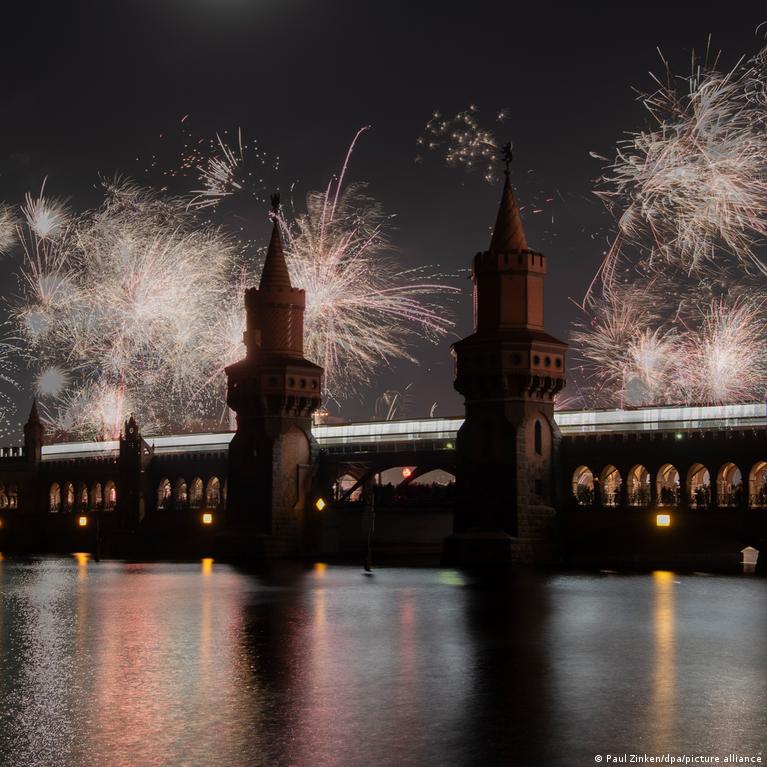
Despite only being able to buy fireworks for two days of the year, demand for New Year’s Eve pyrotechnics in Germany is rising.
WECO, the country’s largest manufacturer, says supply is 10% higher than last year, with similar increases reported across the sector.
Fireworks can be sold only from December 29 to 31, and WECO says returns last year were lower than expected.
Criticism is growing, however, from environmental and animal welfare groups, who warn of noise, debris and harm to wildlife. In cities such as Berlin, New Year’s Eve is often compared to a "war zone."
The GdP police union supports a ban, warning that officers are increasingly attacked with fireworks.
State interior ministers remain split, while a recent local ban on private fireworks on the North Sea island of Föhr was overturned.
The industry argues that fireworks remain a core New Year's Eve tradition and that rising demand shows most Germans still want them.
Germany's capital Berlin has been ranked number one when it comes to trains and railway facilities smeared with graffiti, according to police figures.
The dpa news agency cited data from the Bundespolizei (Federal Police) showing that from January until October, 1,983 graffiti offences were reported in the German capital, up around 5% from last year.
Munich took second place with 872, followed by Hamburg with 515, Nuremberg with 244, Dresden with 241, Leipzig with 200 and Cologne with 194.
Frankfurt recorded a significant decline, with just 162 offenses recorded.
Nationwide, incidences of railway graffiti increased by more than 7% compared to last year, reaching 17,829 cases.
The police figures showed that railway stations were the worst affected.
Only 5% of the more than 18,000 suspects hunted in connection with these incidents have been identified, police said.
State-run rail company Deutsche Bahn (DB) estimated the damage to trains and other rail equipment at around €12 million ($14 million) annually.
Germany could face a decade of loneliness unless the government boosts investment in social infrastructure, the country’s Association of Towns and Municipalities has warned.
André Berghegger, the association’s chief executive, told the Funke media group that "the fight against loneliness must not fail because of a lack of funding," urging federal and state authorities to act quickly.
He called for the creation of a €500 million ($589 million) "Loneliness Fund" alongside broader improvements to municipal financing.
"Municipalities are where loneliness first becomes visible — and also where it can be most effectively countered," Berghegger said. Public meeting places must be reliably open rather than subject to long closures, holiday breaks, staff shortages or early closing times, he added.
Berghegger highlighted libraries and adult education centres as crucial hubs for social contact and lifelong learning, noting that they need stable staffing to remain open consistently.
He stressed that loneliness is no longer confined to older generations but has become a widespread, cross‑generational issue.
A 2024 German government study found that under 30s are now among the groups most at risk of loneliness, having risen steadily from 2005 to 2022.
The head of Germany's Catholic bishops warned against rising nationalism in his Christmas sermon on Thursday.
Bishop Georg Bätzing pointed to what he described as a growing "us first" mentality in parts of German society.
This trend has been amplified by the rise of the far-right Alternative for Germany (AfD), which has become the second-largest party in parliament, partly due to rhetoric emphasizing cultural purity, strict border policies and a rejection of mainstream democratic institutions.
"Where does this new selfish nationalism, with its slogan of 'us first,' ultimately lead?" Bätzing asked in the Limburg Cathedral, where he serves as bishop.
Bätzing described the Christmas message of God as a defenseless child as a "real alternative to the power games of the mighty."
"I admit, this idea has always personally fascinated me and convinced me to believe," the 64-year-old said. "The God to whom Christians profess their faith is so free that he relinquishes all divine power."
Frohe Weihnachten or Merry Christmas from DW in Bonn, on the banks of the Rhine River.
We're continuing our coverage of the top stories from Germany over the festive period, including the growing demand for fireworks as New Year's Eve approaches.
Another topic that often arises over the holiday season is loneliness. The German towns and municipalities association has called for half a billion euros in funding to tackle the epidemic over the next decade.
The debate over growing nationalism in Germany has been taken up by the country's most senior Catholic bishop, who used his Christmas sermon to call it "selfish."
Meanwhile, Germany's environmentally friendly Green Party is demanding the launch of a mandatory app that shows realtime prices in all supermarkets.
The call comes after accusations of profiteering during the recent inflation crisis and the move toward dual pricing, where supermarket app users are offered lower prices than non-app users.
Follow us here for these and the latest headlines throughout the day.