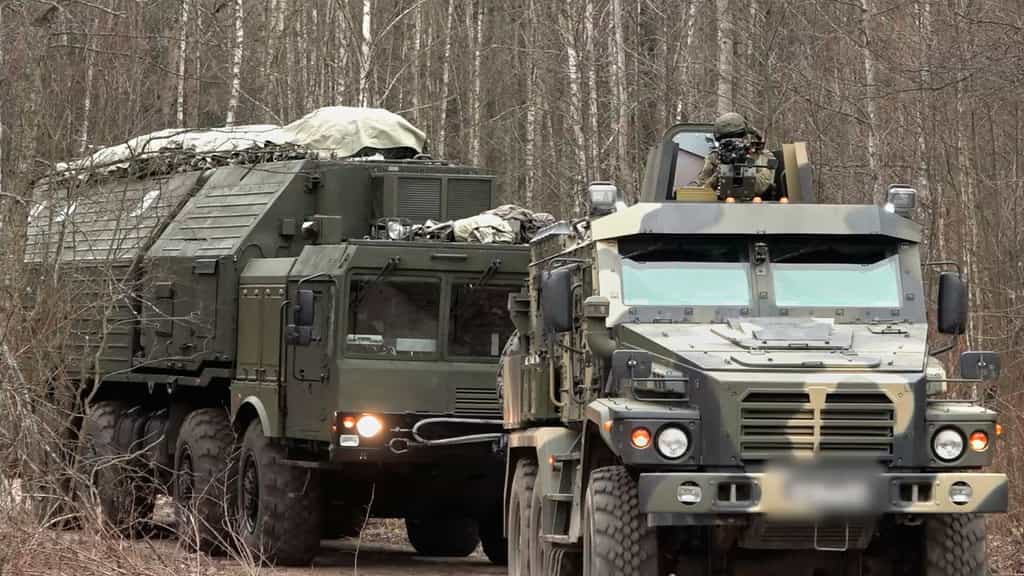
The Russian military says it has fired its Oreshnik missile at a target in Ukraine - the second time it is known to have used the hypersonic weapon.
The missile is capable of carrying nuclear warheads, although there is no suggestion it was fitted with one in the overnight attack on Ukraine.
Its use was, Russia claimed, in response to an attempted Ukrainian drone strike on one of President Vladimir Putin's residences - a claim denied by Kyiv and debunked by the US.
The launch was part of an attack on critical infrastructure in Ukraine.
What do we know about Putin's new weapon?
Intermediate missiles have a range of 3,000-5,500 km (1,860-3,415 miles), which would enable them to strike anywhere in Europe or the US from Russia.
Sky News military analyst Sean Bell notes this is not a new capability for Russia.
While the missile fired at Ukraine overnight didn't have a nuclear warhead, Mr Putin has in the past said it is so powerful that using several fitted with conventional warheads in one attack could be as devastating as a strike with nuclear weapons.
Mr Putin previously claimed air defences cannot destroy the Oreshnik as it travels 10 times the speed of sound (Mach 10).
In a televised address last year following the first known use of the missile, Mr Putin boasted about the Oreshnik, saying "no one in the world has such weapons".
He said Moscow would start producing them on a mass scale, while acknowledging other countries could get hold of them "sooner or later".
Bell said the Oreshnik has six to eight separate warheads and each of those can be individually programmed, meaning they can strike different targets at once.
Normally, he said, the missile would be designed for nuclear weapons, but it can carry conventional ones too.
While noting how their speed makes them difficult to intercept, he pointed to how Mr Putin's claim that no system can shoot them down was also made in relation to previously used Mach 8 missiles - which Bell said the West has been shooting down regularly.
"It's difficult to shoot them down when they're in space, but they inevitably slow down a lot as soon as they hit the Earth's atmosphere and that's when they become more vulnerable," he said.
Bell explained how air density slows missiles down, increasing their chances of being intercepted.
The way intercontinental missiles work is by "going ballistic" and "into space" so they can travel faster.
"You just spend longer in space, so it just makes them really difficult to shoot down," he added.
Editorial Context & Insight
Original analysis & verification
Methodology
This article includes original analysis and synthesis from our editorial team, cross-referenced with primary sources to ensure depth and accuracy.