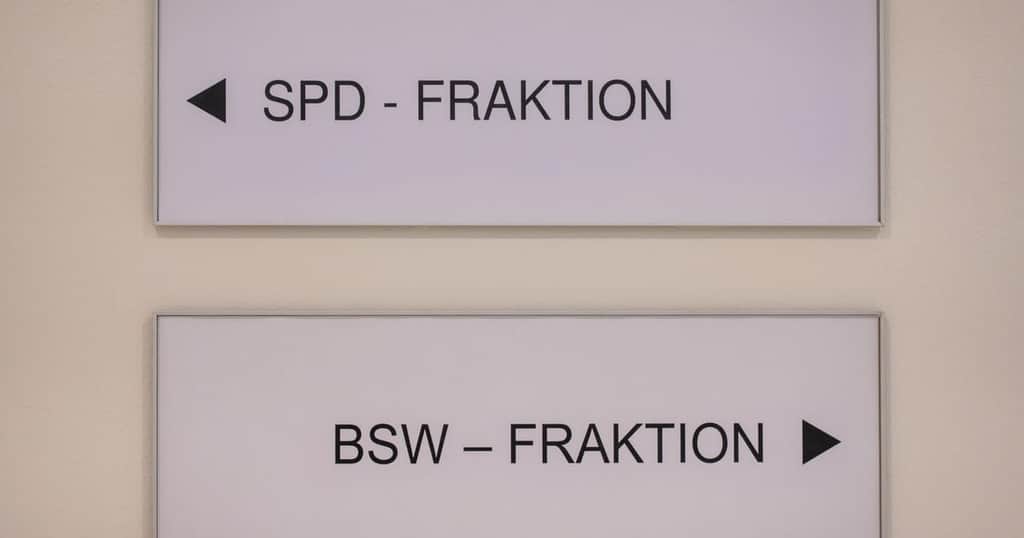
BERLIN — The center-left premier of the eastern German state of Brandenburg dissolved his coalition with the populist left Alliance for Social Justice and Economic Reason (BSW) on Tuesday after just over a year in office.
Despite the collapse, the Social Democratic premier, Dietmar Woidke, said he intends to stay on as leader of a minority government, illustrating the fragile political conditions in Germany’s eastern states, where the far-right Alternative for Germany (AfD) is particularly strong.
“The governmental chaos in Brandenburg can only have one logical consequence: immediate new elections!” one of the leaders of the AfD, Alice Weidel, said in a post on X. Her party is currently polling at 35 percent in Brandenburg, the state that surrounds Berlin, far ahead of all other parties.
The coalition collapse came as two lawmakers and the finance minister left the BSW parliamentary group over policy disagreements. That caused the coalition, which had only a two-vote surplus, to lose its majority in the state parliament.
“This breakdown means that the basis for cooperation in a coalition no longer exists,” Woidke told reporters on Tuesday. The workings within government had become “overshadowed by constant disputes within the BSW,” he added.
The BSW was founded in 2024 by Sahra Wagenknecht, a longtime icon of hard-left politics in Germany. The party merges elements of hard-left and hard-right politics — an ideology Wagenknecht has dubbed “left conservatism.” Wagenknecht stepped down as the party’s leader at the end of last year, but remains an influential figure.
She had come under increasing criticism for tailoring the party too much to her own persona, which also led to a name change — it was originally called the Sahra Wagenknecht Alliance.
In line with this criticism, the departure of members of parliament from the BSW in Brandenburg was largely due to individual politicians disagreeing with Wagenknecht on policy issues such as the reform of the state’s public broadcasters, while the party leadership did not allow them to take a different path.
Woidke said he planned to hold coalition talks with the center-right Christian Democratic Union (CDU) in the future, with whom his Social Democrats would now have a majority. But for the time being, Woidke plans to govern Brandenburg in a minority government.
Minority governments are relatively uncommon in Germany, but might become more frequent in the coming years as the increasing strength of the far right and far left has fractured the political landscape.
In upcoming elections this year in other eastern states, namely Saxony-Anhalt and Mecklenburg-Vorpommern, the AfD aims to break through Germany’s so-called firewall that has been in place since the end of World War II to prevent a far-right party from coming to power again.
Editorial Context & Insight
Original analysis & verification
Methodology
This article includes original analysis and synthesis from our editorial team, cross-referenced with primary sources to ensure depth and accuracy.
Primary Source
POLITICO