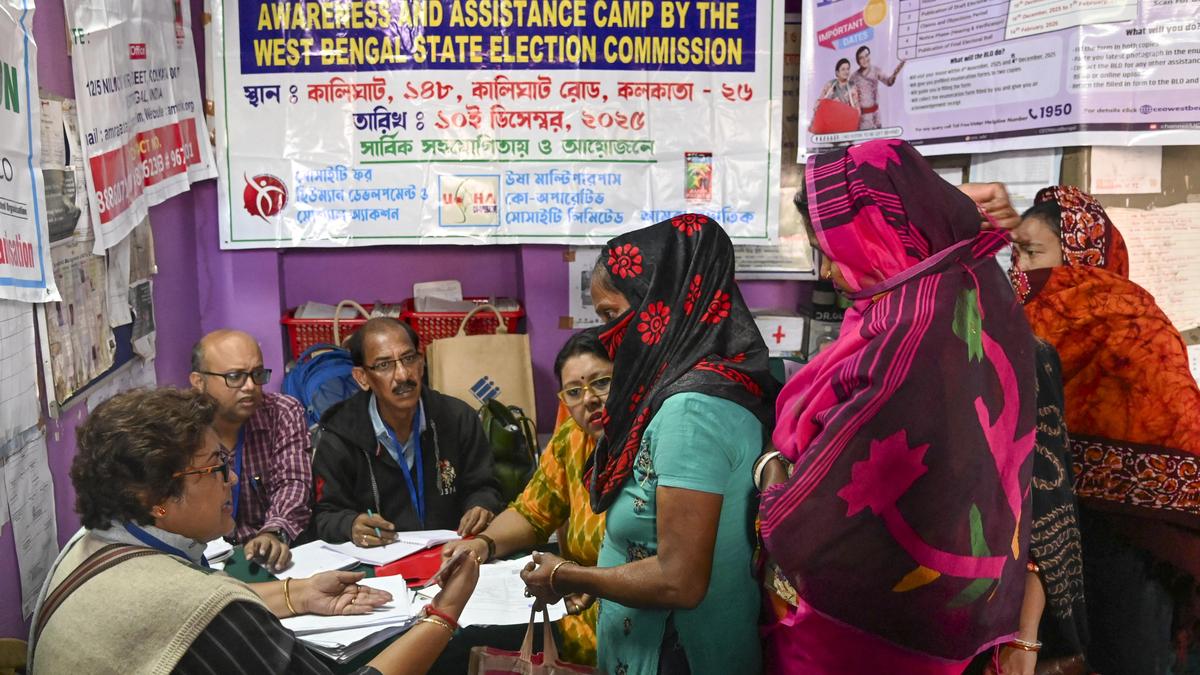
The hearing phase for the ongoing Special Intensive Revision (SIR) will begin on Saturday (December 27, 2025) for nearly 32 lakh electors in West Bengal who could not trace themselves, their parents, or their grandparents in the 2002 electoral roll.
During the hearing phase, identification documents of these ‘unmapped’ electors will be recorded and verified by election officials. According to sources in the office of the Chief Electoral Officer of West Bengal, the hearing process will include recording the signature or thumb print of the elector, taking their photograph, and verifying and uploading their documents on the ERONET software.
This phase will conclude on February 7, 2026.
Each Assembly constituency is likely to have 11 hearing tables across multiple venues like schools or government offices. Cumulatively, 294 electoral registration officers, 3,200 assistant electoral registration officers, 4,600 micro-observers and over 80,000 booth-level officers will be engaged in the hearing process across the State, sources in the CEO’s office said. Micro-observers were recently appointed by the Election Commission of India from existing Group B Central government staff in West Bengal and have been tasked to scrutinise the hearings process in West Bengal.
More electors in addition to the 32 lakh unmapped voters might also receive notices for hearing, if their enumeration forms were flagged for logical discrepancies or if applications for inclusion as a new voter warrants reverification, sources said.
“It is very important that electors practise caution during hearings, because under Section 31 of the Representation of People Act, any false declaration or submission of documents obtained fraudulently will invite prosecution,” a high-ranking official associated with SIR in the State said on Friday (December 26, 2025).
Sources in West Bengal CEO Manoj Kumar Agarwal’s office said that Mr. Agarwal is set to meet the secretary of the State’s Backward Classes Welfare Department on December 29 to discuss the issue of Other Backward Classes (OBC) caste certificates issued after 2010 in West Bengal. The Election Commission of India will subsequently submit its response to the Calcutta High Court on the matter concerning whether OBC caste certificates issued in West Bengal after 2010 would qualify as proof of elector eligibility.
In May 2024, Calcutta High Court had struck down all OBC certificates issued in West Bengal since 2010. The matter concerning revisions in the West Bengal government’s OBC list is currently pending at the Supreme Court.
“Certificates of citizenship granted under provisions of the Citizenship Amendment Act will also be accepted in applications for inclusion of new voters,” Mr. Agarwal said on Friday.
This assumes significance for certain sections of people in West Bengal who had recently applied for citizenship under CAA and are apprehensive of being dropped from the final electoral roll. This especially comprises the State’s Matua community — a sect of Namashudra Hindus who migrated to West Bengal from erstwhile East Pakistan (Bangladesh) after 1947.