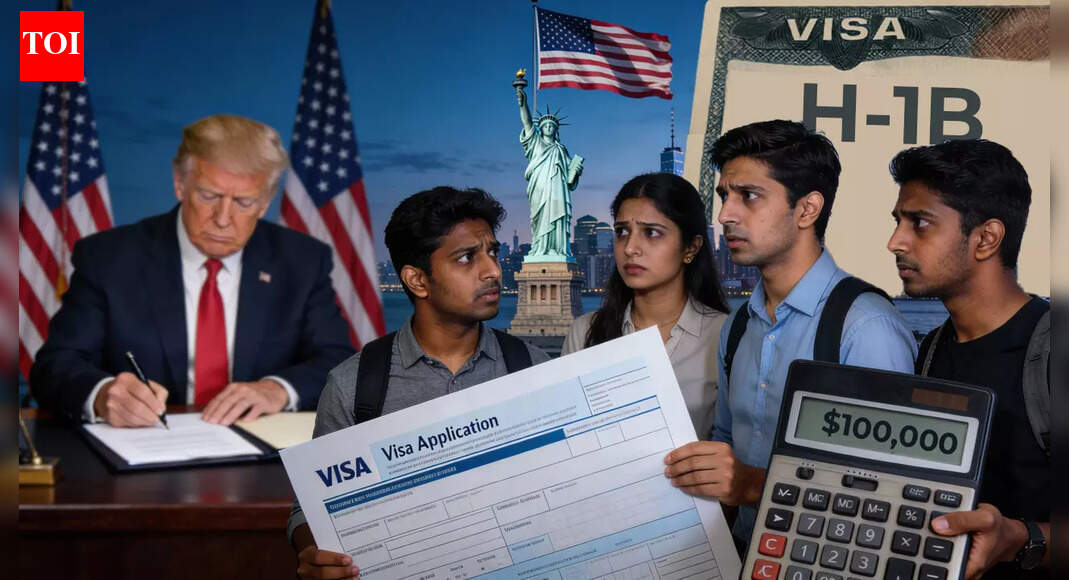
New H-1B visa rules decoded: US President Donald Trump believes that America doesn't have enough talented people - yet he is cracking down on immigration and introducing stricter controls on the people who can study and work in the world’s largest economy.
The Trump administration has put a spanner in the wheel to the American dream of several Indians. Two back-to-back moves on H-1B visas have raised questions on policy uncertainty and employment opportunities in the US. In September this year, Trump announced a massive hike in H-1B visa application fee and now the lottery-based system for visa selection has been scrapped this week. The $100,000 fee was challenged legally by the US Chamber of Commerce, but this week a US court has rejected the plea.
H-1B visas have long been the sought after route to the US for Indians - a fact which is brought to light by the fact that they comprise the biggest group of H-1B visa-holders! They also lead on the advanced degrees front among the immigrant groups and are incidentally, the median income of Indians is also the highest among immigrants - $1,45,000!
US Citizenship & Immigration Services data shows that eight American firms rank in the list of top 10 sponsors of H-1B visas in 2025.
There are just two Indian IT companies that feature in the list - TCS and Cognizant. Of the H-1B visas issued in FY24, Indian nationals made up over 70%, and China ranked second at 10%.
There are two changes to the US H-1B visa programme that mark a significant shift in how skilled foreign talent will be selected. These are: To put it simply: earlier each applicant had an equal chance based on the random lottery selection.
Now, applicants with higher salaries and better skill sets will get higher weightage in the selection process - hence increasing their chance of being selected for an H-1B visa.
The new weighted system of selection is effective February 27, 2026 for the FY 2027 H-1B cap registration season. The annual H-1B quota is unchanged at 85,000 visas (65,000 under the regular cap and 20,000 for applicants with US advanced degrees). Moving away from a purely random lottery system, the new framework prioritises wage levels and specialised skills. Given that Indians form the largest share of the H-1B applicant pool, these new rules may have a disproportionately higher impact on Indian professionals.
The hit is two-fold: The H-1B visa fee has skyrocketed - it’s become 20 times what it was earlier - from an average of $5,000 to a whopping $100,000! Secondly, with the lottery-based selection system being replaced with a wage-weighted process, several aspirants will automatically face rejection.Kuldip Kumar, Partner at Mainstay Tax Advisors notes that the H-1B aspirants that are likely to be most impacted are students, recent graduates, and even new hires with degree-based qualifications who do not work for multinational companies.This group typically includes: These applicants are more dependent on the H-1B lottery system and have fewer alternative employment-based visa options, Kuldip Kumar tells TOI.
Kuldip adds that historically, the number of registrations has been two to three times higher than the available quota. “One needs to see whether this one-time $100,000 H-1B fee will reduce the number of applicants for H-1B visa going forward due to cost considerations. If so, the doing away with the lottery system will have limited impact though it does complement the overall new US immigration policy framework,” he said.Sukanya Raman, Immigration Lawyer, Country Head at Davies & Associates, LLC believes that the fee hike will lead to fewer applications. “The chance of only higher paid employees getting selected will prevail. I don't know how many companies will be willing to give a fee of $100,000 which is close to Rs 90 lakh. So, the new system automatically filters - with only the creamy layer remaining - those who are extremely talented, and the company sees benefit in retaining that talent,” she tells TOI.According to Sukanya Raman, the total fee to get an employee to the US will now range between $110,000 to $120,000. “On top of that the employee will have to be paid a higher wage to qualify under the new system. Earlier the fee for H-1B visa was zero to apply for the lottery. Then a nominal fee was added. If the petition is picked up, there are government fees. Everything put together, it would cost between $10,000-$15,000 which would include government fees, attorney fees etc,” she explains.Anand Dhelia, Partner, Vialto Partners says that Indian professionals, who dominate H-1B filings, particularly in the IT and consulting sectors, are likely to feel the strongest impact.
He also notes that the revised system increases the cost and compliance burden on employers, leading many companies to be more selective about whom they sponsor. “The increased cost is a strong deterrent to hiring of foreign workers, especially bulk hiring.
Smaller firms that hire many early-career foreign workers or pay lower starting salaries may struggle to compete - both under the new weighted system and due to the high application fee,” Dhelia tells TOI.The silver lining?Sukanya Raman points out: “Companies looking to retain talent whose H-1B visas expire normally send them outside the US to their foreign entity. They work in that foreign entity across the globe outside of the US.
And then they are sent in and given a senior position - through that, they come to the US on an L visa. So now, people who will benefit will be senior level employees who qualify for an L visa.”Anand Dhelia too believes that senior professionals with niche expertise and higher salary offers may see improved chances under the new framework and vice-versa.
As the H-1B route becomes more restrictive, employers and professionals are increasingly exploring alternatives.
But, the fundamental thing to understand is that there is no direct substitute to the H-1B visa. Every other route is a workaround and is entirely dependent on the category of applicant it is best suited for.So, the alternative to the H-1B route under the new system may not necessarily be a single replacement - it could be a suite of options that individuals can explore, depending on their qualifications, employer, nationality, or career goals. Kuldip Kumar notes that one limited alternative is the L-1/L-1B visa, which allows multinational companies to transfer their existing employees to the US.
“The L-1 visa has no degree requirement and no annual quota, but it is restricted to employees who have worked outside the US for the same employer for at least one continuous year. As a result, it cannot be used for fresh graduates or new hires,” Kuldip Kumar explains.Sukanya Raman points to two options: “For people who are already in the US, we are seeing a lot of demand for the EB-5 visa which is an investor visa program that allows you to get a green card by investing $800,000 and which also allows the applicant to get an employment authorization document and an advance parole,” she says.“Other than that there are options like the L-visa, which is intra company transfer of manager or supervisory level employee, which can be transitioned into a green card.
Then there is the O visa, which is for extraordinary ability professionals, and then there is EB-1 and EB-2 category,” she adds.Talking about the EB-5 route, Piyush Gupta, Vice President, India & Middle East, at CanAm Enterprises tells TOI that families view it as their main option to gain nationwide professional mobility, and a strong foundation for children to excel academically and in careers within America's competitive landscape, as high-net-worth parents and mid-career tech professionals increasingly turn to it to overcome H-1B obstacles.“For most of our Indian investors, H-1B professionals and students facing decades-long green card backlogs and tightening visa policies in 2025, the EB-5 route has become a vital alternative for US stability, far beyond a mere investment, it's a pathway to secure long-term residency, sidestepping lotteries, employer dependencies, and decades long wait,” he says.Anand Dhelia tells TOI that while most impacted organisations are adopting the ‘wait-and-watch’ approach, some impacted organisations are thinking of shifting operations and talent to non-US locations or nearshoring. “Employers may rethink hiring strategies, sponsor fewer foreign workers and consider hiring local talent, or prioritize senior (higher paid) roles for foreign nationals over mass hiring,” he says.
What is more worrying is the unpredictability of visa and immigration policies under the Trump administration. Kuldip Kumar is of the view that the recent changes indicate a broader policy direction signalling tighter scrutiny, higher compliance costs for employers, and a preference for genuinely high-skill roles.He notes that applicants are already seeing greater scrutiny through stricter interviews, enhanced compliance checks, and broader background and social-media-related reviews.“Together, these developments indicate a shift toward a more restrictive and enforcement-oriented immigration environment,” he tells TOI.Kumar cautions that given the broader US policy focus on protecting domestic employment and wages, it is possible that employment-based visa categories, including the L-1, may also face closer scrutiny in the future. “There are already proposed bills and discussions in the US Congress aimed at taxing or limiting outsourcing, although none of these measures have become law so far,” he says.