


Key takeaways
- Diversification seems to be the common thread running through India’s fintech ecosystem right now.
- Paytm, which already has one of the country’s largest merchant and business networks, now wants to sell AI products built in-house to those…
- “We definitely have decided that we will go to the merchants and the businesses with the solutions and services that we created, and we…
What happened
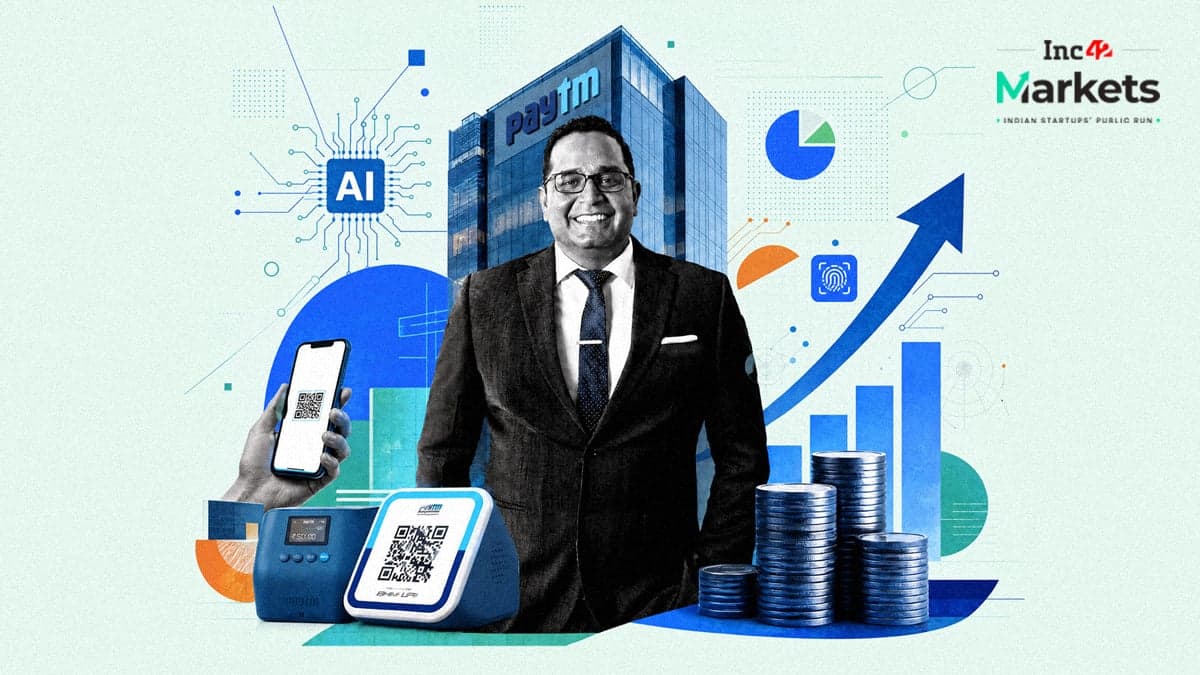
Diversification seems to be the common thread running through India’s fintech ecosystem right now. Last week, we took a closer look at Groww’s expansion moves beyond its core business. This week, it’s Paytm’s turn, but the payments giant has a slightly different ambition. The company isn’t just diversifying within fintech; it’s betting that AI software could become its next growth engine.
The focus, however, will remain firmly on enterprises rather than consumers. Responding to an analyst’s question, Sharma said the company has consciously decided against building consumer AI products, instead tailoring its offerings for businesses of different sizes. “Small people, smaller businesses will take a different kind of service.
Larger ones will take a different kind of product,” he said, indicating that Paytm sees opportunities across both SMEs and large enterprises that already use its payments and merchant ecosystem.
Sharma revealed that the company has built its own AI stack by optimising a large language model into a smaller model designed for Indian languages and deploying it on Paytm’s own infrastructure, allowing it to reduce inference costs and improve response times. Those models are already embedded across several internal workflows, from collections and customer retention to merchant servicing and merchant acquisition.
One example Sharma shared was an in-house AI agent that determines which merchants field sales executives should visit, replacing manual planning with AI-driven recommendations. The company also uses AI for customer outreach and operational workflows that were previously handled through call centres or external software providers. Having proven these tools internally, Paytm now wants to package them into commercial products. “Now here is the magical part.
Once we’ve done it, we will sell it to outside people. ” Sharma exclaimed, suggesting the company believes its internal AI infrastructure can evolve into a software business in its own right. CFO Madhur Deora echoed that view, saying AI is already helping the company “do more with less” through a growing number of internal applications and agents.
Why it matters
Paytm, which already has one of the country’s largest merchant and business networks, now wants to sell AI products built in-house to those very customers, effectively making a push into enterprise AI software and tools.
“We definitely have decided that we will go to the merchants and the businesses with the solutions and services that we created, and we ourselves are the users of them,” Paytm founder and CEO Vijay Shekhar Sharma said during the company’s Q1 FY27 earnings call. Before we unpack what this new AI bet could mean, let’s quickly look at the quarter.
One97 Communications, Paytm’s parent company, reported a 79% year-on-year jump in consolidated net profit to ₹220 Cr in the June quarter, driven by continued strength in payments, merchant subscriptions and financial services distribution. The company also posted its first-ever full-year profit of ₹552 Cr in FY26. Revenue from operations rose 28% year-on-year to ₹2,448 Cr. Cut to its AI plans.
For Sharma, however, AI has been the next chapter for some time now. Even as Paytm was working its way back to profitability, it had been quietly building AI capabilities through Paytm ARMS, a merchant lifecycle insights platform or even Paytm Pi, which is the company’s in-house fraud detection platform.
According to the company, these tools have helped automate merchant onboarding, fraud detection, customer segmentation and pricing optimisation, while improving merchant retention and lifetime value. Now that the turnaround appears largely behind it, Paytm is looking to build on those strengths. Instead of keeping these AI capabilities in-house, the company wants to package and sell them to merchants and enterprises, creating an entirely new business outside payments and financial services.
For the first time, Paytm has spelt out how it plans to monetise the AI capabilities it has been quietly building over the past few years. Rather than treating AI as another feature within its payments or lending businesses, the company is positioning it as an entirely new vertical that sits outside fintech.
While management stopped short of revealing specific product names or pricing, it did disclose that the business is no longer at the experimentation stage. CEO Sharma said some of these products have already begun generating “a few lakhs” in revenue and expressed confidence that, within the next year, the business could become large enough to be reported as a separate revenue line under the company’s Commerce Cloud segment.
What to watch
According to him, AI is not just lowering operating costs but also strengthening operating leverage, allowing indirect expenses to grow much more slowly than revenue while supporting the company’s medium-term profitability ambitions. In other words, Paytm sees AI playing a dual role: first as an efficiency engine inside the company, and eventually as a revenue-generating enterprise software business outside it.
While AI dominated the headlines, Paytm’s core business delivered one of its strongest quarters since the RBI’s action on Paytm Payments Bank in early 2024. Revenue growth was broad-based across payments, merchant subscriptions and financial services, helping the company post a 79% jump in net profit.