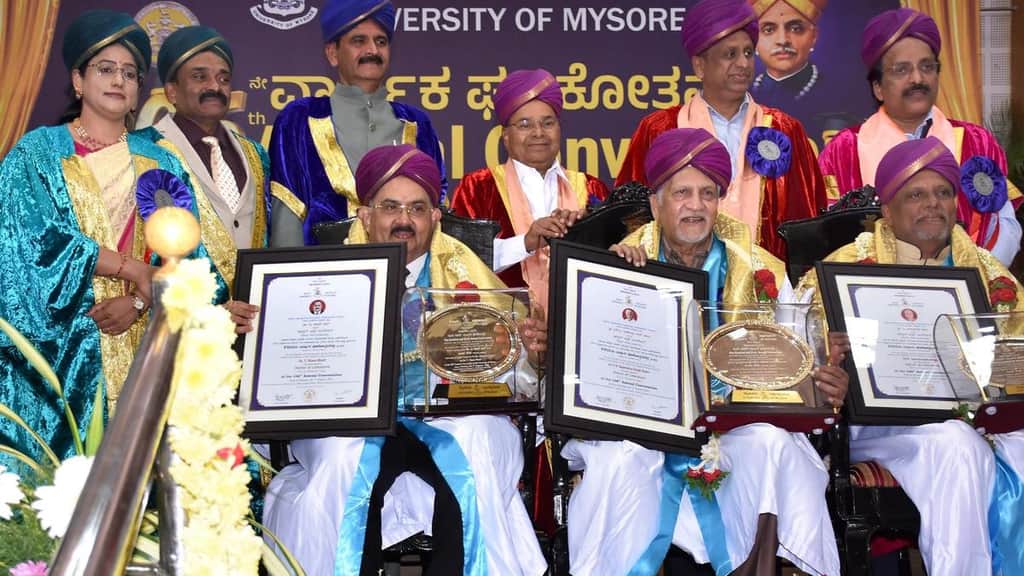
Former ISRO chairman S. Somanath emphasised the need to bridge longstanding gaps to realise India’s full potential at scale and transform the country into a developed and powerful nation under the vision of Viksit Bharat. He said the academic world must work in close coordination with industry, government, and civil society to achieve this goal.
Delivering his address at the 106th annual convocation of the University of Mysore at Crawford Hall here on January 5, he said universities should be crucibles of translational research, places where discoveries move from paper to prototype to product, and where students learn by doing at the edge of the possible.
“Let Mysuru be a place where startups co-create with labs, where internships matter as much as examinations and where technology policy is informed by evidence, ethics and empathy,” he noted.
Though Dr. Somanath said the present instructional program of the university must change, he said this topic can be discussed in the future.
Referring to India’s space programmes such as Chandrayaan-3’s landing, Aditya-L1’s vigilant eye on the Sun, and the Mars Orbiter Mission which announced India’s ingenuity to the cosmos, the former ISRO chairman said these are not just scientific milestones; they are lessons on frugal engineering, systems thinking, and mission integrity.
The eminent space scientist said the upcoming endeavours, including Gaganyaan, the Venus mission, and the Bharatiya Antarish Station, are invitations to the youth — to design, build, test, fly, and to ask not merely if we can, but how responsibly we should.
Dr. Somanath spoke about creating end-to-end manufacturing ecosystems, nurturing suppliers, building test infrastructure, and integrating our strengths in software and AI with advanced hardware and materials.
He also advised students to embrace and internalise emerging technologies such as Artificial General Intelligence, which augments human potential and reimagines learning; quantum computing, which unlocks new possibilities in cryptography, simulations and optimisation; and brain–computer interfaces, which enable new forms of experience and rehabilitation.
“These are not just transformative technologies but tools in the hands of humanity to increase its potential, to make our lives, the earth, and life on earth better,” he expressed.
Governor Thaawarchand Gehlot, who presided over the convocation, conferred honorary doctorates on film director and producer S.V. Rajendra Singh Babu, retired bureaucrat T. Shyam Bhat and educationist P. Jayachandra Raju.
The governor, who is also the university’s chancellor, conferred various degrees on students.
In total, degrees were conferred on 30,966 candidates, of which 18,612 are women.
The highest number of gold medals was presented to N. Aditi for MSc Chemistry; she bagged 24 gold medals and eight cash prizes. She was appreciated by dignitaries and also received a big round of applause from the audience at the packed Crawford Hall.
Minister for Higher Education M.C. Sudhakar also graced the occasion. Vice-Chancellor N.K. Lokanath, registrar M.K. Savitha, and registrar (evaluation) Nagaraj were present.
In the afternoon, Excelsoft Technologies chairman and managing director D. Sudhanva presented degrees to students at Crawford Hall.
Editorial Context & Insight
Original analysis & verification
Methodology
This article includes original analysis and synthesis from our editorial team, cross-referenced with primary sources to ensure depth and accuracy.