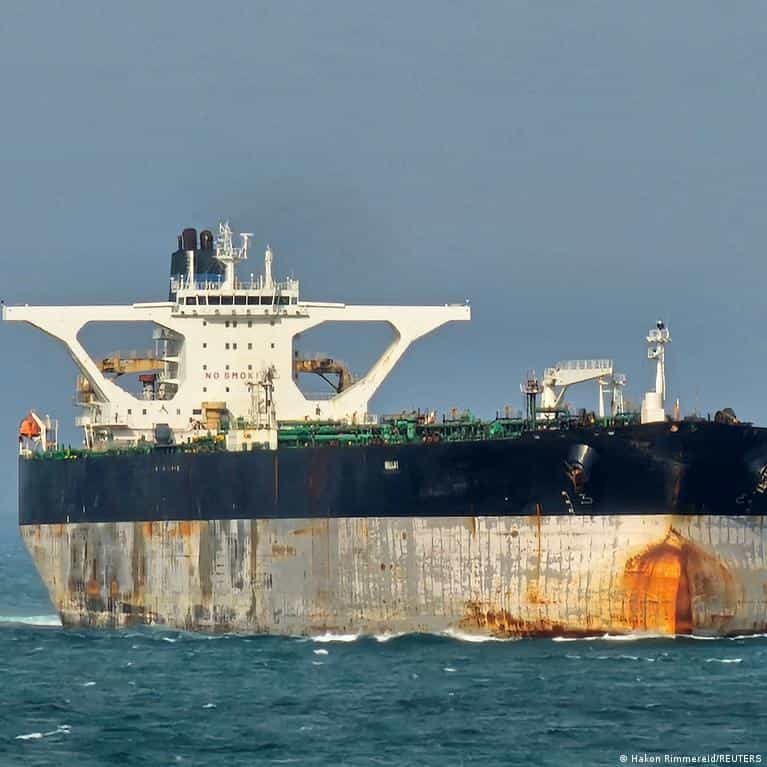
The US Department of Energy announced that the US is lifting some sanctions on Venezuela, which will allow Venezuelan oil to be transported and sold on the global market.
However, the department did not specify which sanctions would be lifted or when the changes would take effect. Currently, several oil tankers involved in transporting Venezuelan crude oil are subject to US sanctions.
The Department of Energy also announced that the US has started selling Venezuelan oil. Initially, the proceeds will be deposited in US-controlled accounts at internationally recognized banks, it said in a statement.
To view this video please enable JavaScript, and consider upgrading to a web browser that supports HTML5 video
Earlier on Wednesday, Energy Secretary Chris Wright said the US will sell Venezuelan oil "indefinitely," after completing sales of the crude currently in storage there.
"We're going to market the crude coming out of Venezuela — first this backed up stored oil, and then indefinitely, going forward, we will sell the production that comes out of Venezuela into the marketplace," Wright said at an energy conference.
On Tuesday, US President Donald Trump unveiled a plan to refine and sell up to 50 million barrels of Venezuelan oil that had been stranded in the country due to a US blockade.
During a press briefing, White House Press Secretary Karoline Leavitt said that the crew of the Russian-flagged oil tanker that was seized by the United States in the Atlantic is subject to prosecution.
"The vessel had a judicial seizure order... so that means the crew is now subject to prosecution for any applicable violation of federal law, and they will be brought to the United States for such prosecution, if necessary," Leavitt said, adding that "the vessel was deemed stateless after flying a false flag."
She also announced that the United States is selectively rolling back sanctions on Venezuela and that President Donald Trump will meet with US oil executives on Friday to discuss plans for Venezuela's oil sector.
"The meeting is on Friday, and it's just a meeting to discuss, obviously, the immense opportunity that is before these oil companies right now," Leavitt told reporters.
The press secretary also said that the United States has "maximum leverage" over Venezuela's interim authorities, and that it will dictate their decisions following the capture of Maduro.
"We're continuing to coordinate closely with the interim authorities, and their decisions will continue to be dictated by the United States of America," Leavitt said.
US Secretary of State Marco Rubio announced that the United States has a three-step plan for Venezuela.
According to Rubio, the first step is to stabilize the country after capturing Nicolas Maduro. Second, the US will oversee the country's recovery, and, finally, facilitate a transition.
"We don't want it descending into chaos," Rubio said after briefing US senators on the Trump administration's plan for the Latin American country.
"The second phase will be a phase that we call recovery, and that is ensuring that American, Western and other companies have access to the Venezuelan market in a way that's fair," Rubio explained.
"Also, at the same time, begin to create the process of reconciliation nationally within Venezuela, so that the opposition forces can be amnestied and released and from prisons or brought back to the country, and begin to rebuild civil society," Rubio added.
"And then the third phase, of course, will be one of transition," he added.
The Russian Foreign Ministry said that it is demanding the United States respect the rights of its citizens aboard a seized oil tanker in the Atlantic.
"Given incoming information about the presence of Russian citizens among the crew, we demand that the United States ensure humane and dignified treatment, strictly respect their rights and interests, and not impede their speedy return to their homeland," the ministry said, according to the Russian state news agency TASS.
The statement did not specify how many Russian nationals were aboard the Russian-flagged tanker, which US forces had pursued from the Venezuelan coast.
The UK Ministry of Defense said Britain provided support to the United States in its operation to seize a Russian-flagged oil tanker in the North Atlantic.
In a statement, the ministry said that the British armed forces provided "pre-planned operational support, including basing," in response to a US request for assistance.
According to the ministry, the military vessel provided support for the US forces pursuing the tanker, and the Royal Air Force provided air surveillance.
Defense Secretary John Healey said the operation targeted a vessel "with a nefarious history" linked to Russian and Iranian sanctions-evasion networks.
"This action formed part of global efforts to crack down on sanctions busting," he added.
Four days after special forces captured Venezuela's authoritarian leader, Nicolas Maduro, and his wife, Cilia Flores, the German government for the first time criticized the US intervention.
On Wednesday, a government spokesman in Berlin said that the US had "failed to convincingly demonstrate to the UN Security Council that its actions (in Venezuela) complied with international law."
"We have noted that the Security Council did not reach a joint assessment" on the classification at the meeting, he said, adding that it "is the current state of affairs as far as the German government is concerned."
During a special meeting of the UN Security Council on Monday, the US defended its actions as a "surgical law enforcement operation" against Maduro, whom the US described as not a legitimate head of state.
Germany initially refrained from condemning the US actions in Venezuela. Chancellor Friedrich Merz said the legal assessment of the operation was "complex" and would take time. He also stressed that Germany had not recognized Maduro's presidency.
Moscow condemned the seizure of a Russian-flagged oil tanker in the Atlantic by the US as a violation of maritime law.
"In accordance with the 1982 UN Convention on the Law of the Sea, freedom of navigation applies in the high seas, and no state has the right to use force against vessels duly registered in the jurisdictions of other states," the Russian Transport Ministry said in a statement.
According to the ministry, the contact with the vessel, the Marinera, was lost after US naval forces boarded it "in the open sea, beyond the territorial waters of any state."
The ministry added that while pursued by US forces off the coast of Venezuela, the vessel changed its name from Bella-1 to Marinera and received "temporary permission" to sail under the Russian flag on December 24.
The UK's Keir Starmer came under fire at the weekly Prime Minister's Questions session from the opposition leader for failing to brief parliament enough on developments in Venezuela and the wider world since the US capture of Nicolas Maduro.
"The truth is the prime minister does not want everyone in this House to be able to ask him questions," Conservative Party leader Kemi Badenoch alleged.
She noted how Foreign Secretary Yvette Cooper had spent more than two hours briefing the House of Commons on Monday, but claimed Starmer was "scared" to face parliament himself.
Badenoch also said it was "concerning" that Starmer had not had a call with US President Donald Trump, "four days after the events in Venezuela."
"Of course I will speak to President Trump," Starmer said.
"I spoke to his senior advisers yesterday," he continued, in reference to Steve Witkoff and Jared Kushner being among the US representatives at a meeting on Ukraine in Paris on Tuesday. "We were with them all day."
He later said that he had spoken with Trump "twice over the Christmas period" on issues like plans to increase British and European defense spending.
The US military announced it had intercepted a tanker in the Caribbean, marking its second seizure of the day.
US personnel "apprehended a stateless, sanctioned dark fleet motor tanker without incident. The interdicted vessel, M/T Sophia, was operating in international waters and conducting illicit activities in the Caribbean Sea," US Southern Command, which is responsible for the area, said in a post on X.
It posted a video purportedly showing the capture of the Sophia.
It said the Coast Guard is escorting the tanker to the United States.
US Defense Secretary Pete Hegseth said a "blockade of sanctioned and illicit Venezuelan oil" remains in place worldwide.
He made the remark in a retweet of the US European Command, which confirmed that US forces seized an oil tanker linked to Venezuela in the North Atlantic.
"This seizure supports @POTUS [President Donald Trump] proclamation targeting sanctioned vessels that threaten the security and stability of the Western Hemisphere," the European Command wrote in their post.
In December, US President Donald Trump ordered a "blockade" of all oil tankers entering and leaving Venezuela.
United States forces have boarded a sanctioned oil tanker in the North Atlantic after a weekslong pursuit, according to officials.
They say the vessel, now called the Marinera, is part of a shadow fleet moving oil for Venezuela, Russia and Iran in violation of US sanctions.
The tanker was previously named Bella-1 and recently switched its registration to Russia. Its crew reportedly even painted a Russian flag on the hull.
The US Coast Guard first tried to intercept the ship in December as it sailed toward Venezuela, where Washington has imposed a naval blockade on sanctioned oil shipments.
When the vessel refused boarding, it crossed the Atlantic, prompting a chase.
On Tuesday, Russia's Foreign Ministry said it was "following with concern" the US pursuit of the tanker.
"For reasons unclear to us, the Russian vessel is receiving heightened attention from the US and NATO militarism attention that is clearly disproportionate to its peaceful status," the ministry said.
The United States is attempting to seize a Russian-flagged oil tanker linked to Venezuela after a two-week pursuit across the Atlantic, the Reuters news agency reported.
US officials say the operation, near Iceland, involves the Coast Guard and the military and Russian warships, including a submarine, are also in the area.
US forces have boarded the tanker, an official told The Associated Press.
The tanker, now called the Marinera, previously sailed under another name and evaded a US maritime blockade. It’s the latest target in Washington’s campaign against Venezuela’s sanctioned oil shipments.
This afternoon’s coverage focuses on a tense standoff at sea: the United States is trying to seize a Russian-flagged oil tanker linked to Venezuela.
The vessel, originally named Bella 1 and now sailing as Marinera under a Russian registration, is one of about a dozen tankers attempting to break through a US naval blockade around Venezuela.
This high-seas drama comes just a day after President Donald Trump announced that Venezuela will “turn over” up to 50 million barrels of oil to the US, a deal worth roughly $2.8 billion (€2.4 billion).
Trump also said the US plans to take control of Venezuela’s oil industry and bring in American companies to revitalize it, though experts warn that restoring the country’s energy infrastructure will require massive investment.
It comes after this weekend's dramatic raid by US special forces on Caracas and the capture of President Nicolas Maduro, who now faces drug trafficking charges in New York.
Follow along with DW for the latest moves by the US toward Venezuela.
Editorial Context & Insight
Original analysis & verification
Methodology
This article includes original analysis and synthesis from our editorial team, cross-referenced with primary sources to ensure depth and accuracy.
Primary Source
Deutsche Welle