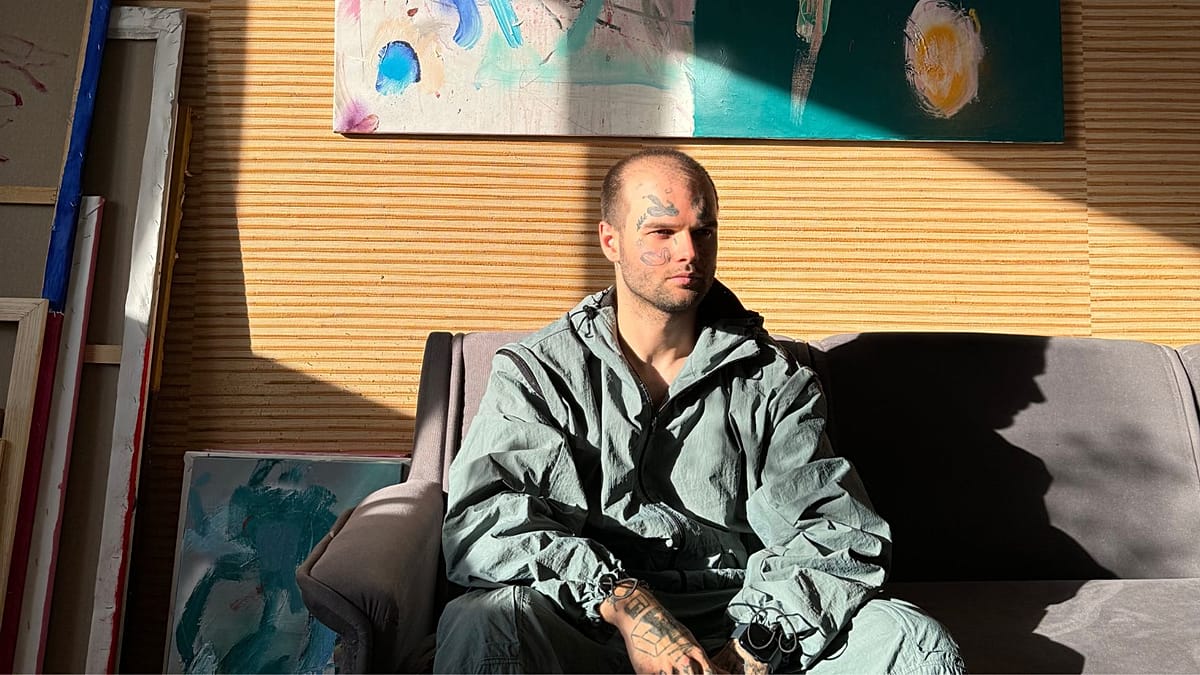
Before Russia's full-scale invasion of Ukraine in February 2022, Vlad's life revolved around art. His days were carefree: he painted in the mornings, strolled through Kyiv at lunchtime, and spent his evenings visiting exhibitions and events.
For the Ukrainian artist, 2021 felt like another cultural renaissance in Kyiv, a city buzzing with talented creatives.
Then came 24 February 2022, when Russia launched its all-out war against Ukraine. In 2023, Vlad joined the Ukrainian Air Force, where he still serves today.
Despite the ongoing attacks, the destruction around him, and the constant fear for his own life and that of his loved ones, Vlad continues to paint in his free time. Art helps him come to terms with the war and his new "job."
This year, he shared his works with Euronews Culture, showing how he channels into his art his experiences as a soldier in the Ukrainian Armed Forces.
"On 2 January, I found out I would have to undergo a military medical examination, as 30 per cent of soldiers were being transferred from the Air Force to the Ground Forces," Vlad told Euronews Culture.
"The war had already been going on for 11 years, and during this time many patriots of our country had been killed. That's why the command decided to draw reserves from the rear," he added.
Vlad felt dazed and anxious, but "another part of me experienced an energetic surge – and I created the strongest painting of my entire life. In the fear of death, miracles happen," he said.
The events of January and the threat of being sent to the front left deep scars on Vlad. "Throughout January, I hardly painted at all" he explained.
"Coming home from service, all I wanted was to lie down and fall asleep – and wake up again in the world I used to live in. A world where my comrades weren't being transferred to the infantry, and where I only painted occasionally on weekends."
He had been prescribed antidepressants the year before, but the fear of redeployment broke him. He stopped taking his medication and began consuming large amounts of sweets and alcohol.
Within two months, he gained over 20 kilos. Looking in the mirror, he barely recognised himself. He found comfort only in memories of his childhood.
"I remembered my grandmother, who had been my best friend. I lived with her, and she often spoiled me with sweets, baked cookies and pies." This painting captures those warm childhood moments, when you didn't have to worry about where the money for sweets would come from, or when you’d have to dash to a shelter during an air raid, Vlad explained.
In March, Vlad started having trouble sleeping. He would wake in the night, his mind filled with thoughts about his life and the fate of those close to him. "The constant explosions outside my window at night started blending with my nightmares", he recalled.
Even now, he can't explain why he stopped taking his medication without speaking to his doctor. "To this day, I don't really understand why I stopped taking my medication without consulting my doctor – I just really wanted to drink alcohol, and I knew it was dangerous to combine it with the meds," he said.
March also brought the first signs of spring. The world began to bloom, and the days grew lighter. But Vlad's own world was unraveling at a terrifying pace.
One day, he thought of his grandfather, who had been a lieutenant colonel in the Soviet Air Force. Thinking about his grandfather's fate made Vlad realise how merciless the Soviet system had been: despite holding a high rank, his grandfather was forced to retire at 40 over an alleged "act of treason" – simply because his sister had married an Italian and moved to Italy.
Vlad remembered the walks they used to take together, the kindergarten walls painted with animals, and the surreal cartoon figures on the gates. It was then that he knew he wanted to capture these images in his own work.
In April, Vlad didn't paint much, but he spent a lot of time thinking about the direction he wanted his work to take. "Nine years ago, in the city of Dnipro, I decided to take up easel painting. Before that, I had been working with film photography, so I was already familiar with art," he explained.
Vlad decided to create abstract canvases inspired by his memories – memories that still had a figurative base. "So I began combining abstraction with figuration. The month of April became decisive for the transformation of my art."
The war kept catching up with Vlad. In May, his stepfather and his comrades came under fire. "He's a soldier too, a volunteer just like me," he added.
Vlad's mother separated from his father when he was 20, and three years later she remarried. "When a family falls apart, it's hard for everyone involved, and for the children most of all", he said.
This painting is a reference to Luchino Visconti's film Violence and Passion, "where a lonely elderly man wants to remain alone, yet everyone around him tries to fill his emptiness, destroying his world in the process."
Vlad isn't sure who his work really depicts: "my father, me, perhaps my stepfather, or my mother."
In June, Vlad was on leave and spent much of his time painting. "When you're on leave, you feel free — the way an artist should feel, without restrictions or outside pressure," he says. That summer, Russia attempted to push towards Pokrovsk, a strategically important city in eastern Ukraine.
In the summer, Russia attempted to advance rapidly in the city of Pokrovsk, which serves as a stronghold on the border of the Donetsk region and has significant logistical importance for Ukraine.
"Immediately after the Donetsk region begins my native region, Dnipropetrovsk, where I serve and defend the skies. It’s hard to describe my feelings even for a moment when trying to imagine that the enemy would reach my hometown, the home where my relatives live. So, on one hand, you are free, but on the other, there is an ongoing war, making it impossible to completely dissolve yourself in art. In Ukraine as a whole, it's impossible to forget about the war, no matter who you are. There are battles at the front, shelling of civilians in the country's rear, columns of fallen soldiers moving through the city every day, and the pain in the eyes of passersby – this is what it means to live in Ukraine."
One warm summer day in July, Vlad's cat Anfisa was playing in the yard, chasing butterflies. Out of boredom, she climbed the old walnut tree – until a black crow suddenly appeared and turned it into a hunt.
"For six long hours she meowed and plaintively called for help. And I stood below and waited; by evening she finally climbed down", Vlad recalled. Since that day, she became a housecat.
"This is not a story about war, but about the struggle with oneself and one's inner world. Sometimes just one day, one situation, is enough to completely change your universe."
By the end of the summer, Vlad began to question whether he could continue with art at all. The war showed no sign of ending, and he had almost no chance of travelling abroad to properly develop his work. His paintings barely sold. His military salary was often not enough to live on.
"So it seemed like a reasonable decision to obtain a military education and follow that path, so as not to wound myself with unattainable dreams or torment myself with a sense of professional inadequacy in art", he added.
In the art world, "young artists" are usually defined as being under 35, he explained. As he approached 30, that label weighed heavily on him. "This winter I will already be 30, and I have never been abroad, and the chances to leave and find my place in the real art world are steadily diminishing", Vlad said.
"So this month has once again been extremely difficult; honestly, my mind feels like it's breaking from these endless emotional roller coasters connected to my creative career."
In September, Vlad was exhausted and barely painted.
"Once, I managed to get free from duty and drove 500 kilometres to sell a painting. It really inspired me – the last time I'd sold a piece was in May," he explained.
It had not been a good year for sales. "The country is at war, the economy is in terrible condition, and the interest rates for sole proprietors are high. People have no time for art – everyone is focused on survival and everyday life."
But as he sped along the motorway at around 180 kilometres per hour, heading to sell the painting, he felt alive. "At that moment I had only had my driver's license for three months, yet I had already driven 5,000 kilometers on duty. It was a wonderful day, and I really like the painting I created that evening."
"I was remembering the kindergarten gazebos from childhood, the drawings on the walls of the sleeping rooms, and the overall atmosphere there – joyful, sincere, without masks. In childhood, everyone could be whoever they wanted: rabbits, cats, deer. This inspired me to recreate something similar. I wanted children today to be happy too", Vlad said of his October artwork.
He wants children today to be happy too. "Children suffer greatly during the war. Some fathers go to the front, and the children stay at home with their mothers. Some families flee to another European country because the parents are exhausted from constant shelling. Others end up under occupation by the Russian Federation and are killed by Russian soldiers, or the children are kidnapped and forcefully placed for adoption in Russia. It is terrible to be a child right now."
For Vlad, November was a month of constant swings – talks of possible negotiations, another leak or betrayal of Ukraine by Donald Trump, domestic political problems with international repercussions, and numerous cases of Ukrainian soldiers abandoning their units.
"Small pawns in the hands of aces – this is how the life of an ordinary Ukrainian on the market fluctuates between a $500 monthly salary, sacrificing youth and health, while others trade the aces hidden up their sleeves. So is the war an American rollercoaster? Or Russian hockey? Where everything changes depending on how the referee looks at the situation – whether to pass the puck to the enemy’s half of the rink or score a goal immediately."
I don't know where I will be after this war – or whether I will exist at all. I don't know where my country will be, where my family and my brothers-in-arms will be. Today's reality is far from optimistic: the front is cracking, the enemy is breaking through at a furious pace, while society prepares for Christmas holidays as if the war were background noise rather than a sentence", Vlad told Euronews Culture.
He is not against holidays, but the thought of someone dying at the front while these lines are read makes him "physically sick". "Not an abstract 'soldier,' but a real person who went to defend this land for those who stayed behind. The rear is part of the war. But when the rear lives as if the war is somewhere far away and not about them, the front pays for it in blood. Western partners speak the right words, but the balance sheets tell a different story", he added, referring to the purchase of Russian energy.
He added that in his opinion, this war has long become "a war of money, a war of interests, a war in which comfort and profit matter more than the life of an entire nation."
"We are supported only to the extent that it does not harm someone else's economy. I am not a romantic or an idealist. I understand how this world works: capital, hierarchies, profit. But there is a line beyond which cynicism stops being 'realism' and becomes complicity. And while some count profits and prepare for holidays, others pay for it with their lives. Maybe one day there will be accountability. Or maybe there won't."