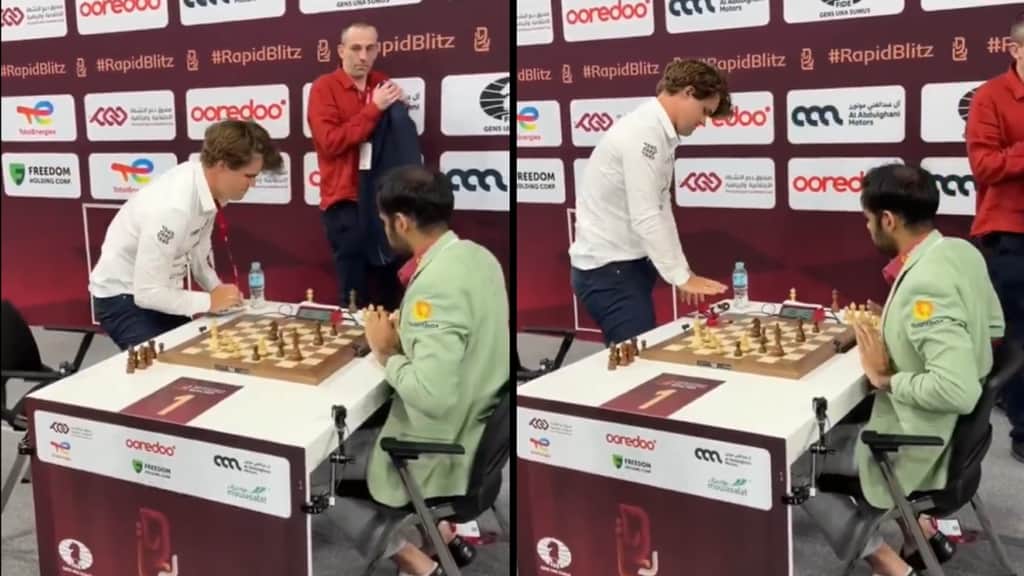
With only two seconds left on his clock, Magnus Carlsen paused the game after inadvertently scattering the pieces into disarray without completely rearranging them to the original position. The move was immediately ruled illegal. His opponent, a visibly frustrated Haik Martirosyan, could do nothing but see Carlsen argue with arbiter Chris Bird. Carlsen soon returned, extended a handshake, and conceded defeat. This wasn’t an isolated lapse in judgment by the Norwegian but one of four separate incidents during the 2025 World Rapid and Blitz Championship in Doha alone.
Many players have questioned FIDE’s reluctance to censure Carlsen but the parent body of chess have stressed to this newspaper that they are not concerned about his actions. The organisation also made clear that as long as the game’s visibility expands, with chess becoming increasingly mainstream and generating strong sponsor and engagement value, FIDE is satisfied with the overall direction.
“FIDE is aware that, with the increasing global attention on major chess events, certain situations can lead to public discussion within the chess community. Such occurrences are normal in every open and engaged circle, and the chess community is one of them. FIDE views any such situation as a valuable opportunity for critical assessment and improvement,” said FIDE when reached out by The Indian Express.
— International Chess Federation (@FIDE_chess) December 29, 2025
“FIDE’s stance is not one of denial, but of proactive growth and dedication to the sport. We have demonstrated that – with more events, increased participation, growing sponsor engagement, and enhanced funding and support for chess players of different levels (not just top professionals),” they said.
Grandmaster Srinath Narayan acknowledges the value of visible emotion in chess. “A certain kind of expression of emotion is good for chess. We need those expressions because people generally don’t see what is happening to a chess player’s mind,” he told The Indian Express. However, he warns of the influence wielded by a player of Carlsen’s stature: “The danger… is that people perceive it to be something cool. And Magnus is very influential… kids look up to him.”
In recent times, emotion has increasingly overridden Carlsen’s composure. He shoved a camera aside after a loss to Vladislav Artemiev, slammed the table when his queen slipped from his grasp under time pressure against Arjun Erigaisi, and shouted aloud after blundering a rook against Fabiano Caruana.
Srinath’s concern is also resonated by Armenian-American Grandmaster Levon Aronian. “I don’t think we should be normalising tantrums like that,” Aronian wrote on social media platform X. “It does affect players who are in the middle of a game who hear loud noises. In many sports such acts are penalized as unsportsmanlike behavior in order to send a message to younger athletes.”
Both grandmasters point to the lack of official repercussions as the core issue. Their comments were provoked in part by a social media post from arbiter Chris Bird, who officiated in Doha and clarified that “no pieces, chessboards or tables were harmed” and that Carlsen had immediately apologised. Yet, for critics, an apology alone is insufficient without disciplinary follow-through.
Srinath also criticised Carlsen’s chronic tardiness, calling it “very annoying” and bad for the sport’s decorum. He argued that while standard financial penalties deter most players, “something similar should be there for such an action” against Carlsen, for whom financial penalties will not matter much, and whose habitual delays “set a very bad example”.
— Norway Chess (@NorwayChess) June 1, 2025
Srinath emphasises that inaction from FIDE sends the wrong message. “Like Levon said, normalising this kind of behaviour or leaving it unaddressed… kids get the message that it is a cool thing to do,” he said. “I believe that is a danger… Which is why I felt that some kind of a reprimand would have delivered [the message] that okay, Magnus did this, but it’s not the right thing to do. And it is not something that should be followed.”
Doha is not the first FIDE event to come under scrutiny following a string of controversies. The organisation’s recent tournaments have consistently been marred by disputes. Examples include the 2024 Candidates’ “shoegate” controversy involving Alireza Firouzja, the 2024 World Rapid and Blitz Championship “jeangate” scandal arising from Carlsen’s stubbornness to challenge the dress code, and the controversial decision to share the Blitz title between Carlsen and Ian Nepomniachtchi, which contradicted regulations requiring play to continue until a clear winner was decided.
Editorial Context & Insight
Original analysis & verification
Methodology
This article includes original analysis and synthesis from our editorial team, cross-referenced with primary sources to ensure depth and accuracy.
Primary Source
The Indian Express