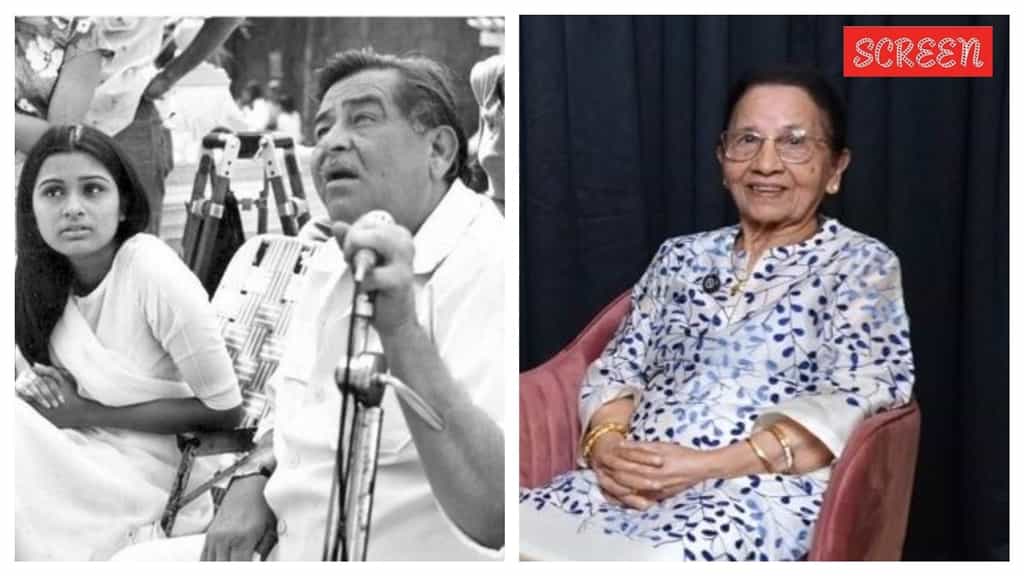
Kamna Chandra was one of the very few women screenwriters of Hindi cinema back in the early 1980s. In many ways, she paved the way for screenwriters like Honey Irani, Sooni Taraporewala, and Juhi Chaturvedi. She’s worked with late legendary filmmakers like Raj Kapoor on Prem Rog (1982) and Yash Chopra (Chandni, 1989). She also co-wrote 1942: A Love Story (1994) with director Vidhu Vinod Chopra, who later became her son-in-law. In an exclusive interview with SCREEN, Kamna breaks down her 40-year-plus journey.
You didn’t have any connections to the film industry. And it was nonetheless an uphill climb for any woman screenwriter to get her script greenlit in the early 1980s. How did you then land a film as seminal as Raj Kapoor’s Prem Rog (1982)?
I’d written extensively before that also, but for magazines, radio, and television in Delhi. People had just started warming up to television back then. My husband, who worked at a multinational company, got transferred to Mumbai. So, excitement sparked within me that I can try writing for films now. I also began writing for radio stations and magazines in Mumbai. I was pleasantly surprised that there was so much respect of the Hindi language in Mumbai. You expect that in Delhi, but even Mumbai surprised me.
When I thought of writing films, Raj Kapoor’s name came to my mind. He was one of my favourite directors. I was in eighth or ninth class when I watched his film Aag (1948). So, I just looked up his name in the phone directory and called up RK Studios. Can you believe it? I never thought that one call would change the course of my career. His secretary picked up the call. He said Raj sahab is very busy, so would I be okay narrating my story to his assistant? I asked, “What if the assistant doesn’t like my story?” Because it’s a creative thing. Each person has a different opinion on a story. So, he asked me to leave my number with him. And can you believe it, I got a call back within a week itself.
How well did Raj Kapoor receive you when you first met him, since you were a newcomer in the business of films?
He gave me a lot of respect. I can’t even tell you. Firstly, his secretary guided me how to reach their office because I was new to the city (laughs). When I reached there, he served me tea and then made me meet Raj sahab. Raj sahab never made me feel like he’s such a prolific director and I was a newcomer in films.
What did he like about your story of Prem Rog?
All the six films I’ve written so far, they’re based on a basic truth. That’s why they appeal to everyone. They’ve come from the heart, and haven’t been curated clinically. It takes years to knit together the screenplay, but the basic story should touch your heart. You should feel the emotions. My mother had narrated me the story of a zamindar in a village. That story stayed with me. I found all of Raj sahab‘s films to be great, but I felt there was a lack of plausibility in Satyam Shivam Sundaram (1978). So, I really wanted to meet Raj sahab. When I narrated the story to him, he’d laugh but also feel sad about what happened to that girl (Padmini Kolahpure’s character). He asked me if I wanted to get involved in the screenplay writing. But my kids were quite young then, and I was quite happy with the fact that my story appealed to Raj sahab. I told him I don’t know anything about writing a screenplay. So, he brought in Jainendra Jain. But the story I gave to him was already more than 100 pages.
Padmini Kolahpure in Prem Rog. Did Raj Kapoor do justice to your story?
He even asked me to get my story registered with the screenwriters association. Can you believe it? He could’ve taken my story and lied to me that he didn’t like it and then made a film out of it. He sent someone to help me with the registration and asked me to keep the original document with me. During the making of the film, I told Raj sahab that my husband got a transfer to Hong Kong. He’d made 9-10 reels by then. So, he invited us to watch the film and give our feedback. When I returned to India for a break, I saw posters of Prem Rog, in which my name was as big as the director, the screenplay writer, and the music director. I don’t know how much more respect he could give me.
Were you wary that Raj Kapoor wouldn’t glamourize Prem Rog too much like he did with Satyam Shivam Sundaram?
(Laughs) He was so worthy of worship that I wouldn’t dare make such a belittling request to him. He’d made so many films. The only film I felt he strayed away from reality was Satyam Shivam Sundaram. I narrated him two stories. There was more scope for glamour in the other story, but he chose this widow’s story. Even when I watched those nine reels, I felt he’d crafted each scene with so much emotion. It became a huge success and was nominated for several awards. I was also nominated for Best Story, but I think the award went to Gulzar for Namkeen. Raj Kapoor used to present his heroines very beautifully. When he told me Padmini Kolhapure would play the lead role, I asked him if she can do justice to it since it’s such a difficult role. He was very confident of her talent. She indeed did such a great job, and even won the Best Actress award for it.
How did Chandni happen after that?
Since Prem Rog was loved so much, Yash ji approached me himself. He also liked my story in the first narration itself. At that time, three big films of his hadn’t worked then — Mashaal (1984), Faasle (1985), and Vijay (1988). But those were mostly action films. Chandni was his return to romance after Silsila (1981). He also treated me with a lot of respect. When we were developing the film, he pointed out that the hero-heroine meeting in college isn’t something new. So, I borrowed from my story Bade Log, which got published in Dharmyug magazine, in which a gorgeous girl visits a new city for a wedding where the hero meets her. It’s a story that’s still very close to me, and is one of my best.
Was Yash Chopra able to make that story even better for the big screen?
Absolutely. The casting was so well done. When Vinod Khanna met me for the first time, he asked me, “Why have you written such a short role for me?” (laughs).
Is it true that in an initial draft, Vinod Khanna’s character marries Chandni (Sridevi)?
No. But there was a draft in which Rishi Kapoor’s character marries Chandni initially. Because I felt it’d have been so tough for her to leave her home after that. But Yash ji didn’t want them to get married then. So, I thought he knows far more than me. He’s made so many films. It’s his movie. But he did full justice to my story. Chandni also became such a huge hit that I got a lot of encouragement. I didn’t really have to struggle. Everything just worked out on its own.
Rishi Kapoor would know you from earlier right, since he was Raj Kapoor’s son?
Oh, very well. Raj ji used to tell him that she’s the mother of this story so you should ask her questions. They treated us so nicely that it never felt that I was an outsider. Raj ji also invited us to the premiere of Ram Teri Ganga Maili (1985) and introduced me to everyone as the writer of Prem Rog. Whenever Rishi would meet me, he’d point out that he worked in two of my films, Prem Rog and Chandni.
How was your interaction with Sridevi like?
Yash ji used to say she’s a woman of few words. But once the camera rolls, she transformed into something else. She must be coming prepared to set, which is why she could blend into her character like that. I met her on the set only a couple of times. She used to greet me very politely, like everyone else.
Rishi Kapoor and Sridevi in Chandni.
Was it your daughter Anupama Chopra who recommended you work with Vidhu Vinod Chopra?
Yes, all my three kids were studying in the US. My husband used to travel there for work, so I’d accompany him so that I also get a chance to meet the kids. One day, we got a video cassette of Parinda (1989) to watch together. None of us could even get up as we watched that film. It was starkly different from the films being made then. I hadn’t heard of Vinod Chopra’s name by then. He’d already won a National Award and got nominated for an Oscar, but I wasn’t aware. It was destiny that Anupama asked me to narrate my next story to that director (laughs).
Wasn’t Parinda a very different film from the ones you’d written?
It was extremely different! It was such an eye-opener. Although I still don’t endorse or write violence, but that film was such an impactful story about the human condition. I didn’t even think whether Vinod can make a romantic film, but I just called up his office in Natraj Studio. They asked me to come over and narrate the story the next day. It was that easy.
Is it true that you wrote Kareeb (1998) before you wrote 1942: A Love Story?
Yes, and it took two years to write Kareeb. I don’t even remember how many drafts we wrote. When I submitted the story, Vinod said, “I don’t work like that,” and asked me I should also get involved in the screenplay. He said if I could write so many stories and dialogues for television (Trishna, Kashish), writing a film screenplay should be a cakewalk. Since my kids were away then, I agreed to write the screenplay as well. We finalized Kareeb, but once I returned from a US visit, he said he’d make it later and nothing goes waste. He wanted to make a bigger film on India’s freedom struggle first.
How did you react to that abrupt change in plans?
I was thrilled because I’d watched India get independent in front of my eyes. Waving the tricolour and listening to then-Prime Minister Jawaharlal Nehru’s speech Tryst with Destiny from the terrace of my school — these are all a part of my childhood. I remember on Raksha Bandhan, a bunch of us girls stormed into the collector’s office and tied him a rakhi which said, “Do or die.” I re-watched 1942: A Love Story after over 30 years at IFFI Goa. It gave me goosebumps watching how hard we’d worked back then.
How easy or tough was it to work with Vidhu Vinod Chopra?
It’s not easy to co-write with Vinod. On the first day, he’d say, “It’s very beautiful, Kamna ji.” The next day, he’d say, “Try harder.” A couple of times, I even said I can’t push myself further. If you remember there’s a Romeo & Juliet play scene in 1942: A Love Story. Vinod didn’t want to show that in English, so he asked me to translate the scene in Hindi. I gave him six-seven scenes written in verse in Hindi. Vinod loved it so much that he asked me to translate the full play in Hindi so that it can get published. But later, he chopped off those scenes from the film. When I asked him why, he said, “Don’t get emotionally attached to your lines.” He wanted to keep the film’s length limited to two and a half hours.
Anil Kapoor and Manisha Koirala in 1942: A Love Story.
Kareeb couldn’t recreate the success of 1942: A Love Story. Why do you think that was the case?
The story changed a lot across the years and the drafts. There were other co-writers too. Sanjay Leela Bhansali was already involved, and later, Abhijat Joshi also joined in. He tells me even today that a lot of other ideas came in from the outside, but my main story got pushed to the back (laughs). My hero eventually became someone who used to wash clothes at a laundromat. Maybe it didn’t work as much as we were hoping it to, but everybody said it’s a sweet film.
Bobby Deol and Shabana Raza in Kareeb.
You worked with your daughter Tanuja Chandra on Qarib Qarib Singlle (2017)?
I’d originally written that as a radio play for Hawa Mahal show on Vividh Bharati long ago. It was about a poet who keeps falling in and out of love. He assumed that they’d be pining for him, but when he visits them again, he finds out they’re happily married. The third one, who’s the richest, even offered him a job in her husband’s mill. He gets very hurt by that (laughs). Tanuja and her co-writer Gazal Dhaliwal turned the story on its head and turned it into a story of today. I wasn’t involved.
How did you like Irrfan Khan’s performance as Yogi?
He was initially a bit hesitant to play that part because he wanted it to reflect that his character was quite sentimental. He did a very fine job. It’s sad that he passed away so young and couldn’t do even more fine work.
Irrfan Khan in Qarib Qarib Singlle.
What were your thoughts on Netflix India’s show adaptation of Vikram’s novel Sacred Games?
It’s an 800-page novel. It was sitting on my dining table for two months (laughs). The reality of that book is it belongs to the criminal world. But to condense it into two seasons, it depends on the director. What he wanted to show and not, it’s their discretion. What to do? Even today, I believe more in love stories.
You said Devdas is one of your favourite books. How did you like Bhansali’s 2002 film adaptation of Sarat Chandra Chattopadhyay’s novel?
He changes the story as per his whims. I know him very closely since we co-wrote Kareeb. He had that spark. He narrated the full story of Khamoshi: The Musical (directorial debut, 1996) to me. He’s very talented, hardworking, and his vision is very vast. What happened with Devdas is that it became very glamorous. The story changed a lot. Paro (Aishwarya Rai) and Chandramukhi (Madhuri Dixit) never even met, but he made them dance together (on “Dola Re Dola”). As a book reader, the story of this Devdas was very different. Maybe things would have been different if it wasn’t titled Devdas.
Have you never thought of pitching your next story to him?
I have, but he’s too busy making all these films (laughs). I don’t want to pester someone just because I know them personally. I’m content with making six films. I still have a couple of stories with me. There are stories all around us. Anything that touches my heart, I’m not able to forget that. I do keep telling Tanuja that since seven is my lucky number, if my seventh film gets made within my lifetime, I’ll be very happy.
Editorial Context & Insight
Original analysis and synthesis with multi-source verification
Methodology
This article includes original analysis and synthesis from our editorial team, cross-referenced with multiple primary sources to ensure depth, accuracy, and balanced perspective. All claims are fact-checked and verified before publication.
Primary Source
Verified Source
The Indian Express
Editorial Team
Senior Editor
Dr. Elena Rodriguez
Specializes in India coverage
Quality Assurance
Copy Chief
Fact-checking and editorial standards compliance