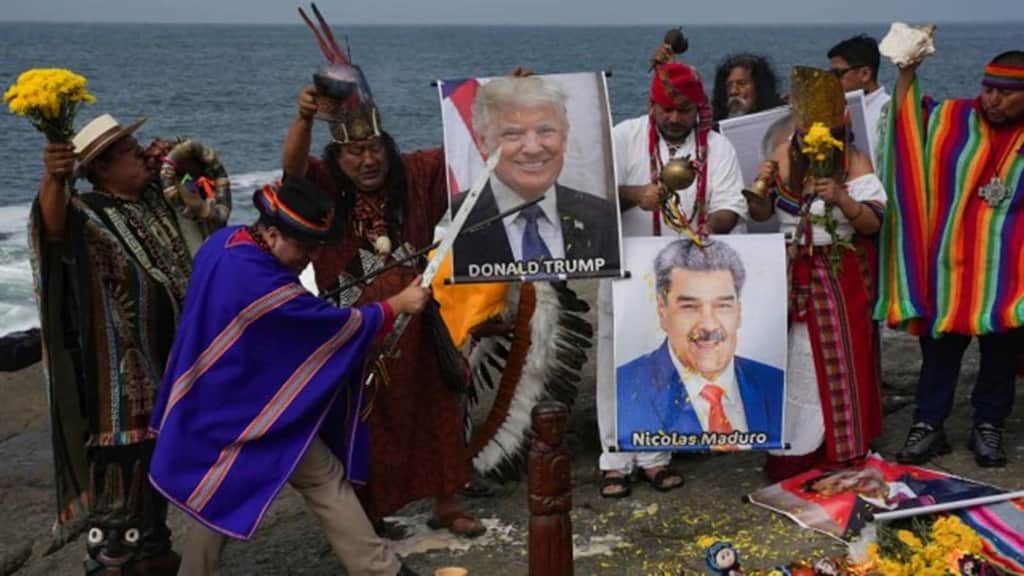
Nicolás Maduro and Venezuela. Donald Trump’s explicit threats of regime change have pushed Venezuela abruptly from chronic crisis into acute confrontation.
The arrest of Nicolás Maduro, the swearing-in of a successor under military backing, and US President Donald Trump’s explicit threats of regime change have pushed Venezuela abruptly from chronic crisis into acute confrontation. While the language surrounding these events is framed in the immediacy of drug trafficking, national security, and law enforcement, the dynamics at play are neither new nor unique.
This moment demands more than headline consumption. It requires historical memory, regional perspective, and an understanding of how interventionist logic is constructed, justified, and resisted. The following short reading list is designed as an entry point for readers seeking to situate the current Venezuela crisis within its deeper political, economic, and cultural context.
Everyone Who Is Gone Is Here by Jonathan Blitzer gives insight into the US policy.
Blitzer’s book is indispensable for understanding how decades of US policy, often framed as security, law enforcement, or humanitarianism, have destabilised Latin America and driven migration, state collapse, and authoritarian backlash. As Trump frames Venezuela as a “narco-terrorist regime” and justifies unilateral action, this book shows how such narratives recur across administrations and routinely produce humanitarian crises rather than stability.
A Short History of U S Interventions in Latin America and the Caribbean by Alan McPherson gives a abridged view of the issue.
McPherson provides a clear, compact history of U.S. military and quasi-military interventions, from the 19th century to the drug war era. His framework (causes, consequences, contestation, collaboration, context) is especially useful for evaluating claims that the Venezuela operation was “law enforcement, not war.” The book helps readers assess whether current events represent continuity rather than exception.
Beneath the United States by Lars Schoultz is a must read.
Schoultz argues that US policy toward Latin America has long been shaped by a paternalistic assumption of regional inferiority. Trump’s language toward Venezuela, and even Colombia, fits squarely within this tradition. This book is essential for understanding how dismissive rhetoric translates into coercive policy, often with little regard for sovereignty or long-term regional stability.
Inevitable Revolutions by Walter LaFeber explores the united States’ relationship with Central America. (Source: amazon.in)
LaFeber’s classic work explains how US efforts to suppress leftist movements in Central America repeatedly produced the very instability they sought to prevent. As Washington once again embraces regime change logic in Venezuela, this book offers a cautionary historical lens on unintended consequences, backlash, and prolonged conflict.
Galeano’s work remains a touchstone for understanding how Latin Americans interpret US actions. (Source: amazon.in)
Though polemical, Galeano’s work remains a touchstone for understanding how Latin Americans interpret US actions involving oil, resources, and political coercion. Trump’s explicit references to Venezuelan oil echo precisely the extractive logic Galeano critiques. Reading this alongside contemporary reporting helps explain regional outrage and resistance to US justifications.
Editorial Context & Insight
Original analysis & verification
Methodology
This article includes original analysis and synthesis from our editorial team, cross-referenced with primary sources to ensure depth and accuracy.
Primary Source
The Indian Express