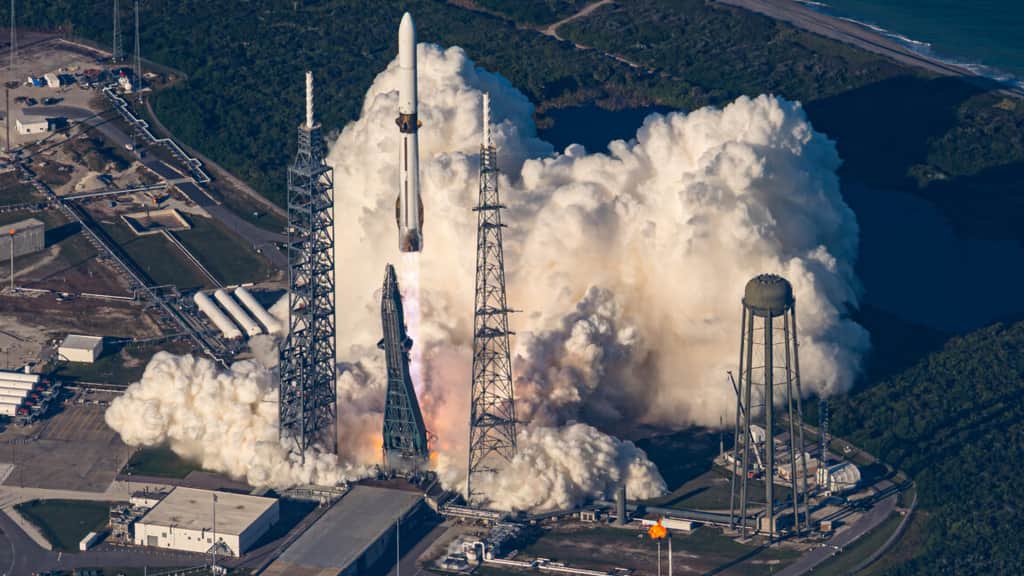
There are some fresh faces entering the rankings this year. Which US rocket companies achieved the most during 2025?
Once again, Ars Technica is here to provide some answers in the form of our annual power ranking of US launch companies. We began doing this in 2022 and have since put out a top-10 list every year (see 2023 and 2024). Our intent, as always, is to spark debate, discussion, and appreciation for the challenge of operating a successful rocket company. It’s a demanding business, both technically and financially. We respect the grit and hustle because we know just how hard this stuff is.
Please also note that this is a subjective list, although hard metrics such as total launches, tonnage to orbit, success rate, and more were all important factors in the decision. And finally, our focus remains on what each company accomplished in 2025, not on what they might do in the future.
It was not difficult to select the first-place company on this list. As it has every year in our rankings, SpaceX holds the top spot. As of the first week of December, SpaceX has launched 165 rockets in 2025, the vast majority of which were used Falcon 9 boosters. The company has put more than 1 million tons of cargo into orbit and remains NASA’s essential contractor for keeping the International Space Station operating with a steady rotation of crew and consumables.
Regarding the larger Starship vehicle, this was a frustrating year for SpaceX. The first three launches of the massive rocket (in January, March, and May) resulted in a failure of the Starship upper stage. The last two flights of the year (in August and October) were much more successful, setting the stage for the company to move to its Block 3 version of the vehicle. However, the first of these Block 3 Super Heavy boosters failed catastrophically during pressure testing.
This is the biggest mover on the list, leaping from No. 4 on the list to No. 2, and this is, of course, because Jeff Bezos’ company sent Katy Perry into space. (They could have achieved No. 1 had they not brought her back). In all seriousness, this was a breakthrough year for Blue Origin, finally shaking the notion that it was a company full of promise that could not quite deliver.
The company delivered big time in 2025. On the very first launch of the massive New Glenn rocket in January, Blue Origin successfully sent a test payload into orbit. Although a landing attempt failed after New Glenn’s engines failed to re-light, it was a remarkable success. Then, in November, New Glenn sent a pair of small spacecraft on their way to Mars. This successful launch was followed by a breathtaking and inspiring landing of the rocket’s first stage on a barge. I certainly did not think they would nail the landing on just the second launch, and it is to their immense credit that Blue Origin pulled this off.
Additionally, Blue Origin’s much smaller New Shepard rocket launched a record number of times, eight, this year. The company also neared completion of its first lunar lander, Blue Moon Mk 1. And it started producing BE-4 rocket engines by the dozen, so many in fact that United Launch Alliance chief Tory Bruno stopped complaining about having enough.
Rocket Lab had an excellent year, garnering its highest total of Electron launches (18 as of early December) and having complete mission success. Rocket Lab has now gone nearly three dozen launches without a failure. The company also continued to make progress on its medium-lift Neutron vehicle, although its debut was ultimately delayed to mid-2026, at least.
Additionally, Rocket Lab continued its ascendance as a spacecraft company. It played a key role in supporting Firefly’s Blue Ghost lander at the beginning of this year, and in November, its two ESCAPADE vehicles were safely switched on after launch, beginning their journey to Mars.
As it has grown, Rocket Lab’s ability to execute has remained excellent.
It was supposed to be a breakthrough year for ULA, having finally gotten the Vulcan rocket flying and moving into an operational cadence. Alas, that did not happen.
In late 2024, the company’s CEO, Tory Bruno, told reporters that ULA aimed to launch as many as 20 missions in 2025, with roughly an even split between the legacy Atlas V launcher and Vulcan. Now, it’s likely that ULA will close out 2025 with six flights—five with the Atlas V and just one with the Vulcan rocket that the company is so eager to accelerate into service.
The Vulcan rocket’s sole launch this year occurred on August 12, when it took off on a mission sponsored by the US Space Force. In an article in November, Ars speculated that Vulcan flew just once in 2025 due to an ongoing investigation of the vehicle’s solid rocket boosters.
To top it all off, at the end of December, Blue Origin swooped in to hire Bruno away to run its new national security division. That is, ULA’s leader is leaving a company that largely subsists on national defense launch contracts to go be a national defense contract rainmaker at its direct competitor. From which ULA buys its rocket engines.
Only one other US company had a successful orbital launch in 2025, and it was Northrop Grumman. In April, the company’s Minotaur IV rocket carried a payload into orbit for the National Reconnaissance Office.
The company also debuted its new, larger Cygnus XL spacecraft this year. However, the vehicle had some issues with its engine burns, delaying its arrival at the International Space Station. As Northrop’s new Antares 330 rocket is still in development, the Cygnus vehicle is flying on SpaceX’s Falcon 9 rocket. One of the interesting things to track next year is whether the Northrop-Firefly collaboration can succeed in getting the Antares 330 flying any time soon. Northrop is contracted for just one more Falcon 9 launch at present for Cygnus.
As part of its launch program, Northrop also provides solid rocket boosters for ULA’s Vulcan rocket and NASA’s Space Launch System vehicle.
The year 2025 started out with a bang—a good one—for Firefly. In January, the company’s Blue Ghost lander launched on a Falcon 9 rocket and subsequently landed on the Moon. This was an extremely impressive achievement, as Firefly became the first private company to complete a fully successful soft landing on the Moon.
Unfortunately, it was a far less successful year in launch. The company launched its Alpha rocket just a single time in 2025, in April, carrying an experimental satellite for Lockheed Martin. However, a problem occurred during stage separation, damaging the rocket’s upper stage engine and preventing the payload from reaching orbit.
Then, in September, as Firefly was working toward a second Alpha launch in 2025, the rocket was destroyed on the company’s vertical test stand in Texas. Imagery posted on social media platforms showed a fireball engulfing the test stand and a column of black smoke rising into the sky over Firefly’s facility roughly 40 miles north of Austin. So 2025 also ended with a bang, albeit a bad one.
Stoke Space has yet to launch a rocket, but it continues to make progress toward that goal. When Ars visited the company’s launch site in November, we found all of the elements for the Nova rocket’s ground systems in place, with finishing work being done. The company is working toward the debut of Nova in 2026, but as with all new rockets, caution should abound when it comes to launch dates.
What sets Stoke apart from some of its other similarly unproven competitors is the level of its fundraising. In October, Stoke announced a massive $510 million Series D funding round. That was a lot of money in a challenging time to raise launch firm funding and meant the company has a deep war chest in order to survive the challenging final months of developing a new launch vehicle. It also means that investors, with a peek behind the curtain, find Stoke to be highly credible.
A year ago, Relativity Space looked to be fading into bankruptcy. However, in the spring of this year, former Google chief executive Eric Schmidt stepped in to provide funding critical to keeping the California-based launch company solvent. He is now effectively the company’s owner and chief executive.
Thanks to hundreds of millions of dollars from Schmidt, as well as his efforts to privately raise additional capital, Relativity is back on solid footing and is pressing ahead with development of the Terran R rocket. This will be a beast of a launch vehicle if and when it reaches the pad and takes flight. The question is, how far along is Terran R really? Aside from slickly produced monthly updates, the company has been doing little public outreach under Schmidt. I’d be surprised to see Terran R take flight in 2026, but it sure would be cool if it did.
What’s going on at Astra, which last year was resurrected from a near-death experience? We can’t be quite sure, but the company has continued development of its Rocket 4 vehicle this year, which is intended to have a payload capacity of 600 kg to low-Earth orbit.
We know that work is ongoing with the vehicle’s first stage engine, thanks to hotfire test videos posted on social media channels in recent months, here and here. And in September, the company told Space News it is targeting mid-2026 for the debut launch of Rocket 4, which, if you speak the language of launch delays, almost certainly means 2027. But just like with Nova and Terran R, we are hopeful to see Rocket 4 take flight in 2026.
However, I would say there is about a one-in-three chance that we see a single one of these three new rockets launch in 2026.
We are putting these companies on the list not because of a strong conviction that either will ever reach orbit. Rather, it is because a list of the top 10 launch companies ought to have at least 10 companies on it. And here we are.
Moreover, we have placed Phantom and Vaya together in the 10th spot because they are sharing Launch Complex 13 at Cape Canaveral Space Force Station. This is the site formerly leased to SpaceX for use as its Landing Zone 1 and Landing Zone 2 pads.
We really don’t know how Phantom is doing with the development of its Daytona rocket, nor Vaya with its Dauntless launch vehicle. Both seem to be perpetually about two years away from a launch. If either reaches orbit before the end of this decade, I would be rather impressed.
Editorial Context & Insight
Original analysis & verification
Methodology
This article includes original analysis and synthesis from our editorial team, cross-referenced with primary sources to ensure depth and accuracy.
Primary Source
Ars Technica