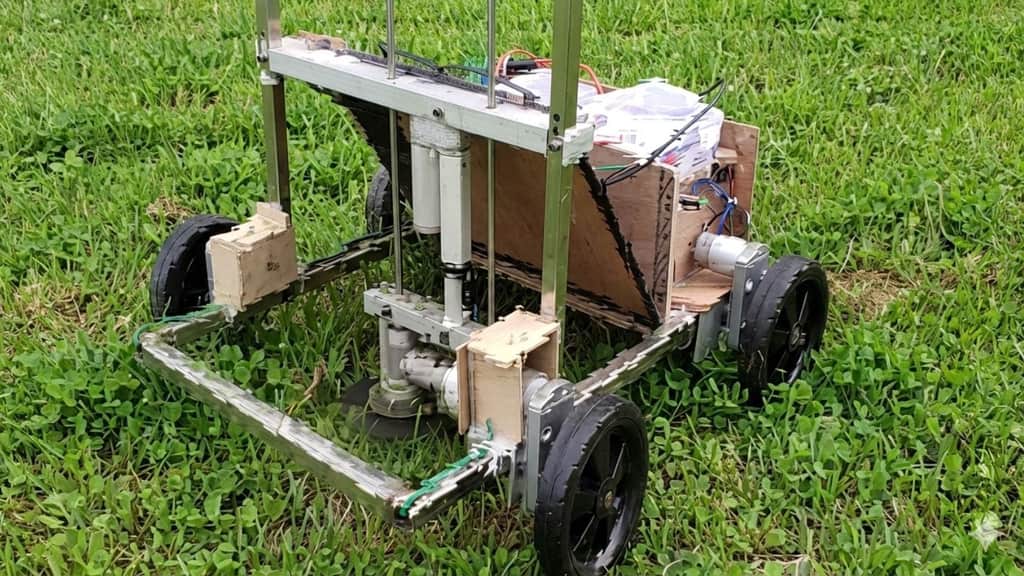
The grass printer works like a robotic lawn mower but with added intelligence that allows it to print messages or designs on grass. (Express photo)
In a significant leap towards automated landscaping and precision robotics, Panjab University’s Design Innovation Centre (DIC) has received an Indian patent for an autonomous robot called the ‘Grass Printer’, a system that can cut grass at different heights to create letters, symbols and patterns on lawns.
The patent has been granted to Professor Naveen Aggarwal and his research team for their invention titled, ‘Grass Printer: An Automated Multi-Level Grass Cutter to Make Character Impression on Grass’.
The grass printer works like a robotic lawn mower but with added intelligence that allows it to print messages or designs on grass by creating visible contrasts. It is designed to move on its own across gardens and open grounds.
Cutting grass at multiple levels, it creates clear impressions that can be seen from a distance. Users can enter the required text or pattern through a mobile application, making the process simple and reducing manual labour.
The technology can be used at airports, sports stadiums, corporate parks, public gardens and university campuses, where large lawns are maintained and visual display or branding is needed.
PU Vice-Chancellor Renu Vig said the development is in line with national goals on innovation and self-reliance.
Aggarwal said the patent highlights the focus on practical and usable research at PU, and said the system makes advanced landscaping possible without specialised technical skills, even in large public areas.
The robot includes a special multi-level cutting system, unlike regular lawn mowers. It also has a manual training mode, where an operator guides it once to map the area. After this, the robot can repeat the task fully on its own, manage its power usage and return to its starting point after finishing the work.
Editorial Context & Insight
Original analysis & verification
Methodology
This article includes original analysis and synthesis from our editorial team, cross-referenced with primary sources to ensure depth and accuracy.
Primary Source
The Indian Express