(UPSC Ethics Simplified is a special series under UPSC Essentials by The Indian Express. It examines news and syllabus themes from an ethical perspective, integrates real-life or hypothetical case studies, and revisits static concepts of ethics. The series aligns current affairs with core ethical principles for an ethical understanding of life, helping aspirants build clarity, application skills, and value-based understanding for GS-IV. In this article, ethicist Nanditesh Nilay discusses the life of Swami Vivekananda and his enduring ethical message, marking his birth anniversary on 12 January.)
The lives of great personalities carry enduring messages for us. Not only are they relevant for Ethics and Essay papers in the UPSC examination, they also guide us in life more broadly. In both good and difficult times, it is the ethical conduct of such individuals that shows us the righteous path. Swami Vivekananda is one such personality.
Let us begin by remembering Vivekananda with awe and reverence, and with the echo of that deafening applause that enveloped the World’s Parliament of Religions after his universal call of fellowship: “Sisters and brothers of America.” Why was it that after this speech, the whole of America, and later Europe, seemed to be at his feet?
The year was 1893. India was viewed with disdain by the British and much of the Western world. How, then, did a man from the East, in the midst of colonial domination, emerge and succeed in the West? Why did an elderly woman, Kate Sanborn, feel compelled to help him during a train journey and offer hospitality and contacts in Massachusetts? Why did this chance meeting repeat itself when she introduced him to John Henry Wright, a distinguished scholar of classical philology at Harvard? What made Wright write a recommendation letter to the Chairman of the Parliament without hesitation? Why were those few lines enough to awaken the West from its slumber: “Here is a man who is more learned than all our learned professors put together.” Why did Vivekananda thank the Parliament “in the name of the oldest order of monks in the world” and “in the name of millions of religions”?
The answer lies in the fact that he understood the self, the purpose of life, and Hinduism far more deeply than most in either the East or the West, and that understanding remains relevant even today.
Vivekananda believed that if God exists, then God cannot be outside His own creation. To experience divinity, one must cast off the narrow prison of individual fragility and ego. He argued that the freedom the West spoke of was not the same as the freedom that comes from realizing infinite bliss. He famously said that he belonged to a religion that teaches universal acceptance. At the World’s Parliament of Religions, seated among speakers of various faiths, he felt no need to mention the 330 million gods of Hinduism. For him, Hinduism was a process of reaching or realizing God; the ultimate goal was to cast off “this little prison of individuality.”
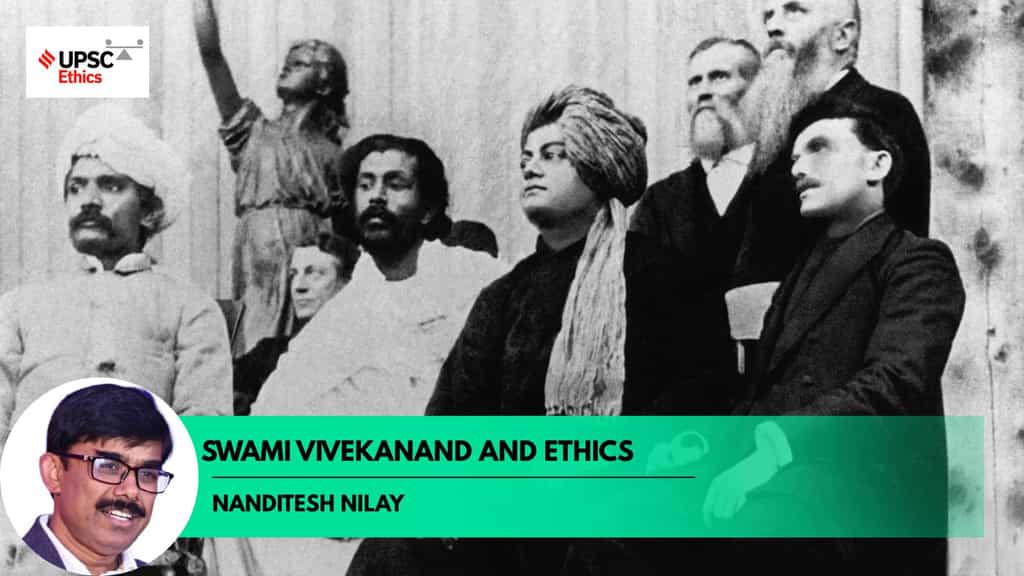
Swami Vivekananda 1893 Chicago image Harrison. The image was first published in Neely’s History of the Parliament of Religions and Religious Congresses at the World’s Columbian Exposition in 1893 (Wikimedia Commons)
For Vivekananda, the world was a home, and the aim of life was to “recognise divinity in every man and woman, and whose whole scope, whose whole force, will be created in aiding humanity to realise its own true, divine nature.”
Swami Vivekananda’s nationalism was never divorced from spirituality. His relationship with nationhood was as intimate as that of the soul with the body. He was deeply human, and his ideas were aligned with universal values. His nationalism was rooted in a glorious Bharat that was being forgotten under colonial rule. He said, “Each nation has a destiny to fulfil; each nation has a message to deliver; each nation has a mission to accomplish.” He urged Indians to understand their historical role, destiny, and contribution to the harmony of races.
Vivekananda’s nationalism was essentially a spiritual Hinduism grounded in humanism and universalism. Serving mankind, without attachment to any narrow ‘ism’, was his idea of nationalism. He warned sharply, “As long as ‘touch-me-not-ism’ is our creed and the cooking pot is our deity, we cannot rise spiritually.” His vision of nationalism was thus a blend of selfless service, human dignity, and moral courage aimed at national integration. Political parties and global leaders ignore Vivekananda at their own risk.
Any leadership that embraces Karmayoga, or the karmayogi ideal exemplified by Vivekananda, holds the potential to free a nation from self-inflicted bondage and dogmatic misery. What Vivekananda stood for was the essence of Hinduism, which elevates nationalism to a more humane and universal plane. He believed that Hinduism is rooted in the Vedantic message of the inherent divinity of man and the unity of all existence. The spiritual path, he argued, leads only to truth and peace. As he said, “Do not care for doctrines, dogmas, sects, or churches; they count little compared with the essence of existence in each man, which is spirituality.”
Vivekananda was more knowledgeable, more rational, more emotional, more insightful, and more human than many others of his time. His voice was a gift. Perhaps the best tribute we can offer him on his birth anniversary is to expand our humanity, break the inner ego, refine ourselves, and strive to become good human beings who believe in doing good. The French opera singer Emma Calvé once remarked, “He possesses a voice like a cello, with low vibrations that one cannot forget.”
That voice still deserves to be heard and heeded, again and again, for it reminds us that becoming truly human is a lifelong process of becoming.
Happy Birthday, Swami Vivekananda.
“True nationalism is rooted in humanism and universalism.” Discuss this statement in the light of Swami Vivekananda’s ethical thought.
(The writer is the author of ‘Being Good’, ‘Aaiye, Insaan Banaen’, ‘Kyon’ and ‘Ethikos: Stories Searching Happiness’. He teaches courses on and offers training in ethics, values and behaviour. He has been the expert/consultant to UPSC, SAARC countries, Civil services Academy, National Centre for Good Governance, Central Bureau of Investigation (CBI), Competition Commission of India (CCI), etc. He has PhD in two disciplines and has been a Doctoral Fellow in Gandhian Studies from ICSSR. His second PhD is from IIT Delhi on Ethical Decision Making among Indian Bureaucrats. He writes for the UPSC Ethics Simplified (concepts and caselets) fortnightly.)
Stay updated with the latest UPSC articles by joining our Telegram channel – Indian Express UPSC Hub, and follow us on UPSC section of The Indian Express on Instagram and X.
For your queries and suggestions write at manas.srivastava@indianexpress.com
Editorial Context & Insight
Original analysis & verification
Methodology
This article includes original analysis and synthesis from our editorial team, cross-referenced with primary sources to ensure depth and accuracy.
Primary Source
The Indian Express