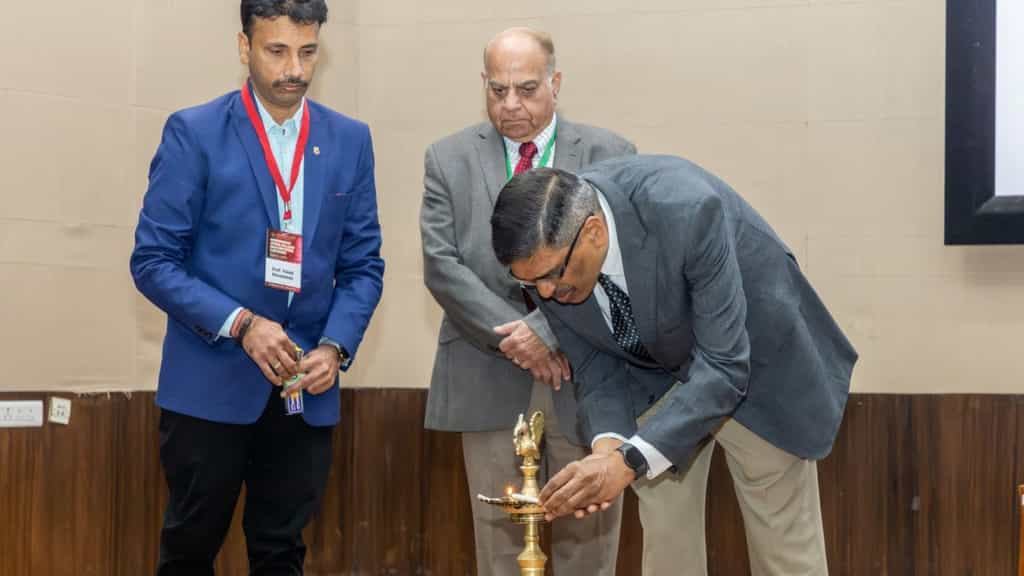
The symposium began with the ceremonial lighting of the lamp, followed by a welcome address by Prof Vinod Narayanan, Conference Chair, IITGN. (Photo: X@iitgn)
Traditional methods alone can no longer keep pace with complex simulations. AI provides tools to accelerate solutions, though it must be used responsibly, said Prof Akshai K Runchal of Analytic and Computational Research Inc (ACRi), CFD, India at the inauguration of three-day International Symposium on Artificial Intelligence–Driven Computational Fluid Dynamics, at Indian Institute of Technology (IIT) Gandhinagar on Monday.
Prof Runchal highlighted the transformative potential of AI in computational fluid dynamics, saying, “Traditional methods alone can no longer keep pace with complex simulations. AI provides tools to accelerate solutions, though it must be used responsibly.”
He explained AI can integrate theoretical models with real-world data, creating simulations that are far more accurate and efficient than conventional approaches. “There is no aspect of human industry or activity today where CFD does not play a role,” he was quoted as saying in an IITGN release.
Stressing on the importance of collaboration, he said, “This symposium aims to connect leading researchers in India and internationally, encouraging joint programs, innovative research, and informing policymakers on technological solutions.”
The three-day International Symposium on Artificial Intelligence–Driven Computational Fluid Dynamics, scheduled from January 12 to 14 was inaugurated at Indian Institute of Technology (IIT) Gandhinagar. The symposium focuses on advancing interdisciplinary research by integrating Artificial Intelligence with computational fluid dynamics. It aims to foster innovative problem-solving approaches and equip participants with cutting-edge tools to effectively address complex challenges in fluid dynamics.
“Artificial Intelligence is a sophisticated, high-end statistical system capable of addressing computationally infeasible problems, and its integration with Computational Fluid Dynamics will transform the way complex engineering challenges are solved,” said Prof Rajat Moona, Director, IIT Gandhinagar.
Sharing his own experience from his PhD, Prof Moona recalled how early computational models, even with relatively simple problems, could take days or weeks to run due to limited computing power. He said, “Even a small weather simulation at that time could take 24 hours of uninterrupted computation, and managing power and data availability was a major challenge. Traditional methods alone could not keep pace with such complex simulations, which is why high-performance computing and AI have become indispensable tools for engineers and researchers.”
Editorial Context & Insight
Original analysis and synthesis with multi-source verification
Methodology
This article includes original analysis and synthesis from our editorial team, cross-referenced with multiple primary sources to ensure depth, accuracy, and balanced perspective. All claims are fact-checked and verified before publication.
Primary Source
Verified Source
The Indian Express
Editorial Team
Senior Editor
Dr. Elena Rodriguez
Specializes in India coverage
Quality Assurance
Senior Reviewer
Fact-checking and editorial standards compliance