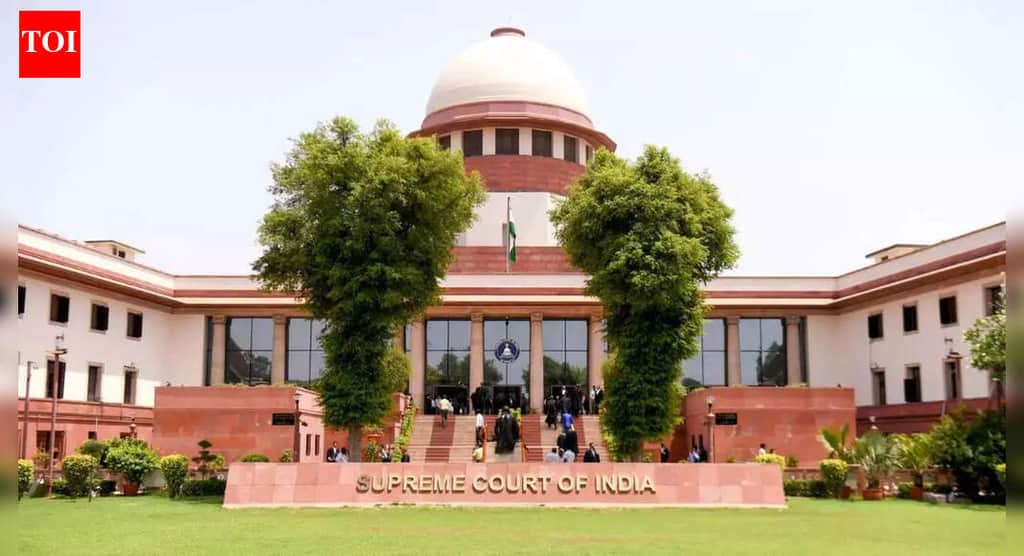
NEW DELHI: Observing that a fearless judge is the bedrock of an independent judiciary, Supreme Court on Monday held that disciplinary proceedings can’t be initiated against a judge for an error of judgment on their part.
It also expressed concern over frivolous complaints being filed against members of judiciary, which lead to trial court judges treading with trepidation with regard to bail matters.
Coming to the rescue of a trial judge whose services were terminated by Madhya Pradesh high court for an error of judgment in grant of bail to an accused, a bench of Justices J B Pardiwala and K V Viswanathan said it is not the correctness of the verdict but the conduct of the judicial officer in question which is determinative.
While HC must immediately intervene when an allegation against a judge is true “to weed out black sheep sullying the fair name of the judiciary”, it must also defend a judge facing false and anonymous complaints, the court said.
“A fearless judge is the bedrock of an independent judiciary, as much as an independent judiciary itself is the foundation on which rule of law rests.”
Invariably, one party to the case would lose and go back unhappy. Disgruntled elements amongst them, wanting to settle scores, may raise frivolous allegations. The trial judiciary also has tremendous work pressure and works under trying working conditions. Large number of cases are listed in a day and most of the judicial officers give their very best while discharging their duties,” Justice Viswanathan, who penned the judgment, said.The functioning of trial judiciary would be seriously impacted and fearless discharge of duties would become a casualty if inquiries are launched on ill-conceived or motivated complaints, the court said, pointing out that a wrong decision can be a bona fide error of judgment.“It should be ensured that only because an order is wrong or there is an error of judgment, without anything more, a judicial officer is not put through the ordeal of a disciplinary proceeding or a prosecution...
When false allegations fly thick and fast, the judicial officers cannot react. Here is where the high court, which is vested with the supervisory control, has to exercise great caution and circumspection,” the bench said while quashing the HC order and directing that the judicial officer be reinstated with back wages.The court said there was no merit in the allegation against the judge and the integrity of a judge cannot be questioned merely because of an erroneous order.
“It will be a dangerous proposition to hold that judgments and orders which do not refer expressly to statutory provisions are per se dishonest judgments.”Justice Pardiwala said that initiation of departmental proceedings on mere suspicion is one of the primary reasons trial court judges are reluctant to exercise their discretion for grant of bail, resulting in HCs and SC being flooded with bail pleas. “It should not happen that because of the lurking fear in the mind of a trial court judge, of some administrative action being taken, that even in a deserving case, well within the principles of law, bail is declined.
.. Over a period of time, the trial court judges have exhibited tendency to shirk from their solemn judicial function and responsibility when it comes to exercising discretion in matters relating to bail,” he said.
Editorial Context & Insight
Original analysis & verification
Methodology
This article includes original analysis and synthesis from our editorial team, cross-referenced with primary sources to ensure depth and accuracy.
Primary Source
Times of India