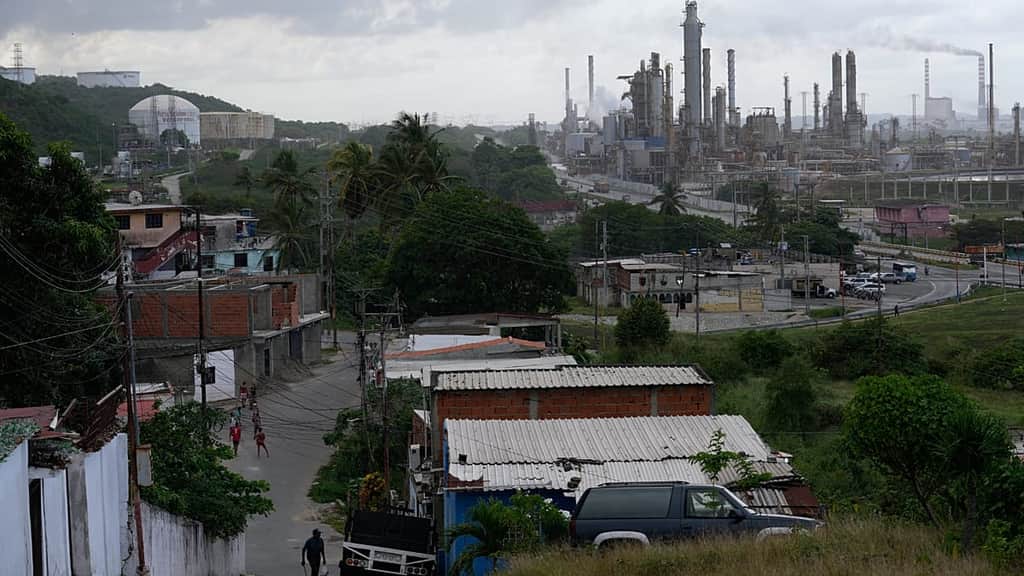
US President Donald Trump has said he wants to run Venezuela “through oil” and pointed to billions of dollars in profit for US companies - but what does that mean in practical terms? The answer is far from clear, and experts point to considerable logistical hurdles.
For starters, the idea of running a country through oil does not answer fundamental points such as: Who will run the daily business? Will the Chavista regime cooperate? And will US companies - and perhaps even US taxpayer money - underwrite an enormous investment overhauling the country's vast, but outdated extraction facilities?
For the time being, Trump has not offered any details even as he doubled down on the idea that the US stands to benefit and companies have expressed "huge interest."
For the US president, energy is power and Venezuela holds the key to the world's largest confirmed oil reserves. In Trump's thinking, that will hand Washington extra leverage in geopolitical terms and cement its status as superpower in the region and beyond.
According to analysts at US investment banking giant Goldman Sachs, combined oil reserves from Venezuela, neighbouring Guyana, where US companies are deeply involved, and the US could give the United States about 30% of global oil reserves.
Goldman Sachs estimates that oil production could rise dramatically under US influence could rise to 1.4 million barrels per day - from its current production of 0.8 million barrels per day - within two years and reach 2.5 million barrels per day within a decade.
"We maintain our view that regime change in Venezuela would immediately represent one of the largest upside risks to the global oil supply for 2026 and 2027," the bank said in a note published Monday. "The shift could give the US greater influence over oil markets (...) and reshape the balance of power in international energy markets."
But first, US companies would have to go in and foot the cost of reviving its industry.
And the Venezuelan interim authorities - which have often condemned US imperialism - would have to collaborate and the international community agree to what may end up looking like the expropriation of another nation's strategic resources.
Chevron is the only major US oil company operating in Venezuela under a special license.
Still, the US president seems to believe he can bypass those obstacles. In a press conference, he suggested US companies had already expressed their interest, without providing specifics, and insisted that they stand to make billions if they do.
He also floated a financial reimbursed for their investment as an incentive.
“They will be reimbursed for what they’re doing,” Trump said. “We’ll be selling large amounts of oil to other countries, many of whom are using it now, but I would say many more will come."
Venezuela, a member of the Organization of Petroleum Exporting Countries (OPEC), holds the largest proven oil reserves in the world: about 17% or 3.3 billion barrels, ahead of OPEC behemoth Saudi Arabia, according to the London-based Energy Institute.
For Chevron, which has been operating is the country for almost a century, Venezuela is a market they know well and has remained a profitable operation, but that is not the case other US companies like Exxon Mobil, which exited the country in 2007 after former Venezuelan leader Hugo Chávez nationalised its assets.
ConocoPhillips also had its assets nationalised that same year.
Trump has argued this constituted "a theft" and the US must be compensated.
Beyond the politics, there is the logistical operation.
Much of the infrastructure (wells, pipelines, refineries etc.) is old, poorly maintained, or non-operational, which means major material rebuilding is required before output can be meaningfully increased.
In addition, years of underinvestment mean Venezuela has lost a lot of trained workers - companies would have to rebuild a modern workforce.
Looking at the numbers, the scale of the required investment is staggering.
Restoring pre-sanctions production levels could cost tens or even hundreds of billions of dollars, said Peter McNally of Third Bridge, a London-based private equity and investment research firm.
Venezuela would also have to reform its laws to allow for larger investment by foreign oil companies. Caracas nationalized the industry in the 1970s, and in the 2000s ordered a forced migration to joint ventures controlled by its state oil company, Petróleos de Venezuela, S.A. (PDVSA).
McNally added that it may take at least ten years for western oil companies to commit to Venezuela.
Whether American oil companies will agree to back into Venezuela remains unclear -- and the costs associated with the operation may not represent an attractive business case for their shareholders, even if the US administration agrees to reimburse a part of the cost without further financial incentives.
"The US oil majors main responsibility is towards their shareholders, not the government," said Ole Hansen, an analyst at Danish investment company Saxo Bank.
"With that in mind I doubt we will see a rush of interest to get back into Venezuela anytime soon."
On Saturday, a US Delta Force operation removed and captured strongman Nicolás Maduro in a spectacular raid. He is now facing charges on narcoterrorism in New York pending trial. His number 2, Delcy Rodríguez, is now in command of the country.
Still, questions about the legality of the US operation and the potential for long-term political instability in Venezuela loom large on potential investors.
“American firms won’t return until they know for sure they will be paid and will have at least a minimal amount of security,” said Mark Christian, director of business development at CHRIS Well Consulting in Oklahoma City.
He also said the companies would not go back until US sanctions against the country are removed. For the time being, the US administration has not indicated it will remove them.
US Secretary of State Marco Rubio suggested a policy of "oil quarantine" for the new leadership led by Rodríguez, which has kept many elements of the hardcore Maduro regime including the army and the interior minister intact.
Furthermore, frequent changes in Venezuelan policy, unresolved debt, and disputes over nationalization remain a sticking point.
For ConocoPhillips, the Venezuelan authorities owe them around $10 billion for the expropriation of their assets in 2007 and has signaled it will remain cautious.
"ConocoPhillips is monitoring developments in Venezuela and their potential implications for global energy supply and stability. It would be premature to speculate on any future business activities or investments," a company spokesperson said.
Ed Hirs, an energy fellow at the University of Houston, said that history is full of recent examples of American excursions that didn't produce notable results for U.S. companies.
"Trump now joins the history of US presidents who have overthrown regimes of countries. Bush with Iraq. Obama with Libya. In those cases, the United States has received zero benefit from the oil,” Hirs said. “I’m afraid that history will repeat itself in Venezuela."
Editorial Context & Insight
Original analysis & verification
Methodology
This article includes original analysis and synthesis from our editorial team, cross-referenced with primary sources to ensure depth and accuracy.
Primary Source
Latest News From Euronews | Euronews RSS